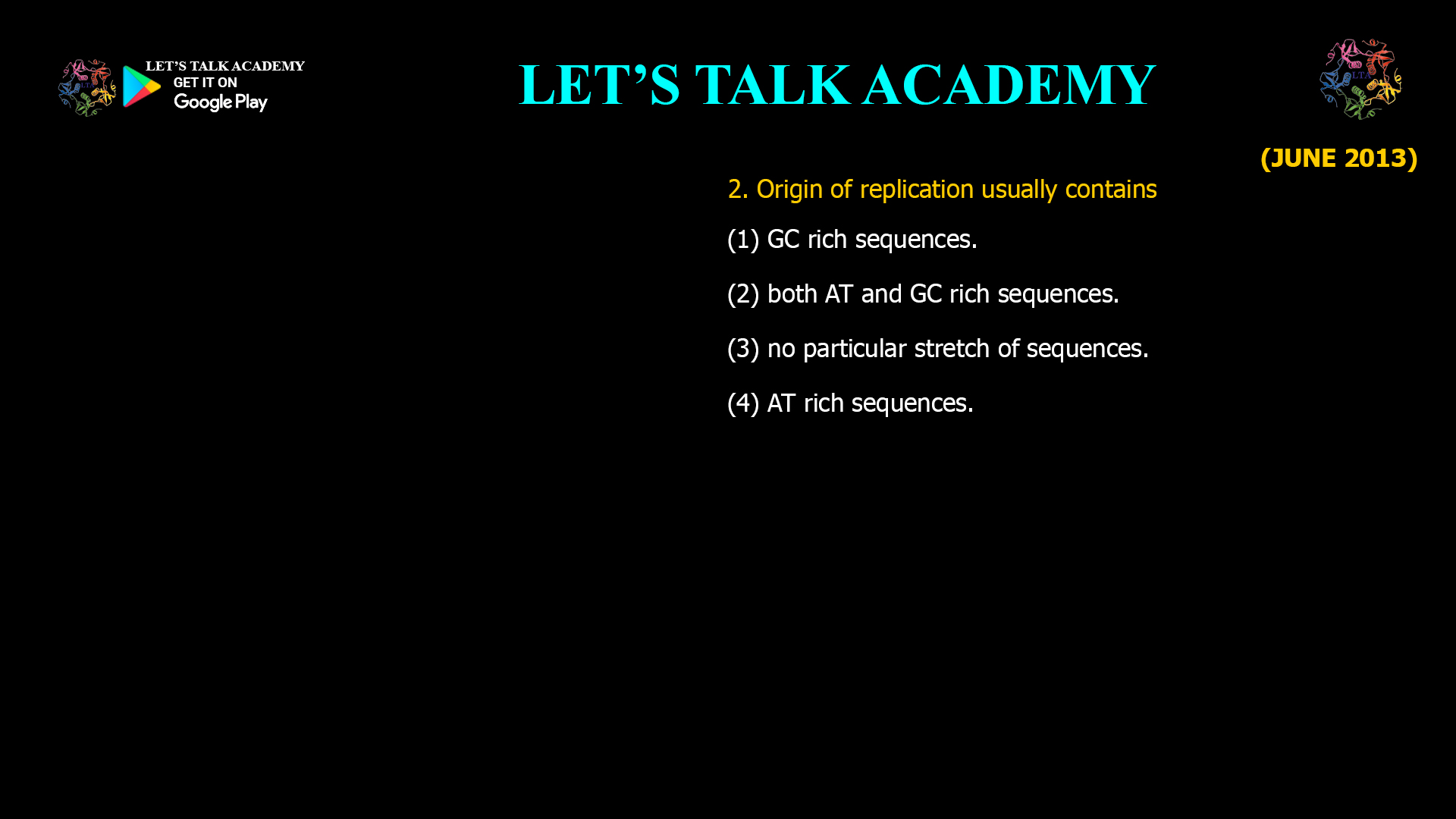
- Origin of replication usually contains
(1) GC rich sequences.
(2) both AT and GC rich sequences.
(3) no particular stretch of sequences.
(4) AT rich sequences.
Introduction
The origin of replication is a specific DNA sequence where the process of DNA replication begins, ensuring accurate and timely duplication of the genome. A key characteristic of most origins of replication across diverse organisms is their AT-rich composition. This article explains why origins of replication typically contain AT-rich sequences, how this feature facilitates replication initiation, and the biological significance of this sequence composition.
What Is the Origin of Replication?
The origin of replication (ori) is a defined region in the genome where DNA synthesis is initiated. It serves as the binding site for initiator proteins and replication machinery, including helicases and DNA polymerases. Replication proceeds bidirectionally from these origins to duplicate the entire genome before cell division.
-
In prokaryotes, such as E. coli, there is usually a single origin (e.g., oriC).
-
In eukaryotes, multiple origins are distributed along linear chromosomes to speed replication.
Why Are Origins of Replication AT-Rich?
1. Lower Stability of AT Base Pairs
-
DNA is composed of base pairs: adenine-thymine (A-T) and guanine-cytosine (G-C).
-
A-T pairs are held together by two hydrogen bonds, whereas G-C pairs have three hydrogen bonds.
-
The fewer hydrogen bonds in AT pairs make AT-rich regions less thermodynamically stable and easier to separate.
2. Facilitation of DNA Strand Separation
-
Initiation of replication requires local unwinding of the double helix to expose single-stranded DNA templates.
-
AT-rich sequences melt (denature) more easily than GC-rich sequences, lowering the energy barrier for helicase-mediated strand separation.
-
This property allows replication proteins to efficiently open the DNA duplex at the origin.
3. Binding Sites for Initiator Proteins
-
Origins contain specific sequence motifs recognized by initiator proteins (e.g., DnaA in bacteria).
-
These proteins bind to AT-rich repeats or boxes, facilitating the recruitment of helicase and other replication factors.
Examples of AT-Rich Origins
-
Bacterial oriC: Contains three 13-base pair AT-rich repeats and four 9-base pair DnaA binding sites. The AT-rich repeats are the initial unwinding sites.
-
Eukaryotic origins: Although more complex, many contain AT-rich regions adjacent to initiator protein binding sites, enabling origin activation.
Why Not GC-Rich or Mixed Sequences?
-
GC-rich sequences are more stable and harder to unwind, making them less suitable for origin melting.
-
While origins may contain both AT and GC sequences, the critical unwinding region is predominantly AT-rich.
-
Some origins have GC-rich motifs for protein binding, but the unwinding occurs at adjacent AT-rich stretches.
Summary Table
| Feature | AT-Rich Sequences | GC-Rich Sequences |
|---|---|---|
| Number of Hydrogen Bonds | 2 per base pair | 3 per base pair |
| Stability | Lower, easier to unwind | Higher, harder to unwind |
| Role in Origin of Replication | Facilitate strand separation | Less involved in strand separation |
| Presence in Origins | Common in unwinding regions | May be present in regulatory motifs |
Conclusion
Origins of replication usually contain AT-rich sequences because these regions are easier to unwind due to fewer hydrogen bonds, facilitating the initiation of DNA replication. This characteristic is conserved across prokaryotes and eukaryotes, underscoring the fundamental importance of DNA sequence composition in genome duplication.
Answer:
The origin of replication usually contains (4) AT rich sequences.


42 Comments
Diksha chhipa
July 29, 2025Ori is AT rich so that melt easily than GC.
It is thermodynamically less stable than GC.
Initiator protein bind on AT rich seq than GC
Niti tanwar
July 29, 2025Ori is rich AT.bcz A-T between 2 hydrogen bond. G-C 3 hydrogen bond. Easily open A-T .
Correct answer is 4.
Pratibha Sethiya
July 29, 2025Correct option is option (4)
The origin of replication is the site where DNA replication initiated ,
A–T pairs have 2 hydrogen bonds, while G–C pairs have 3 hydrogen bonds (stronger). , so
Agar DNA ko easily open Krna h to we need weaker hydrogen bond bcz wo easily break ho jayega
So, the DNA opens more easily at AT-rich regions.
Priya dhakad
July 29, 2025Origin of replication usually contains AT rich sequence
Aafreen
July 30, 2025Correct answer is 4th, AT rich sequence
Bcoz AT have 2 hydrogen bond and GC have 3 hydrogen bond. AT stability is less than GC that’s why it’s easily unwind.
Khushi Agarwal
July 29, 2025At rich sequence bcz There are only 2 hydrogen bonds between A and T whereas there are 3 hydrogen bonds between G and C. So it is easier to unwind A and T as compared to G-C.
Anurag giri
July 29, 2025Ans is 4 bcoz AT have two hydrogen bond and GC HAVE three . In replication hydrogen bond breaks so AT rich sequence makes process energy efficient and fast
Ravindra Pindel
July 29, 2025Answer aatha h but Summary reading se more than 10 question our solution
Vanshika Sharma
July 29, 2025Ans is 4 :AT rich , AT will melt easily bcz it has 2 H bond and GC will not melt easily bcz it has 3H bond
Surbhi Rajawat
July 29, 2025AT rich sequences are less stable and more prone to unwinding which is the need at origin of replication so that unwinding can happen fast and replication can start. Hence the answer is A T rich
HIMANI FAUJDAR
July 29, 2025Correct answer is AT rich sequence present on the origin of replication site because to unwind AT sequence less energy required because of double hydrogen bonding compare to GC sequence
Priti Khandal
July 29, 2025At rich bcz it has 2 H bond and it melt easily
Khushi Mehra
July 29, 2025Answer is 4 … because AT have 2 H-bond and GC have 3 H-bond. Thus it is easier to break 2 H-bond than the 3 H- bond…hence origin of replication (Ori) site contains AT rich sequence
Khushi Mehra
July 29, 2025.AT have 2 H-bond and GC have 3 H-bond. Thus it is easier to break 2 H-bond than the 3 H- bond. Therefore Ori site have AT rich sequence.
Heena
July 29, 2025Ori is usually AT rich region on dna strand as to facilitate unwinding of ds strand bcoz of less thermodynamic stability nd hydrogen bonds as compared to GC bonding
Priya Khandal
July 29, 2025Answer d right it at has to hydrogen bond and GT has 3 hydrogen bond and last stable so unwinding which is the need of origin of application that and winding can happen fast and replace in start and gthas 3 hydrogen bonding ane not isily malte so 4 is right
shruti sharma
July 29, 2025AT rich SO THAT MELT EASILY
Khushi Vaishnav
July 29, 2025AT rich sequence because In between G and C there is three hydrogen bonds and in A and T there are two hydrogen bonds which is easier to unwind as compared to G-C.
Priyanka choudhary
July 29, 2025The right answer is at rich siquece
Avni Besarwaria
July 29, 2025ori is AT rich because of 2 hydrogen bond which makes it easier to unwind
Monika jangid
July 29, 2025AT rich sequence
Juber Khan
July 30, 2025Ans(4) bcz A=T Rich sequence stability is lower in compair of GC Rich sequence so AT easily unwind and separate
Payal Gaur
July 30, 2025AT rich sequence present on ori because in AT two hydrogen bond and in GC three hydrogen bond present so AT easily unwind compare to GC.
Sneha Kumawat
July 30, 2025At rich it will break easily because of hydrogen bonding
Dipti Sharma
July 30, 2025Correct answer : 4
AT Rich sequence because of less hydrogen bonding than GC ,it will break easily
Deepika Sheoran
July 30, 2025AT Rich because it 2Hydrogen bond&it melt easily than GC
Aman Choudhary
July 30, 2025AT rich sequences
Rakesh Dhaka
July 30, 2025AT rich sequences bcz it have two hydrogen bonds
Komal Soni
July 30, 2025AT rich sequence
Anisha jakhar
July 30, 2025AT rich
Shivani panwar
July 31, 2025At rich sequence
Priyanka choudhary
August 1, 2025Right answer is at rich siquences
Priyanka choudhary
August 1, 2025Right answer is at rich siquences because of this ye bhot week hote h jisse DNA easily open ho jata h
Varsha tatla
August 2, 2025AT rich
Mahima Sharma
August 2, 2025AT rich sequence
Vijay Marmat
August 2, 2025At rich ✔️
Varsha Tatla
August 3, 2025Option 4 will be correct
AT rich
Anjani sharma
August 5, 2025Correct answer 4 as AT will melt fast than GC because of there difference in hydrogen bonding
Ravindra Pindel
August 26, 2025Done sir
Alec
August 30, 2025option 4 – AT rich sequence.
Santosh Saini
September 14, 2025AT rich sequence
Deepika Sheoran
November 6, 2025AT Rich sequence because it 2 hydrogen bond and it melt easily than GC.