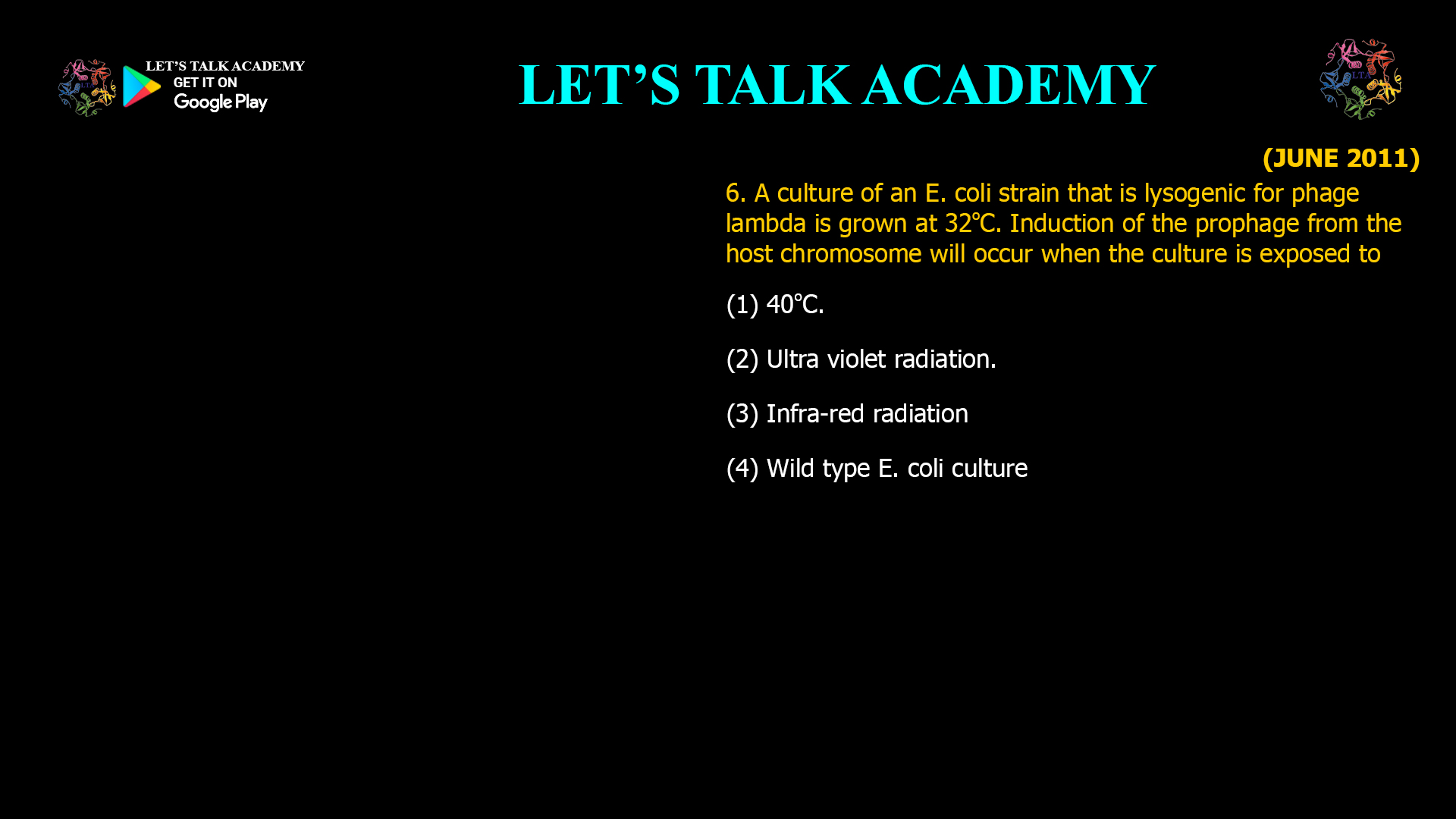
6. A culture of an E. coli strain that is lysogenic for phage lambda is grown at 320C
Induction of the prophage from the host chromosome will occur when the culture is exposed to
(1) 400C.
(2) Ultra violet radiation.
(3) Infra-red radiation
(4) Wild type E. coli culture
Bacteriophage lambda is a temperate phage that can exist in two states within Escherichia coli: the lysogenic state, where the phage genome integrates into the host chromosome as a prophage, and the lytic state, where the phage replicates and lyses the host cell. When an E. coli strain lysogenic for phage lambda is grown at 32°C, the prophage remains dormant, maintaining a stable relationship with the host. However, certain environmental stresses can induce the prophage to exit lysogeny and enter the lytic cycle, leading to the production of new phage particles and host cell lysis.
What Triggers Prophage Induction?
Among various factors, ultraviolet (UV) radiation is a well-known and effective inducer of lambda prophage from lysogenic E. coli cultures. Exposure to UV light causes DNA damage in the host cell, which activates the bacterial SOS response, a global regulatory system for DNA repair.
How Does UV Radiation Induce Prophage?
The induction mechanism involves the inactivation of the lambda repressor protein (CI), which normally maintains the prophage in a dormant state by repressing lytic genes. UV-induced DNA damage activates the host RecA protein, which facilitates the autocleavage of the CI repressor, thereby lifting repression on the prophage genes.
-
Once CI repressor is inactivated, early lytic genes are expressed.
-
This triggers the prophage to excise from the host chromosome.
-
The phage genome then replicates, assembles new viral particles, and eventually lyses the host cell to release progeny phages.
Why Not Temperature or Other Factors?
-
High temperature (e.g., 40°C or above) can induce prophage in some temperature-sensitive lambda mutants but is not the general or primary inducer under normal circumstances.
-
Infrared radiation does not have sufficient energy to cause the DNA damage necessary for induction.
-
Co-culturing with wild-type E. coli does not induce prophage; induction is primarily a response to DNA damage or stress signals.
Scientific Evidence Supporting UV-Induced Induction
Studies have shown that lysogenic E. coli cultures grown at 32°C maintain stable prophages. When exposed to UV radiation, the prophage is efficiently induced, entering the lytic cycle. This induction is accompanied by measurable phage production and host cell lysis.
The temperature-sensitive lambda repressor mutants (such as cI857) can also be induced by shifting the culture temperature to around 42°C, but this is a specific case related to mutant repressor proteins losing function at elevated temperatures. In wild-type strains, UV radiation remains the more universal and robust inducer.
Summary Table: Factors Affecting Lambda Prophage Induction
| Inducing Factor | Effect on Lambda Prophage Induction | Mechanism |
|---|---|---|
| Ultraviolet (UV) radiation | Strong inducer | DNA damage → SOS response → CI repressor cleavage |
| High temperature (40-42°C) | Induces temperature-sensitive mutants only | Heat inactivation of mutant CI repressor |
| Infrared radiation | No significant induction | Insufficient energy to damage DNA |
| Wild type E. coli culture | No induction | No direct effect on prophage induction |
Biological Significance of Prophage Induction
Prophage induction allows the phage to escape a potentially damaged or dying host and produce new virions to infect fresh bacterial cells. This switch from lysogeny to the lytic cycle is a survival strategy for the phage in response to environmental stress.
Conclusion
When a lysogenic E. coli culture harboring phage lambda is grown at 32°C, the prophage remains stable and dormant. However, exposure to ultraviolet (UV) radiation induces the prophage to enter the lytic cycle by triggering DNA damage responses that inactivate the lambda repressor protein. This leads to prophage excision, viral replication, and host cell lysis. While temperature shifts can induce certain mutant prophages, UV radiation is the primary and most effective inducer of prophage induction under natural conditions.
Understanding the triggers and mechanisms of lambda prophage induction provides important insights into virus-host dynamics, bacterial stress responses, and phage biology, with implications for molecular genetics and biotechnology.


