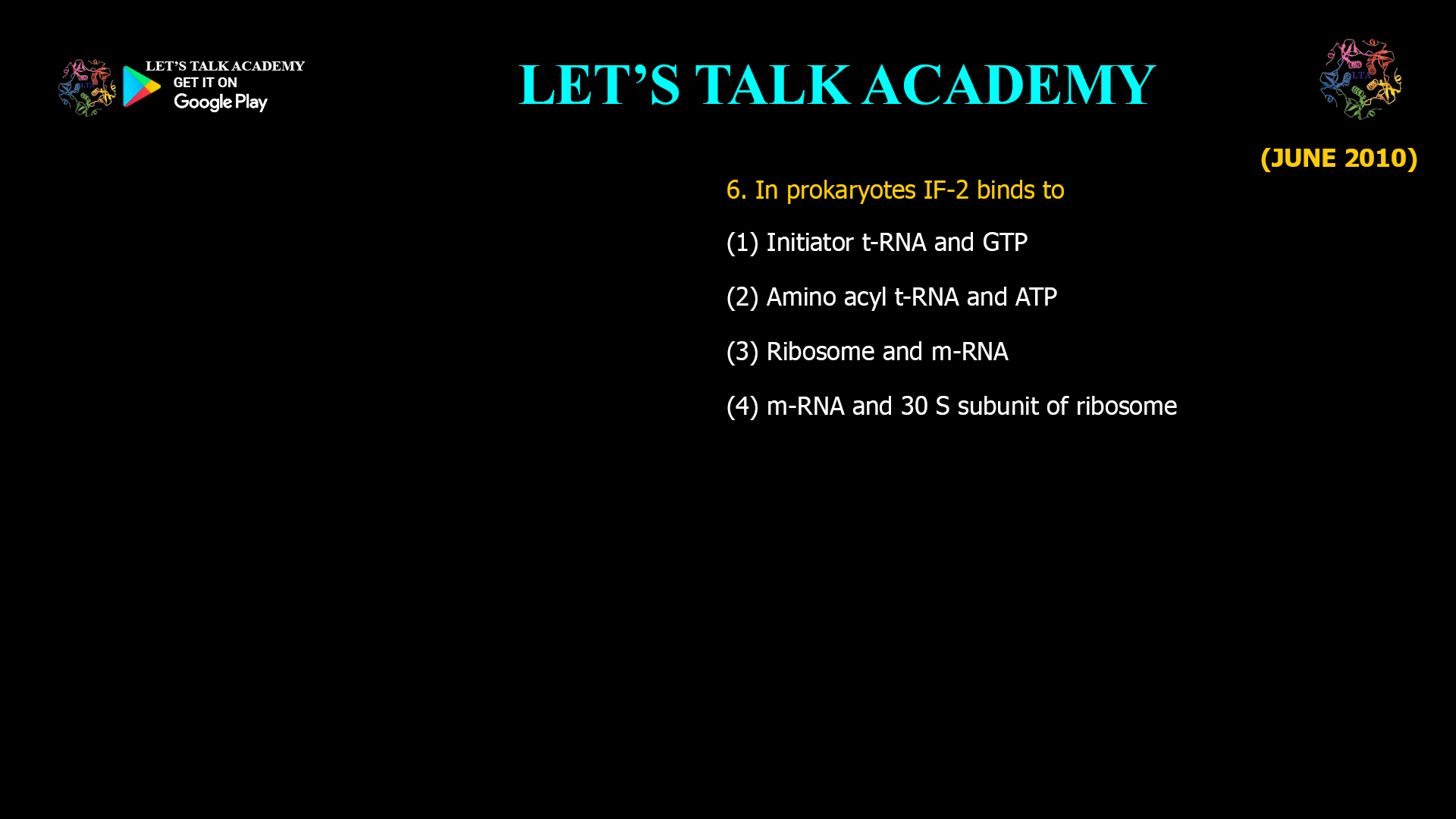
- In prokaryotes IF-2 binds to
(1) Initiator t-RNA and GTP
(2) Amino acyl t-RNA and ATP
(3) Ribosome and m-RNA
(4) m-RNA and 30 S subunit of ribosome
Introduction
Protein synthesis in prokaryotes is a tightly regulated process that begins with the assembly of the initiation complex. Among the key players is initiation factor 2 (IF-2), a crucial protein that ensures the correct positioning of the initiator tRNA on the ribosome. Understanding what IF-2 binds to during this process is essential for grasping the fundamentals of prokaryotic translation.
Overview of Prokaryotic Translation Initiation
Translation initiation in prokaryotes involves the coordinated action of several initiation factors: IF-1, IF-2, and IF-3. Their main function is to assemble the ribosomal subunits around the mRNA and recruit the initiator tRNA, which is charged with a modified methionine (fMet-tRNA). This process is vital for the accurate and efficient synthesis of proteins.
The Role of IF-2 in Translation Initiation
IF-2 is a GTPase that plays a central role in the initiation phase of translation. Its primary function is to promote the binding of the initiator tRNA (fMet-tRNA) to the small ribosomal subunit (30S) and to facilitate the joining of the large ribosomal subunit (50S) to form the functional 70S ribosome. IF-2 is also involved in ensuring that only the initiator tRNA, and not other aminoacyl-tRNAs, is used at the initiation step.
What Does IF-2 Bind To?
The binding partners of IF-2 during translation initiation are critical for its function. Let’s analyze the options provided:
1. Initiator t-RNA and GTP
Correct Option:
IF-2 binds to GTP and the initiator tRNA (fMet-tRNA) to form a ternary complex. This complex is essential for delivering the initiator tRNA to the small ribosomal subunit during the initiation of translation.
Recent studies have clarified that IF-2·GTP can bind to the 30S ribosomal subunit independently of fMet-tRNA, but the formation of a stable ternary complex (IF-2·GTP·fMet-tRNA) in solution is transient. However, the functional delivery of initiator tRNA to the ribosome is still mediated by IF-2 in association with GTP.
2. Amino acyl t-RNA and ATP
Incorrect Option:
IF-2 does not bind to just any aminoacyl-tRNA; it specifically recognizes the initiator tRNA (fMet-tRNA). Additionally, ATP is not involved in this process; GTP is the required nucleotide.
3. Ribosome and m-RNA
Incorrect Option:
While IF-2 interacts with the ribosome (specifically the 30S subunit), it does not bind directly to mRNA. Its main role is to recruit the initiator tRNA to the ribosome.
4. m-RNA and 30 S subunit of ribosome
Incorrect Option:
IF-2 does not bind directly to mRNA. It interacts with the 30S ribosomal subunit, but its primary binding partners are GTP and the initiator tRNA.
The Mechanism of IF-2 Action
Formation of the Ternary Complex
IF-2 binds GTP and the initiator tRNA (fMet-tRNA) to form a ternary complex. Although this complex in solution may be unstable, the ribosome-bound IF-2 promotes the correct positioning of the initiator tRNA on the 30S subunit.
Recruitment to the 30S Initiation Complex
IF-2·GTP can bind to the 30S ribosomal subunit before or independent of the initiator tRNA. Once bound to the ribosome, IF-2 accelerates the recruitment of fMet-tRNA by providing anchoring interactions or inducing a favorable ribosome conformation.
Joining of Ribosomal Subunits
After the initiator tRNA is positioned, IF-2 facilitates the joining of the 50S ribosomal subunit to the 30S subunit, forming the functional 70S ribosome. This step is accompanied by the hydrolysis of GTP, which leads to the release of IF-2 from the ribosome.
Why GTP Is Essential
GTP binding is crucial for the activity of IF-2. The GTP-bound form of IF-2 is active and promotes the binding of the initiator tRNA and the joining of ribosomal subunits. Upon GTP hydrolysis, IF-2 is released, and the ribosome is ready for the elongation phase of translation.
The Specificity of IF-2 for Initiator tRNA
IF-2 specifically recognizes the initiator tRNA (fMet-tRNA) and not other aminoacyl-tRNAs. This specificity ensures that only the correct tRNA is used at the start of protein synthesis, preventing errors in the initiation process.
Structural Insights into IF-2
Structural studies have revealed that IF-2 undergoes significant conformational changes upon binding GTP or GDP. These changes are essential for its function as a molecular switch during translation initiation. The GTP-bound form of IF-2 is active and promotes the assembly of the initiation complex, while the GDP-bound form is inactive.
Comparison with Eukaryotic Initiation Factors
In eukaryotes, the function of IF-2 is carried out by two factors: eIF2 and eIF5B. eIF2 delivers the initiator tRNA (Met-tRNA) to the small ribosomal subunit, while eIF5B facilitates the joining of the large ribosomal subunit. The prokaryotic IF-2 combines aspects of both eukaryotic factors, but its mechanism is more closely related to that of eIF5B in terms of subunit joining.
Summary Table
| Option | Correctness | Explanation |
|---|---|---|
| Initiator t-RNA and GTP | Correct | IF-2 binds GTP and fMet-tRNA for initiation |
| Amino acyl t-RNA and ATP | Incorrect | IF-2 is specific to initiator tRNA and uses GTP |
| Ribosome and m-RNA | Incorrect | IF-2 binds the ribosome, not mRNA |
| m-RNA and 30 S subunit of ribosome | Incorrect | IF-2 does not bind mRNA |
Conclusion
In prokaryotes, initiation factor 2 (IF-2) binds to GTP and the initiator tRNA (fMet-tRNA) to promote the correct assembly of the initiation complex on the ribosome. This binding is essential for the accurate initiation of protein synthesis. IF-2 does not bind to mRNA or to other aminoacyl-tRNAs, and its activity is strictly dependent on GTP.
Correct answer: (1) Initiator t-RNA and GTP


6 Comments
Suman bhakar
June 12, 2025Done sir 👍
Arushi saini
June 12, 2025Suraj sir is great
Kirti Agarwal
November 2, 2025Initiator t-RNA and GTP
Deepika Sheoran
November 4, 2025Initiator t RNA and GTP
Heena Mahlawat
November 6, 2025Option 1
MOHIT AKHAND
November 14, 2025Done sir ✅