Transcription Initiation Steps in Bacteria and Eukaryotes
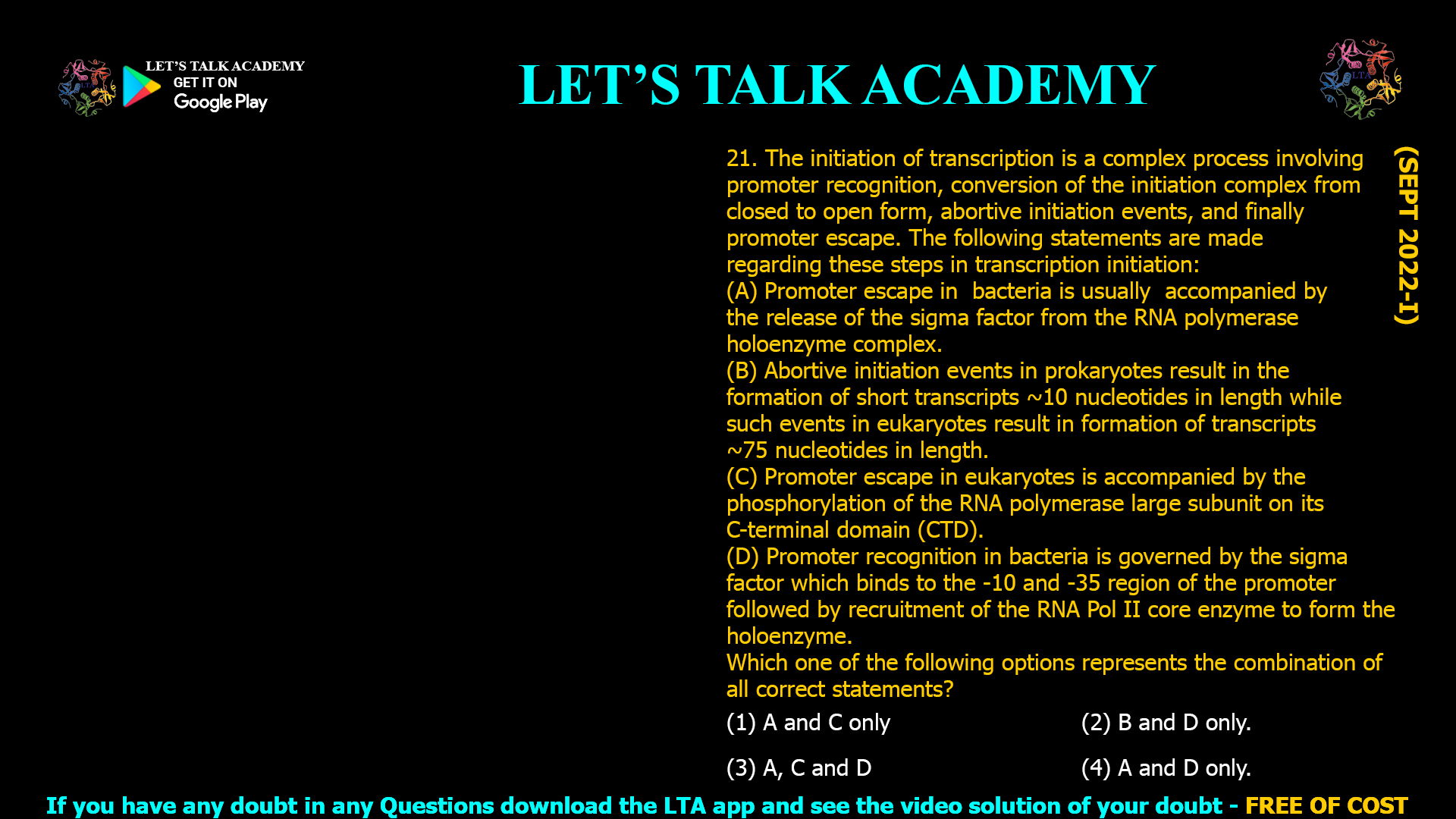
- The initiation of transcription is a complex process involving promoter recognition, conversion of the initiation complex from closed to open form, abortive initiation events, and finally promoter escape. The following statements are made regarding these steps in transcription initiation:
(A) Promoter escape in bacteria is usually accompanied by the release of the sigma factor from the RNA polymerase holoenzyme complex.
(B) Abortive initiation events in prokaryotes result in the formation of short transcripts ~10 nucleotides in length while such events in eukaryotes result in formation of transcripts ~75 nucleotides in length.
(C) Promoter escape in eukaryotes is accompanied by the phosphorylation of the RNA polymerase large subunit on its C-terminal domain (CTD).
(D) Promoter recognition in bacteria is governed by the sigma factor which binds to the -10 and -35 region of the promoter followed by recruitment of the RNA Pol II core enzyme to form the holoenzyme.
Which one of the following options represents the combination of all correct statements?
(1) A and C only (2) B and D only.
(3) A, C and D (4) A and D only.
Correct Answer:
(1) A and C only
Detailed Explanation:
(A) Promoter escape in bacteria is usually accompanied by the release of the sigma factor from the RNA polymerase holoenzyme complex.
This is true. In bacteria, the RNA polymerase holoenzyme consists of the core enzyme plus the sigma factor, which is essential for promoter recognition and initiation. After synthesis of a short RNA (~10 nucleotides), the polymerase escapes the promoter, and the sigma factor typically dissociates, allowing the core enzyme to proceed with elongation.
(B) Abortive initiation events in prokaryotes result in short transcripts ~10 nucleotides in length while such events in eukaryotes result in transcripts ~75 nucleotides in length.
This is false. Abortive initiation in both prokaryotes and eukaryotes involves the synthesis and release of short RNA transcripts, typically around 10 nucleotides long. The claim that eukaryotic abortive transcripts are ~75 nucleotides is incorrect; abortive transcripts are generally short in both systems.
(C) Promoter escape in eukaryotes is accompanied by the phosphorylation of the RNA polymerase large subunit on its C-terminal domain (CTD).
This is true. In eukaryotic RNA polymerase II, promoter escape and transition into productive elongation is tightly regulated by phosphorylation of the CTD of the largest subunit. This phosphorylation, mainly on serine residues, facilitates release from the promoter and recruitment of elongation and RNA processing factors.
(D) Promoter recognition in bacteria is governed by the sigma factor which binds to the -10 and -35 region of the promoter followed by recruitment of the RNA Pol II core enzyme to form the holoenzyme.
This is false. While the sigma factor indeed recognizes the -10 and -35 promoter elements in bacteria, it is part of the RNA polymerase holoenzyme from the start. The holoenzyme is formed by the core RNA polymerase plus sigma factor before promoter binding. Also, RNA Pol II is a eukaryotic enzyme, not bacterial. The bacterial core enzyme is RNA polymerase (without the “II”), and the sigma factor associates with it to form the holoenzyme prior to promoter recognition.
Summary Table
| Statement | Description | True/False | Explanation |
|---|---|---|---|
| A | Promoter escape in bacteria involves sigma factor release | True | Sigma factor dissociates after promoter escape allowing elongation by core RNA polymerase. |
| B | Abortive initiation transcripts ~10 nt in prokaryotes, ~75 nt in eukaryotes | False | Abortive transcripts are short (~10 nt) in both prokaryotes and eukaryotes. |
| C | Promoter escape in eukaryotes involves phosphorylation of RNA Pol II CTD | True | CTD phosphorylation triggers transition from initiation to elongation in eukaryotes. |
| D | Sigma factor binds -10 and -35, then recruits RNA Pol II core to form holoenzyme in bacteria | False | Sigma factor is part of holoenzyme before promoter binding; RNA Pol II is eukaryotic enzyme. |
Conclusion
The correct combination of statements is (1) A and C only. Sigma factor release marks promoter escape in bacteria, and eukaryotic promoter escape is regulated by RNA Pol II CTD phosphorylation. The other statements contain inaccuracies regarding abortive transcript lengths and bacterial holoenzyme formation.


9 Comments
Suman bhakar
June 2, 2025👍👍
Mosam gurjar
June 4, 2025Best explanation 👍
Sakshi Kanwar
November 3, 2025Promoter escape in bacteria by the release of the sigma factor from the RNA polymerase holoenzyme complex. Option A
Promoter escape in eukaryotes is by the phosphorylation of the RNA polymerase large subunit having serine in 5th position on its C-terminal domain (CTD). Option C
Santosh Saini
November 4, 2025Statement A and C are correct ( sigma factor release marks promoter escape in bacteria , and eukaryotic promoter escape is regulated by RNA plo II CTD phosphorylation
Anurag Giri
November 4, 2025The correct combination of statements is (1) A and C only. Sigma factor release marks promoter escape in bacteria, and eukaryotic promoter escape is regulated by RNA Pol II CTD phosphorylation
Sonal Nagar
November 4, 2025Option 1st
Deepika Sheoran
November 4, 2025Promoter Escape in bacteria involves sigma factor Release.
Sakshi Kanwar
November 7, 2025A and C
Muskan Yadav
November 7, 2025(1) A and C only is the correct answer.