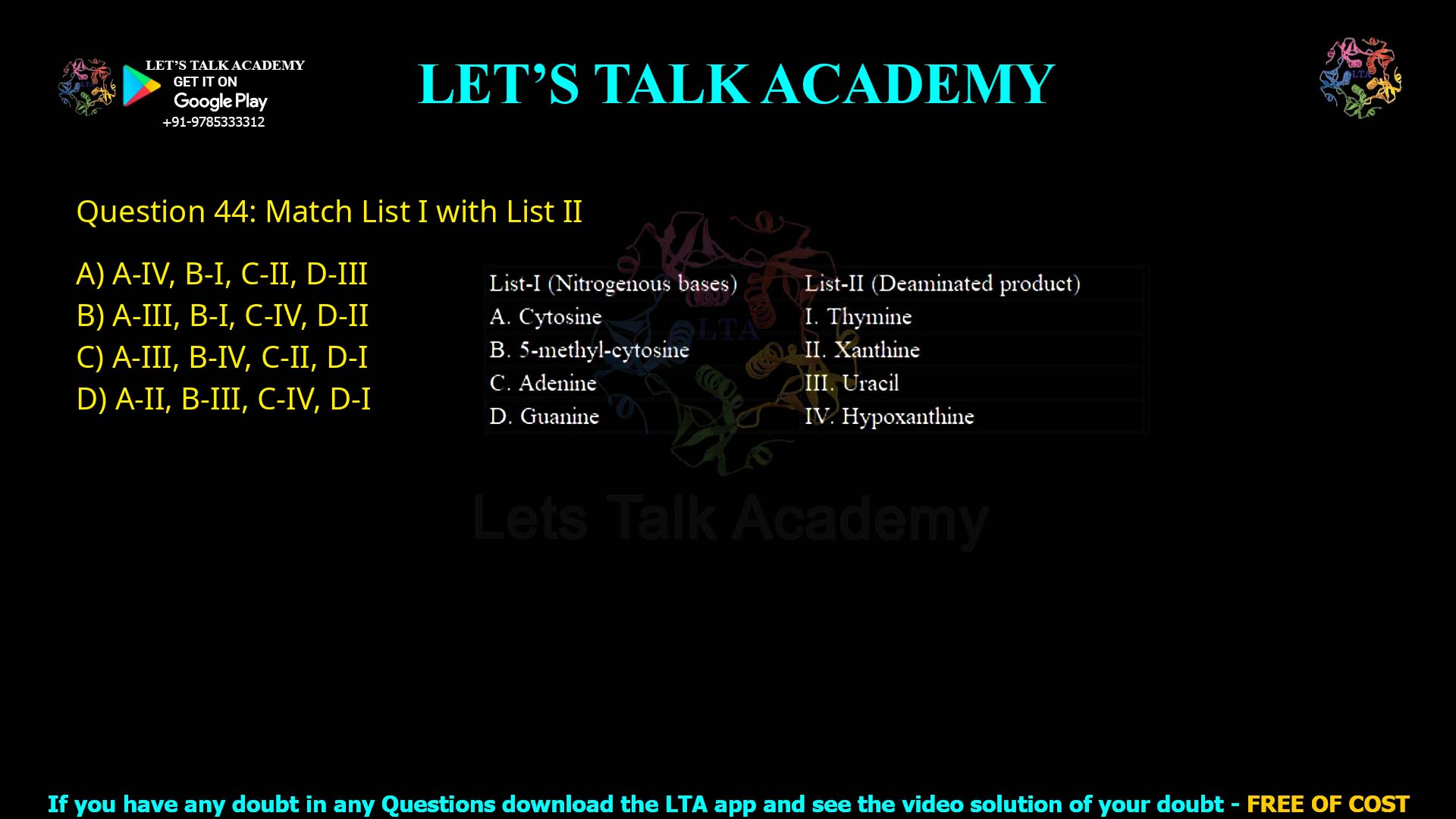
Q44.Match List I with List II
List-I (Nitrogenous bases)
A. Cytosine
B. 5-methyl-cytosine
C. Adenine
D. Guanine
List-II (Deaminated product)
I. Thymine
II. Xanthine
III. Uracil
IV. Hypoxanthine
Choose the correct answer from the options given below:
(A) A-IV, B-I, C-II, D-III
(B) A-III, B-I, C-IV, D-II
(C) A-III, B-IV, C-II, D-I
(D) A-II, B-III, C-IV, D-I
The correct answer is option (B): A-III, B-I, C-IV, D-II. This matches each nitrogenous base from List-I to its specific deaminated product in List-II, reflecting standard DNA biochemistry reactions.
Base-Deamination Matches
-
A. Cytosine → III. Uracil: Cytosine deamination replaces its amino group with a keto group, yielding uracil (C→U), a common mutagenic event repaired by uracil-DNA glycosylase.
-
B. 5-methyl-cytosine → I. Thymine: 5-methylcytosine (5mC), an epigenetic mark, deaminates to thymine (5mC→T), creating a C:G→T:A mutation often missed by standard repair.
-
C. Adenine → IV. Hypoxanthine: Adenine loses its amino group to form hypoxanthine (A→Hx), which pairs with cytosine during replication, causing A:T→G:C transitions.
-
D. Guanine → II. Xanthine: Guanine deamination produces xanthine (G→X), which still base-pairs with cytosine but is repaired less efficiently than other lesions.
Option Analysis
-
(A) A-IV, B-I, C-II, D-III: Incorrect. Cytosine makes uracil (III), not hypoxanthine (IV); guanine makes xanthine (II), not uracil.
-
(B) A-III, B-I, C-IV, D-II: Correct, matching each deamination pathway precisely.
-
(C) A-III, B-IV, C-II, D-I: Incorrect. 5mC deaminates to thymine (I), not hypoxanthine (IV); adenine to hypoxanthine, not xanthine.
-
(D) A-II, B-III, C-IV, D-I: Incorrect. Cytosine doesn’t make xanthine (II); guanine doesn’t make hypoxanthine (IV).
Cytosine, 5-methyl-cytosine, adenine, and guanine deamination products—uracil, thymine, hypoxanthine, xanthine—dominate match List I with List II nitrogenous bases questions in NEET biology. This guide decodes C→U, 5mC→T, A→Hx, G→X reactions for exam success.
Deamination Pathways Explained
Cytosine deamination yields uracil, repaired by UDG to prevent C:G→T:A mutations. 5-methyl-cytosine uniquely deaminates to thymine, evading standard glycosylases and driving CpG mutations. Adenine forms hypoxanthine, mimicking guanine during replication. Guanine produces xanthine, less mutagenic but still repaired via BER.
Why Option (B) Perfectly Matches
Option (B) A-III, B-I, C-IV, D-II captures match List I with List II nitrogenous bases deamination exactly—5mC→thymine explains cancer hotspots at CpG islands.
Master these for exams—deamination drives ~30% of human point mutations, especially 5mC→T at CpG sites.


