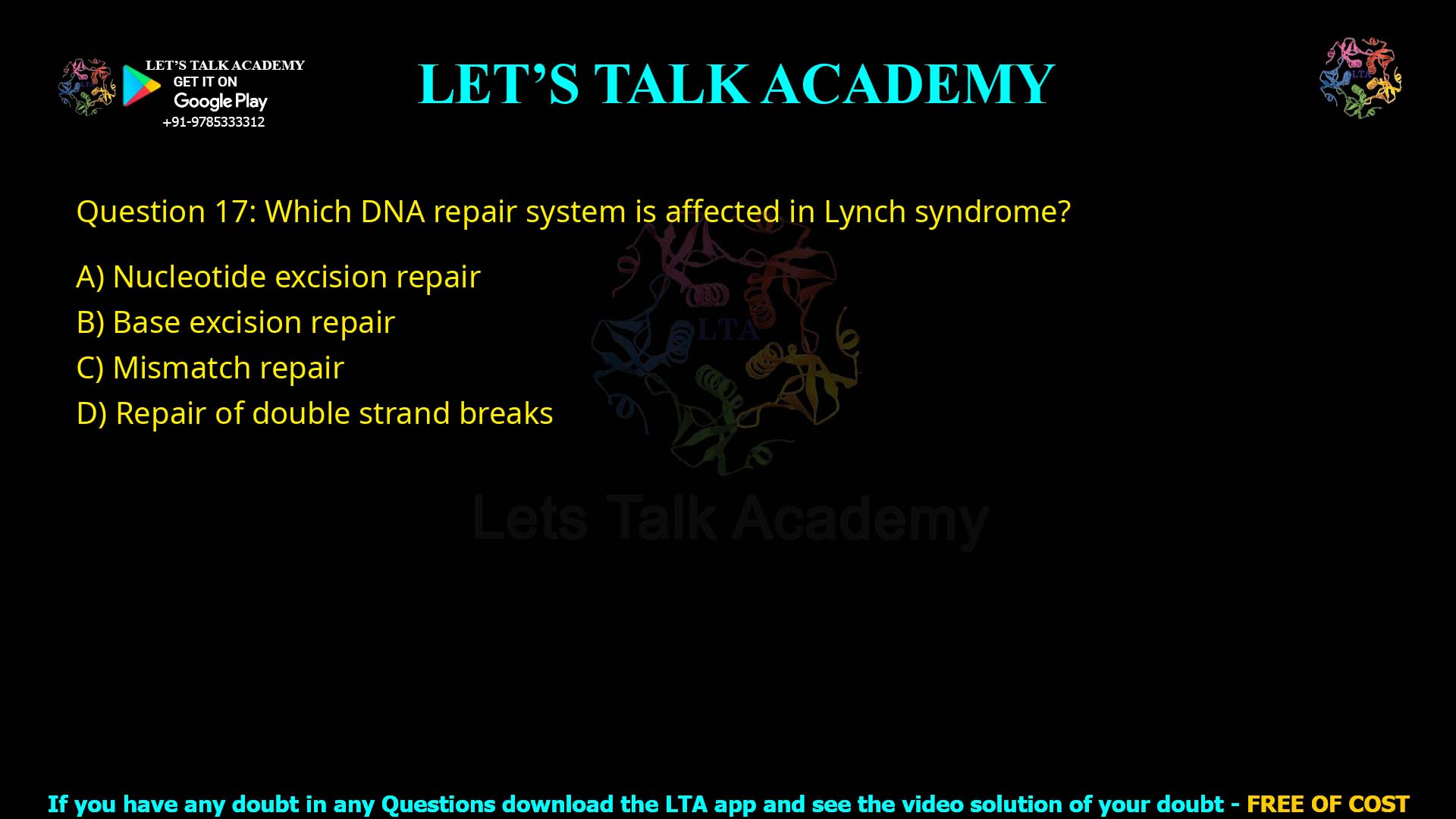
Q17.Which DNA repair system is affected in Lynch syndrome?
(A) Nucleotide excision repair
(B) Base excision repair
(C) Mismatch repair
(D) Repair of double strand breaks
Lynch syndrome affects the mismatch repair (MMR) system, making (C) the correct answer.
This hereditary condition arises from germline mutations in MMR genes like MLH1, MSH2, MSH6, PMS2, or EPCAM, leading to defective DNA mismatch repair and microsatellite instability, which drives cancers such as colorectal and endometrial. Below, each option is explained in detail.
Option Analysis
(A) Nucleotide Excision Repair
Nucleotide excision repair (NER) removes bulky DNA lesions like UV-induced thymine dimers or chemical adducts by excising a short oligonucleotide segment containing the damage.
It does not handle replication errors or small mismatches, so NER defects cause xeroderma pigmentosum, not Lynch syndrome.
(B) Base Excision Repair
Base excision repair (BER) fixes small, non-bulky base modifications such as oxidation, deamination, or alkylation using DNA glycosylases, AP endonuclease, and polymerase.
BER targets spontaneous base changes rather than polymerase slippage mismatches, and its defects link to conditions like MUTYH-associated polyposis, unrelated to Lynch syndrome.
(C) Mismatch Repair
Mismatch repair (MMR) identifies and corrects base-base or insertion/deletion mismatches from DNA replication errors, involving proteins like MSH2/MSH6 (MutSα) for recognition and MLH1/PMS2 (MutLα) for excision-resynthesis.
MMR deficiency is the hallmark of Lynch syndrome (hereditary nonpolyposis colorectal cancer), causing microsatellite instability and lifetime cancer risks up to 80% for colorectal cancer.
(D) Repair of Double Strand Breaks
Double-strand break (DSB) repair uses non-homologous end joining (NHEJ) for rapid ligation or homologous recombination (HR) for accurate repair using a sister chromatid.
DSB defects associate with BRCA-related cancers or ataxia-telangiectasia, not the replication-error focus of Lynch syndrome.
Lynch syndrome, a key topic in molecular genetics and oncology, stems from defects in a specific DNA repair system affected in Lynch syndrome—mismatch repair (MMR). This hereditary disorder heightens risks for colorectal, endometrial, and other cancers due to unrepaired replication errors. Understanding the DNA repair system affected in Lynch syndrome helps in diagnosis via microsatellite instability testing and immunohistochemistry.
Core Mechanism of MMR Deficiency
MMR scans post-replication DNA for mismatches, excising the erroneous strand via endonucleases and resynthesizing accurately. Mutations in MMR genes (MLH1, MSH2, etc.) impair this, accumulating mutations at microsatellites. Over 90% of Lynch cases trace to MMR flaws, distinguishing it from sporadic cancers.
Comparing DNA Repair Pathways
This table clarifies why mismatch repair is the DNA repair system affected in Lynch syndrome, not others.
Clinical Relevance for Biology Students
For exams like NEET-PG or research, note MMR’s role in preventing mutagenesis. Screening via Bethesda guidelines or genetic testing is vital. Early surveillance reduces mortality.


