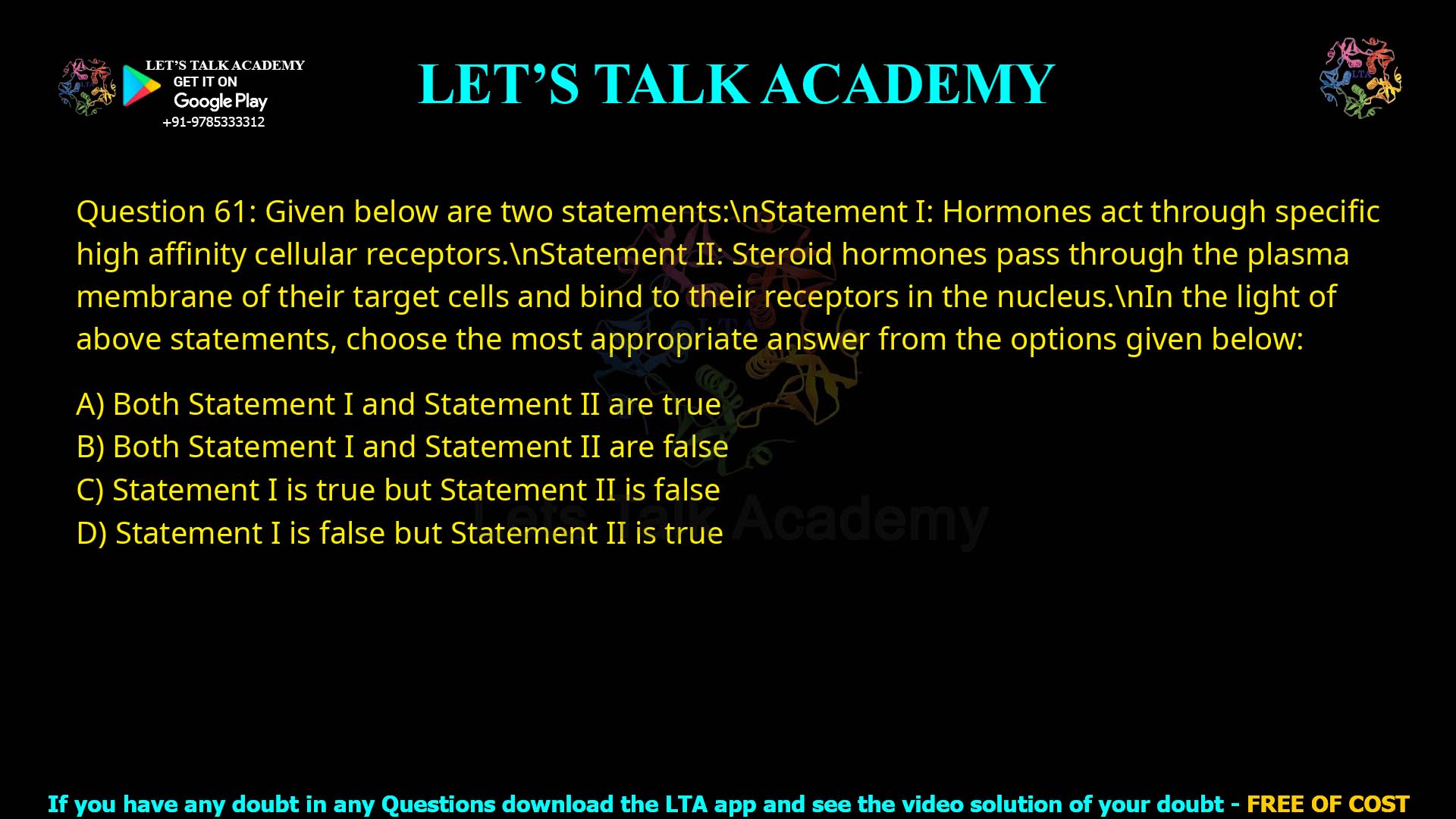
Q.61 Given below are two statements:
Statement I: Hormones act through specific high affmity cellular receptors.
Statement II: Steroid hormones pass through the plasma membrane of their target cells and bind to their
receptors in the nucleus.
In the light of above statements, choose the most appropriate answer from the options given below:
1. Both Statement I and Statement II are true
2. Both Statement I and Statement II are false
3. Statement I is true but Statement II is false
4. Statement I is false but Statement II is tme
Both Statement I and Statement II are true, so the correct answer is option 1.
Statement Analysis
Hormones indeed act through specific high-affinity cellular receptors, making Statement I true.
Steroid hormones, being lipid-soluble, diffuse across the plasma membrane and typically bind receptors in the cytoplasm or nucleus (often translocating to the nucleus), so Statement II is also true.
Option Breakdown
-
Option 1: Correct, as both statements align with established hormone action mechanisms.
-
Option 2: Incorrect, since both are factually accurate.
-
Option 3: Incorrect, because Statement II holds (steroids cross membranes to reach intracellular receptors).
-
Option 4: Incorrect, as Statement I is a core principle of hormone-receptor specificity.
Note: While some research mentions rapid non-genomic effects via plasma membrane receptors, the classical (genomic) pathway described in Statement II remains standard in textbooks.
Steroid hormones pass through the plasma membrane of their target cells due to their lipid-soluble nature, enabling binding to intracellular receptors—often in the nucleus—for gene regulation. This mechanism, central to molecular biology exams, involves high-affinity receptors as outlined in key statements on hormone action.
Hormones and High-Affinity Receptors (Statement I)
Hormones exert effects via specific high-affinity cellular receptors, ensuring targeted signaling without off-target impacts. These receptors vary: peptide hormones use membrane-bound types, while lipophilic ones like steroids engage intracellular ones. This specificity underscores Statement I’s truth in endocrinology.
Steroid Hormone Mechanism (Statement II)
Steroid hormones, derived from cholesterol (e.g., cortisol, estrogen), diffuse freely across the phospholipid bilayer of the plasma membrane. Inside, they bind cytoplasmic or nuclear receptors, forming complexes that act as transcription factors to modulate gene expression. Statement II accurately captures this genomic pathway, dominant in standard biology curricula.
Why Both Statements Are True
Both describe complementary facts: general receptor specificity (I) and steroid-specific entry/binding (II). Exceptions like membrane-initiated steroid signaling exist but don’t negate the classical model tested here.
| Aspect | Statement I | Statement II |
|---|---|---|
| Core Claim | High-affinity receptors | Steroids cross membrane, bind nucleus |
| Applies To | All hormones | Steroid hormones only |
| Accuracy | True | True |
Exam Relevance for Life Sciences
For NEET, GATE, or CSIR-UGC exams, this tests hormone classification: water-soluble (e.g., insulin) vs. lipid-soluble (steroids/thyroid). Memorize: steroids → no second messengers, direct DNA impact. Practice matching statements to options for assertion-reason questions.


