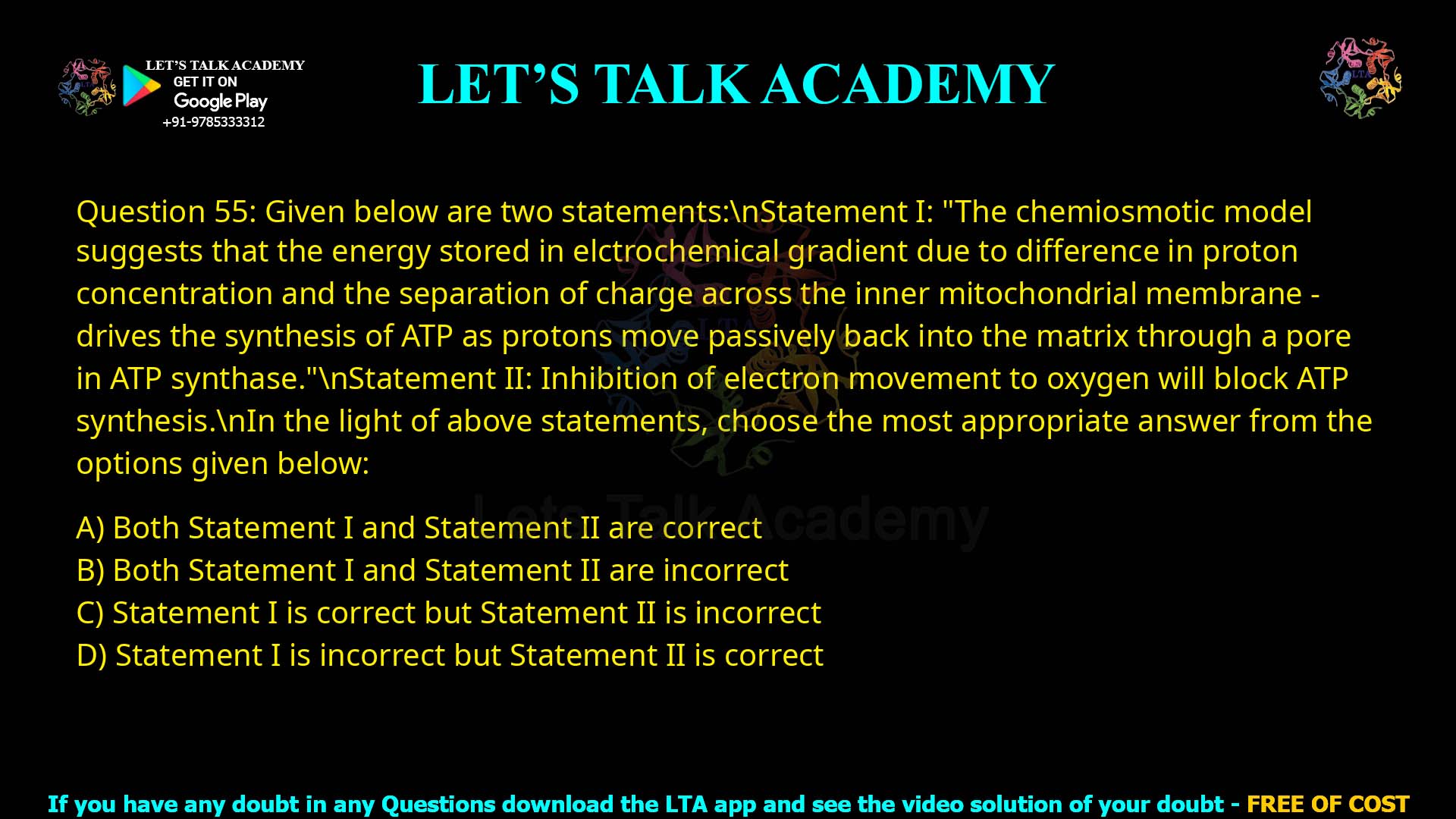
Q.55 Given below are two statements:
Statement I: “The chemiosmotic model suggests that the energy stored in elctrochemical gradient due to
difference in proton concentration and the separation of charge across the inner mitochondrial membrane –
drives the synthesis of ATP as protons move passively back into the matrix through a pore in ATP synthase.”
Statement II: Inhibition of electron movement to oxygen will block ATP synthesis.
In the light of above statements, choose the most appropriate answer from the options given below:
1. Both Statement I and Statement II are correct
2. Both Statement I and Statement II are incorrect
3. Statement I is correct but Statement II is incorrect
4. Statement I is incorrect but Statement II is correct
Correct Answer
The correct option is:
1. Both Statement I and Statement II are correct.
Concept Recap (Chemiosmotic Model and ETC–ATP Coupling)
-
The chemiosmotic model states that electron transport through the respiratory chain drives active pumping of protons from the mitochondrial matrix to the intermembrane space, creating an electrochemical proton gradient (proton‑motive force) across the inner mitochondrial membrane.
-
Protons then move passively down this gradient back into the matrix through the proton channel (F₀) of ATP synthase, and this flow drives ATP formation in the catalytic F₁ headpiece (oxidative phosphorylation).
-
In the mitochondrial electron transport chain (ETC), oxygen is the terminal electron acceptor; if electron flow to oxygen is blocked, proton pumping stops, the gradient collapses, and ATP synthesis ceases.
Evaluation of Statements
Statement I
“The chemiosmotic model suggests that the energy stored in electrochemical gradient due to difference in proton concentration and the separation of charge across the inner mitochondrial membrane drives the synthesis of ATP as protons move passively back into the matrix through a pore in ATP synthase.”
-
This is a correct description of the chemiosmotic hypothesis:
-
Proton pumping by ETC complexes creates a proton gradient and membrane potential (proton‑motive force).
-
Protons flow back into the matrix down this gradient via ATP synthase (F₀ channel), and this energy is converted into chemical energy in ATP.
-
-
The statement correctly mentions:
-
Inner mitochondrial membrane
-
Electrochemical gradient (ΔpH + membrane potential)
-
Passive movement (downhill flow) of protons through ATP synthase
-
Coupling of this flow to ATP synthesis
-
So, Statement I is correct.
Statement II
“Inhibition of electron movement to oxygen will block ATP synthesis.”
-
In oxidative phosphorylation, electrons move through complexes I–IV of the ETC, and oxygen acts as the final electron acceptor at complex IV (cytochrome c oxidase).
-
If electron movement to oxygen is inhibited (for example, by ETC inhibitors like cyanide, CO, or by lack of oxygen), then:
-
Electron flow stops.
-
Proton pumping across the inner mitochondrial membrane stops.
-
The proton gradient cannot be maintained.
-
Without the gradient, ATP synthase cannot operate in the forward (ATP‑forming) direction.
-
-
Therefore, ATP synthesis via oxidative phosphorylation is blocked.
So, Statement II is also correct.
Why Each Option Is Right or Wrong
Option 1: Both Statement I and Statement II are correct
-
As analysed above,
-
Statement I accurately reflects the chemiosmotic model of ATP synthesis in mitochondria.
-
Statement II correctly states the consequence of blocking electron flow to oxygen on ATP synthesis.
-
-
Therefore, Option 1 is the correct choice.
Option 2: Both Statement I and Statement II are incorrect
This cannot be true because:
-
Statement I correctly explains ATP synthesis driven by proton‑motive force and proton flow through ATP synthase.
-
Statement II correctly states that blocking electron movement to oxygen stops proton pumping and thereby blocks ATP synthesis.
Therefore, Option 2 is incorrect.
Option 3: Statement I is correct but Statement II is incorrect
-
Statement I is indeed correct.
-
However, Statement II is also correct because oxidative phosphorylation depends on continuous electron flow to oxygen; without it, the proton gradient cannot be sustained and ATP synthesis stops.
-
Thus, it is wrong to say that Statement II is incorrect.
Therefore, Option 3 is incorrect.
Option 4: Statement I is incorrect but Statement II is correct
-
Statement II is correct, but Statement I is not incorrect; it correctly describes the chemiosmotic mechanism.
-
The description of electrochemical gradient, inner mitochondrial membrane, and passive proton flow through ATP synthase is conceptually sound.
Therefore, Option 4 is incorrect.
Use this framing in your notes:
-
Key idea: ETC → proton gradient → ATP synthase → ATP; block ETC to oxygen → no gradient → no ATP.


