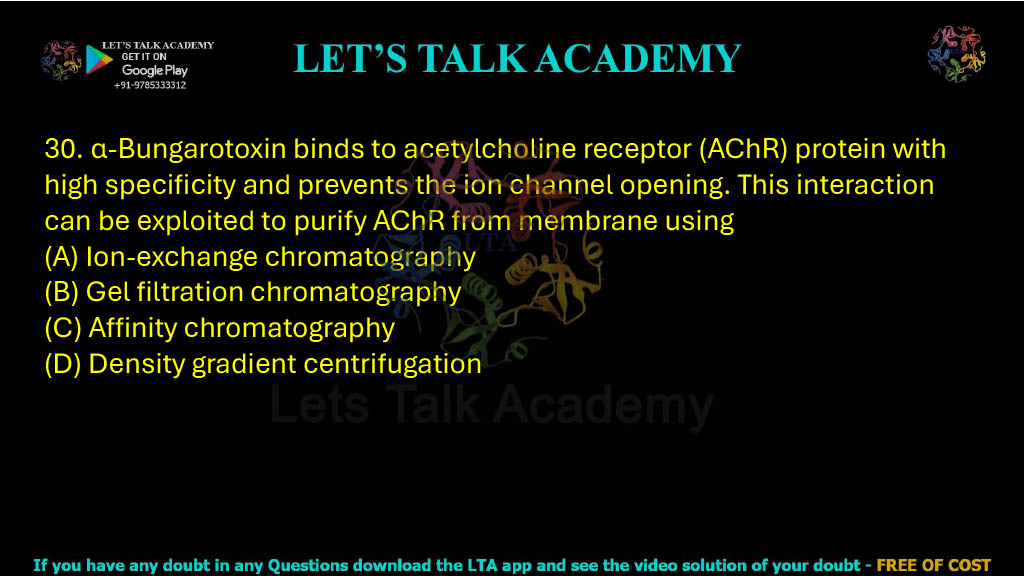
30.
α-bungarotoxin binds to acetylcholine receptor (AChR) protein with high specificity and
prevents the ion channel opening. This interaction can be exploited to purify AChR from
membrane using
- (A) Ion-exchange chromatography
- (B) Gel filtration chromatography
- (C) Affinity chromatography
- (D) Density gradient centrifugation
α-Bungarotoxin Affinity Chromatography for AChR Purification: MCQ Solved
α-Bungarotoxin’s specific binding to the acetylcholine receptor (AChR) enables targeted purification from membranes via affinity chromatography, making option (C) correct. This technique exploits the toxin’s high-affinity interaction to isolate the receptor protein effectively.
Option Analysis
Ion-exchange chromatography (A) separates proteins based on charge differences using ion exchangers, but lacks specificity for AChR without a unique charge profile matching α-bungarotoxin. It suits general protein mixtures, not ligand-specific purification.
Gel filtration chromatography (B), or size-exclusion, fractions proteins by molecular size through porous beads, ineffective for isolating AChR amid similar-sized membrane proteins. It provides no binding-based selectivity.
Affinity chromatography (C) uses immobilized ligands like α-bungarotoxin on beads to capture specific targets, eluting AChR selectively after washing non-specific binders. This is the standard method for receptor purification using toxin affinity columns.
Density gradient centrifugation (D) bands particles by buoyant density in gradients like sucrose, useful for membrane fractionation but non-specific for AChR without toxin exploitation.
α-Bungarotoxin binds acetylcholine receptor (AChR) proteins with exceptional specificity, blocking ion channel opening and enabling precise purification from membranes. This interaction is ideal for affinity chromatography in biochemistry labs studying nicotinic receptors.
Purification Mechanism
α-Bungarotoxin, from snake venom, irreversibly binds AChR’s α-subunit, allowing immobilization on agarose beads for affinity columns. Solubilized membrane extracts flow through; AChR binds tightly, unbound proteins wash away, and specific elution (e.g., high salt or competing ligand) yields pure receptor for functional assays.
Technique Comparison
Method Principle Suitability for AChR Ion-exchange Charge-based Low specificity Gel filtration Size-based No ligand selectivity Affinity Ligand-specific binding High purity via toxin Density gradient Buoyant density Membrane fractionation only Affinity chromatography dominates for toxin-receptor pairs, as seen in historic AChR isolations from Torpedo electric organs.
Exam Relevance
This CSIR-NET/GATE Life Sciences PYQ tests protein purification concepts in molecular biology. Understanding ligand exploitation differentiates it from physical separation methods.


2 Comments
Vanshika Sharma
February 2, 2026Bu using affinity chromatography
Kanica Sunwalka
June 25, 2026affinity chr