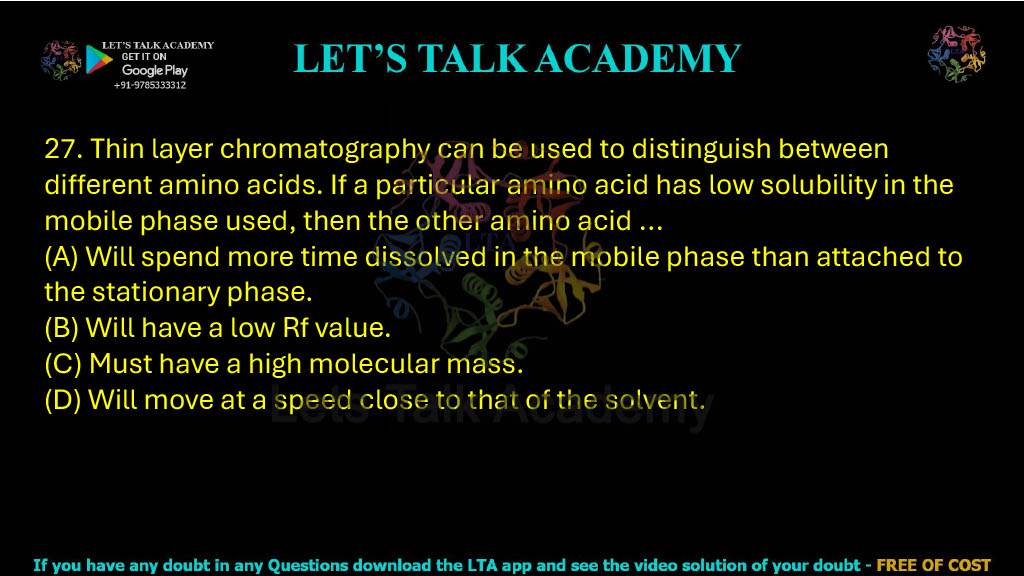
27. Thin layer chromatography can be used to distinguish between different amino acids.
If a particular amino acid has low solubility in the mobile phase used, then the other amino acid:
A. Will spend more time dissolved in the mobile phase than attached to the stationary phase
B. Will have a low Rf value
C. Must have a high molecular mass
D. Will move at a speed close to that of the solvent
Thin Layer Chromatography Amino Acid Low Rf Value
In thin layer chromatography, if one amino acid has low solubility in the mobile phase, the other amino acid will have a low Rf value to distinguish it effectively. The correct answer is option B.
Question Breakdown
This MCQ tests TLC separation principles for amino acids, focusing on solubility effects on Rf values—key for GATE Life Sciences biochemistry.
Option Analysis
-
A. Will spend more time dissolved in the mobile phase than attached to the stationary phase: Incorrect. Low mobile phase solubility means the other amino acid favors stationary phase more, spending less time dissolved.
-
B. Will have a low Rf value: Correct. The “other” amino acid (for distinction) must also interact strongly with stationary phase, yielding low Rf to create separation gap.
-
C. Must have a high molecular mass: Incorrect. TLC separates primarily by polarity/interactions, not molecular weight.
-
D. Will move at a speed close to that of the solvent: Incorrect. Solvent front speed indicates Rf ≈ 1.0 (high solubility), opposite of what’s needed for distinction.
Introduction
Thin layer chromatography can distinguish amino acids where low solubility in mobile phase results in the other amino acid having a low Rf value. This principle drives separation via differential stationary/mobile phase partitioning, essential for biochemical identification in competitive exams like GATE Life Sciences.
TLC Amino Acid Separation Mechanism
Silica stationary phase interacts strongly with polar amino acid R-groups. Low mobile phase solubility = strong silica binding = low Rf (travels short distance).
Rf Formula: Distance traveled by compound / Distance traveled by solvent front
For separation: Amino acids need DIFFERENT Rf values. If one has very low solubility (very low Rf), the other must also have relatively low Rf (but higher than first) for clear spots.
Amino Acid TLC Characteristics
| Amino Acid Property | Stationary Phase Interaction | Rf Value | Distance Traveled |
|---|---|---|---|
| Low mobile solubility | Strong binding | Low | Short |
| High mobile solubility | Weak binding | High | Long |
Practical Applications
-
Identify unknown mixtures via Rf comparison to standards
-
Purity checks in peptide synthesis
-
Food/forensic amino acid profiling
Ninhydrin visualization reveals purple spots; Rf database confirms identity.


2 Comments
Vanshika Sharma
February 2, 2026Will have low rf value
Kanica Sunwalka
June 25, 2026low rf value