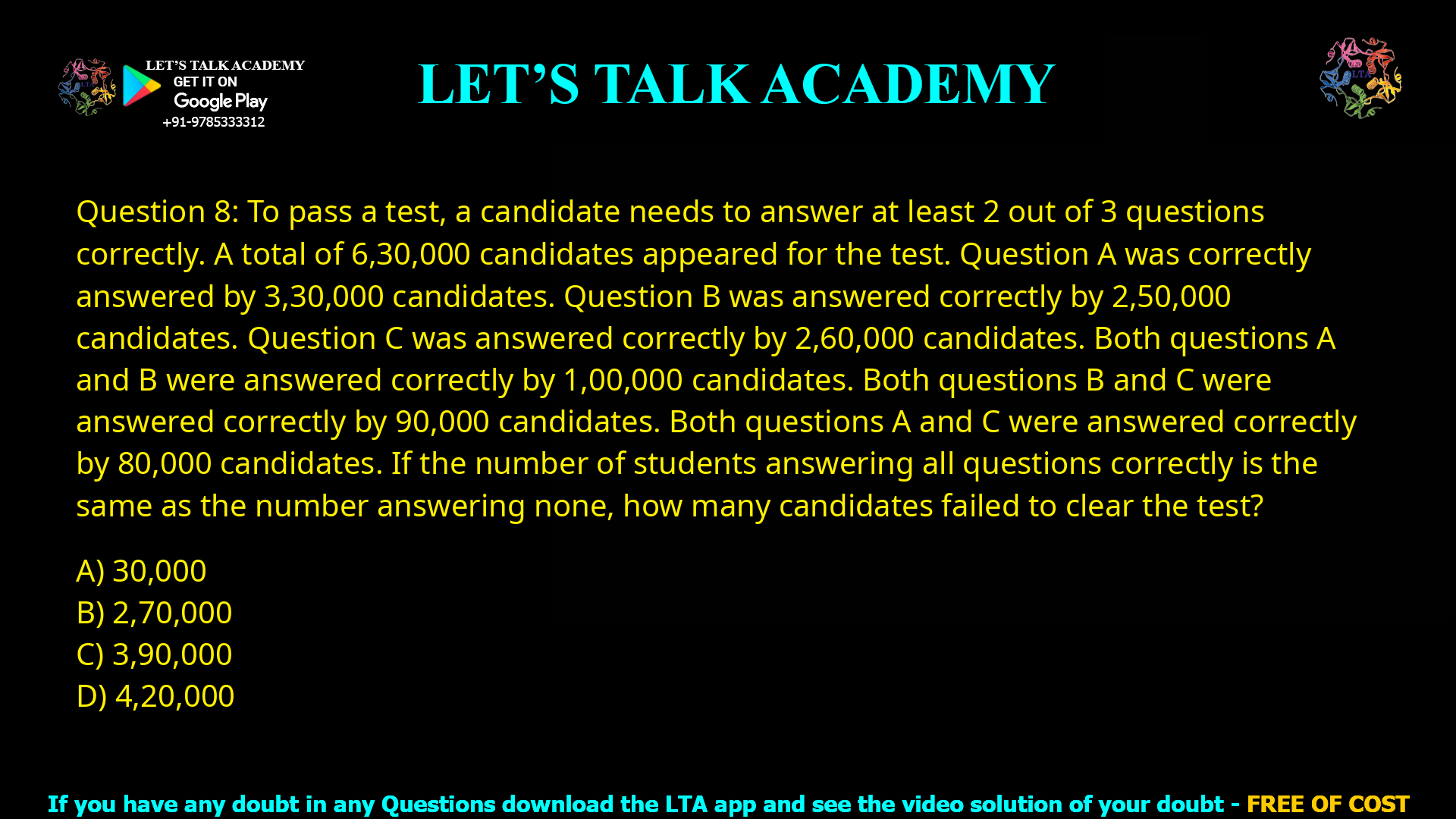
Q.8 To pass a test, a candidate needs to answer at least 2 out of 3 questions correctly. A total of
6,30,000 candidates appeared for the test. Question A was correctly answered by 3,30,000
candidates. Question B was answered correctly by 2,50,000 candidates. Question C was
answered correctly by 2,60,000 candidates. Both questions A and B were answered
correctly by 1,00,000 candidates. Both questions B and C were answered correctly by
90,000 candidates. Both questions A and C were answered correctly by 80,000 candidates.
If the number of students answering all questions correctly is the same as the number
answering none, how many candidates failed to clear the test?
(A) 30,000 (B) 2,70,000 (C) 3,90,000 (D) 4,20,000
To pass the test, candidates need at least 2 out of 3 questions correct, so failures are those correct on exactly 1 or 0 questions. Using the inclusion-exclusion principle and Venn diagram regions for sets A, B, C (with all three correct equal to none correct), the number who got all correct (and none) is 30,000, and total failures are 390,000. This matches option (C).
Problem Setup
- Total candidates: 6,30,000
- |A| = 3,30,000 (correct on A)
- |B| = 2,50,000 (correct on B)
- |C| = 2,60,000 (correct on C)
- |A ∩ B| = 1,00,000
- |B ∩ C| = 90,000
- |A ∩ C| = 80,000
- Let x = |A ∩ B ∩ C| = number answering none correctly
Venn Diagram Regions
- Only A: |A| – |A∩B| – |A∩C| + x = 3,30,000 – 1,00,000 – 80,000 + x = 1,50,000 + x
- Only B: |B| – |A∩B| – |B∩C| + x = 2,50,000 – 1,00,000 – 90,000 + x = 60,000 + x
- Only C: |C| – |A∩C| – |B∩C| + x = 2,60,000 – 80,000 – 90,000 + x = 90,000 + x
- Only A and B: |A∩B| – x = 1,00,000 – x
- Only B and C: |B∩C| – x = 90,000 – x
- Only A and C: |A∩C| – x = 80,000 – x
- All three: x
- None: x
Total Candidates Equation
(1,50,000 + x) + (60,000 + x) + (90,000 + x) + (1,00,000 – x) + (90,000 – x) + (80,000 – x) + x + x = 6,30,000
Simplifies to: 5,70,000 + 2x = 6,30,000 → 2x = 60,000 → x = 30,000
Failures Calculation
Failures = only one correct + none
(1,50,000 + 30,000) + (60,000 + 30,000) + (90,000 + 30,000) + 30,000 = 3,90,000
Option Analysis
| Option | Value | Matches? | Reason |
|---|---|---|---|
| (A) | 30,000 | No | Equals x (all/none only), ignores one-correct cases |
| (B) | 2,70,000 | No | Underestimates; perhaps only two-correct misread as fail |
| (C) | 3,90,000 | Yes | Exact: 3,00,000 (one-correct base) + 4×30,000 |
| (D) | 4,20,000 | No | Overestimates; total – passers exceeds actual passers |
SEO Article Content
In competitive exams like GATE, the candidates failed test 630000 3 questions puzzle tests set theory mastery. With 6,30,000 candidates needing at least 2/3 correct—Question A by 3,30,000, B by 2,50,000, C by 2,60,000, and pairwise intersections given—this candidates failed test 630000 3 questions problem hinges on the condition that all-correct equals none-correct.
Step-by-Step Venn Solution
Apply inclusion-exclusion: Define x as all three correct (and none). Only-one regions sum to 3,00,000 + 3x; pairs to 2,70,000 – 3x; total balances at x=30,000. Failures (0 or 1 correct): 3,90,000.
Why 390000 is Correct
Option (C) fits precisely, as verified by total summation. Common traps: Confusing passers/failers or ignoring x.
Master this for biotech/GATE quantitative aptitude—practice similar candidates failed test 630000 3 questions variants boosts scores.


