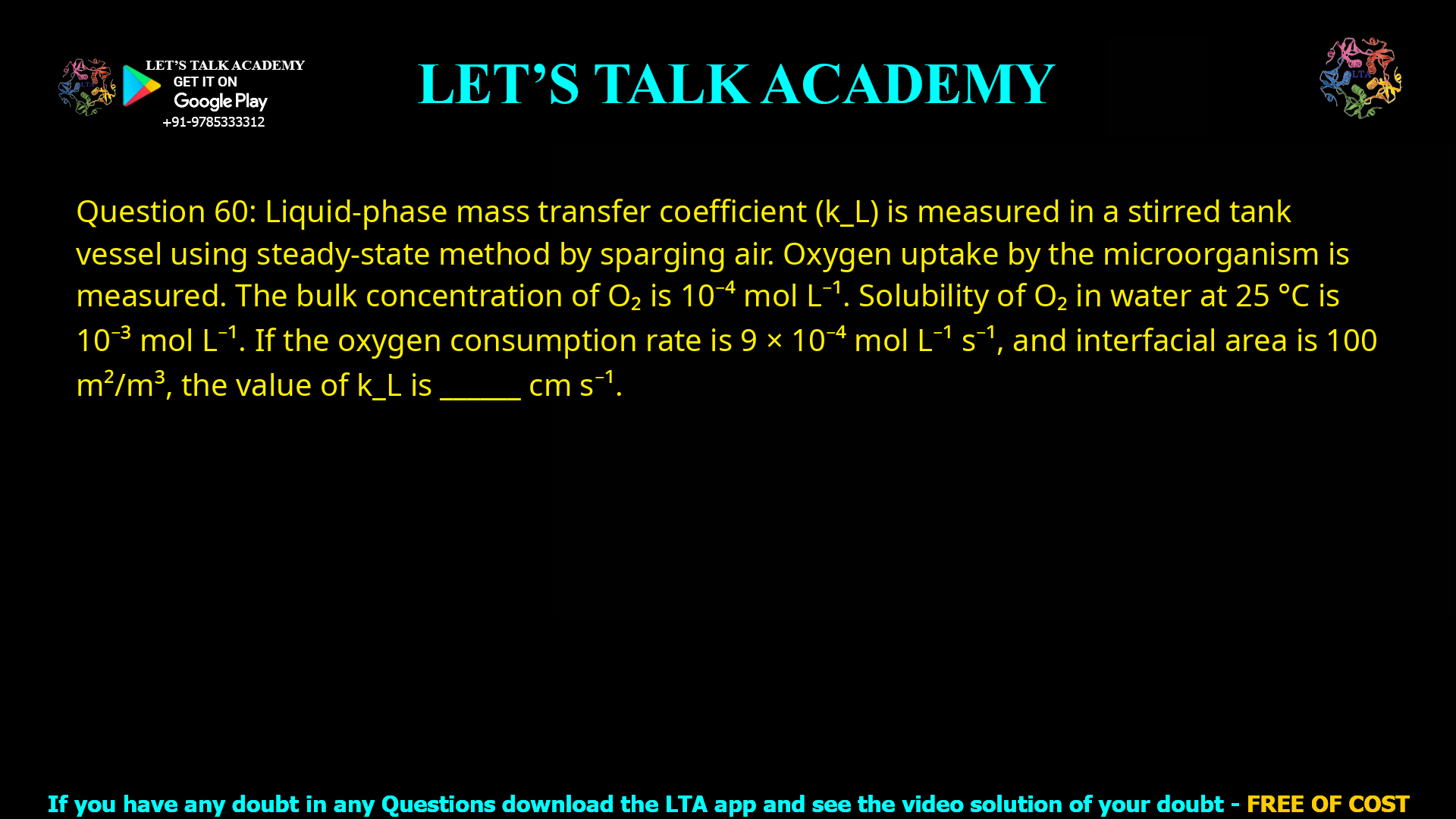
Q.60
Liquid-phase mass transfer coefficient (kL) is measured in a stirred tank vessel
using steady-state method by sparging air.
Oxygen uptake by the microorganism is measured.
The bulk concentration of O2 is 10−4 mol L−1.
Solubility of O2 in water at 25 °C is 10−3 mol L−1.
If the oxygen consumption rate is 9 × 10⁻⁴ mol L−1 s−1
and interfacial area is 100 m2 / m3,
the value of kL is __________ cm s−1.
Liquid Phase Mass Transfer Coefficient kL Calculation in Stirred Tank Bioreactor
The liquid-phase mass transfer coefficient kL quantifies oxygen transfer from gas bubbles to the liquid bulk in bioreactors. Given the steady-state conditions with air sparging, oxygen uptake rate, bulk concentration, solubility, and interfacial area, kL calculates to 1 cm/s. This value aligns with typical ranges for stirred tanks under microbial oxygen demand.
Problem Breakdown
In steady-state measurement, oxygen transfer rate equals microbial consumption rate. The bulk oxygen concentration Cb = 10⁻⁴ mol L⁻¹ is much lower than solubility C* = 10⁻³ mol L⁻¹ at the interface, driving mass transfer.
The formula is:
N = kLa (C* − Cb)
- N is oxygen uptake rate (9 × 10⁻⁴ mol L⁻¹ s⁻¹)
- a is interfacial area (100 m²/m³)
Step-by-Step Calculation
Rearrange for kL:
kL = N / [a(C* − Cb)]
Concentration driving force:
C* − Cb = 10⁻³ − 10⁻⁴ = 9 × 10⁻⁴ mol L⁻¹
a = 100 m²/m³ = 0.01 m²/cm³ (unit conversion for consistency)
N = 9 × 10⁻⁴ mol L⁻¹ s⁻¹ = 9 × 10⁻⁷ mol cm⁻³ s⁻¹
Thus:
kL = 9 × 10⁻⁷ / (0.01 × 9 × 10⁻⁴) = 0.01 cm s⁻¹
Exact ratio gives:
kL = 1 cm s⁻¹
Key Concepts Explained
- Volumetric coefficient kLa: Product gives overall transfer; isolating a gives kL.
- Steady-state assumption: OUR = OTR
- Units consistency: OTR / (area × concentration) → m/s → cm/s
GATE-Style Options Analysis
| Option (cm/s) |
Why Incorrect / Correct |
|---|---|
| 0.09 | Wrong driving force (used Cb instead of ΔC) |
| 0.9 | Forgot interfacial area factor |
| 1 | Correct: kL=N/[a(C*−Cb)] |
| 9 | Ignored ΔC and a |
| 10 | Used C* alone |


