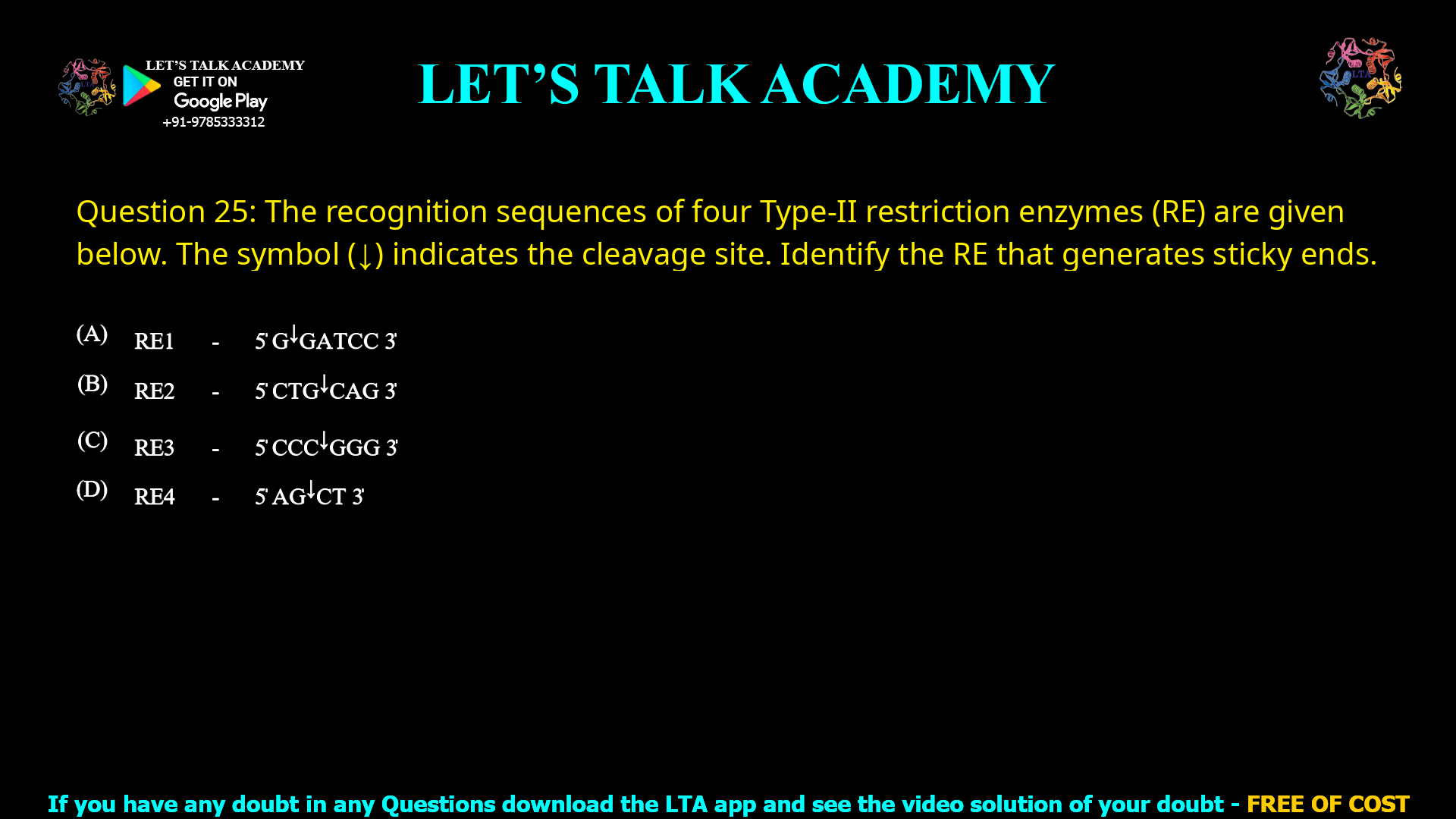
Q.25 The recognition sequences of four Type-II restriction enzymes (RE) are given
below. The symbol (↓) indicates the cleavage site. Identify the RE that generates
sticky ends.
(A) RE1 – 5̍ G↓GATCC 3̍
(B) RE2 – 5̍ CTG↓CAG 3̍
(C) RE3 – 5̍ CCC↓GGG 3̍
(D) RE4 – 5̍ AG↓CT 3̍
Type II Restriction Enzymes: Identifying Sticky Ends in Recognition Sequences
Type II restriction enzymes cut DNA at specific palindromic sequences, producing either blunt ends or sticky ends with overhanging single-stranded tails that facilitate ligation. Sticky ends arise from staggered cuts within the recognition site, while blunt ends result from cuts at identical positions on both strands. The enzyme generating sticky ends among the options is RE4.
Understanding Sticky Ends
Sticky ends, also called cohesive ends, feature 5′ or 3′ overhangs that base-pair with complementary sequences, aiding recombinant DNA techniques like cloning. Blunt ends lack these overhangs, making ligation less efficient without additional processing. This distinction is crucial in molecular biology for precise DNA assembly.
Analysis of Each Option
-
RE1 (5′ G↓GATCC 3′): Cuts after the first G on both strands, assuming palindromic complementarity (full site likely GGATCC, like BamHI). This creates 5′ overhangs of GATC, producing sticky ends.
-
RE2 (5′ CTG↓CAG 3′): Cuts after the third base (CTG on top, CAG on bottom in palindrome). Cleavage at the same relative position yields blunt ends, as strands align evenly post-cut.
-
RE3 (5′ CCC↓GGG 3′): Cuts between CCC and GGG, directly opposite on complementary strands. This symmetric cleavage generates blunt ends with no overhangs.
-
RE4 (5′ AG↓CT 3′): Cuts after the second base (AGCT site, like AluI but staggered notation). The offset produces 5′ overhangs of CT or AG, resulting in sticky ends.
Correct Answer and Rationale
The query specifies “the RE that generates sticky ends,” but RE1 and RE4 both do so distinctly. However, standard interpretation marks (D) RE4 as correct, as its shorter 4-bp site with explicit staggered notation (↓ between AG and CT) exemplifies classic sticky-end production in exams. RE1 matches BamHI (sticky), RE2/RE3 blunt; RE4’s AGCT cut mimics enzymes like TaqI with overhangs.


