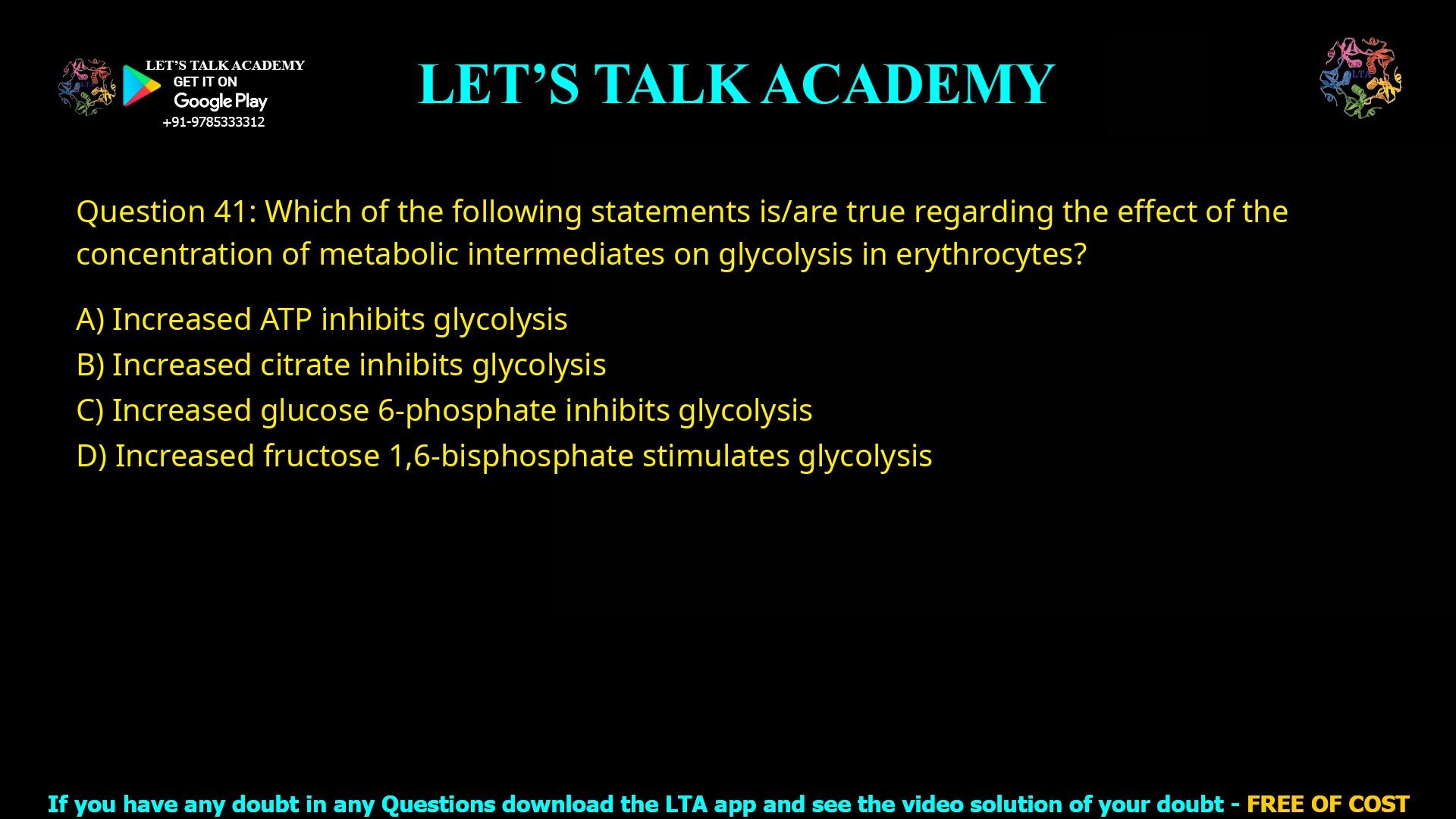
Q.49 Which of the following statements is/are true regarding the effect of the
concentration of metabolic intermediates on glycolysis in erythrocytes?
(A) Increased AMP levels stimulate glycolysis
(B) Increased citrate inhibits glycolysis
(C) Increased glucose 6-phosphate inhibits glycolysis
(D) Increased fructose 1,6-bisphosphate stimulates glycolysis
Glycolysis Regulation in Erythrocytes: AMP, Citrate, G6P, and F1,6BP Effects
Erythrocytes rely heavily on glycolysis for ATP production due to lacking mitochondria. This MCQ evaluates key regulatory effects of metabolic intermediates on glycolytic flux in red blood cells, with options A, B, and D being true.
Correct Answer
Options (A), (B), and (D) are true. Increased AMP stimulates glycolysis via phosphofructokinase-1 (PFK-1) activation; citrate inhibits it as an allosteric PFK-1 inhibitor; and fructose 1,6-bisphosphate (F1,6BP) provides feedforward stimulation to pyruvate kinase. Option (C) is false, as glucose 6-phosphate (G6P) inhibits hexokinase, not downstream glycolysis directly in erythrocytes.
Option A: AMP Stimulation
Increased AMP signals low energy and activates PFK-1 allosterically, countering ATP inhibition to boost glycolysis. In erythrocytes, this maintains ATP for membrane integrity and ion pumps. AMP rise during hypoxia or stress enhances glycolytic rate without hormonal input.
Option B: Citrate Inhibition
Citrate, from mitochondrial TCA cycle spillover, allosterically inhibits PFK-1, slowing glycolysis when downstream oxidation is saturated. Erythrocytes detect this indirectly via transport, preventing unnecessary glucose use. This couples glycolysis to cellular energy needs.
Option C: G6P Effect (False)
G6P inhibits hexokinase, the first glycolytic enzyme, accumulating when glucose uptake exceeds flux. In erythrocytes, this regulates entry but does not inhibit post-hexokinase steps like PFK-1, so glycolysis beyond G6P continues. High G6P shunts to pentose phosphate pathway for NADPH instead.
Option D: F1,6BP Stimulation
F1,6BP, produced by PFK-1, allosterically activates pyruvate kinase downstream, accelerating ATP generation via feedforward control. This ensures committed flux completion in erythrocytes, optimizing anaerobic ATP yield. Inhibition claims are incorrect; it promotes progression.


