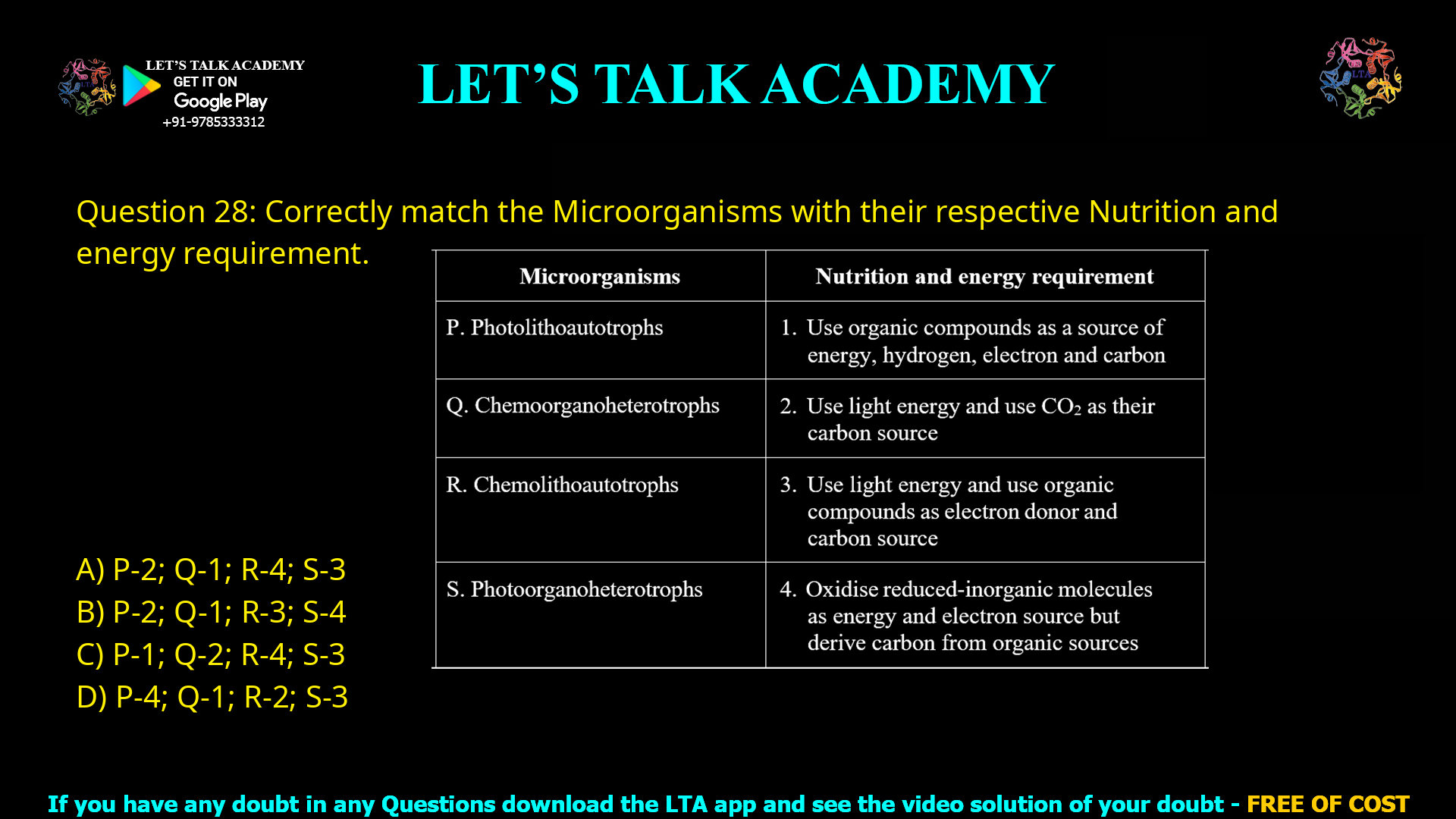
Q.36 Correctly match the Microorganisms with their respective Nutrition and energy
requirement.
Microorganisms Nutrition and energy requirement
P. Photolithoautotrophs 1. Use organic compounds as a source of energy, hydrogen, electron and carbon
Q. Chemoorganoheterotrophs 2. Use light energy and use CO2 as their carbon source
R. Chemolithoautotrophs 3. Use light energy and use organic compounds as electron donor and carbon source
S. Photoorganoheterotrophs 4. Oxidise reduced-inorganic molecules as energy and electron source but derive carbon from organic sources
(A) P-2; Q-1; R-4; S-3
(B) P-2; Q-1; R-3; S-4
(C) P-1; Q-2; R-4; S-3
(D) P-4; Q-1; R-2; S-3
Microbial nutrition hinges on sources of energy, electrons, and carbon, classifying organisms into distinct groups like photolithoautotrophs and chemoorganoheterotrophs. This GATE Biotechnology question tests precise matching of these terms to their requirements. The correct answer is option (A): P-2; Q-1; R-4; S-3.
Photolithoautotrophs (P)
Photolithoautotrophs harness light as their energy source while fixing CO2 for carbon, using inorganic compounds like hydrogen sulfide as electron donors. This matches description 2 perfectly, as seen in cyanobacteria and purple sulfur bacteria. Examples include algae that perform oxygenic photosynthesis.
Chemoorganoheterotrophs (Q)
These microbes derive energy, electrons, hydrogen, and carbon entirely from organic compounds through oxidation, such as glucose breakdown. Description 1 aligns directly, typical of common heterotrophs like Escherichia coli in animal guts. No light or inorganic sources are involved.
Chemolithoautotrophs (R)
Chemolithoautotrophs oxidize reduced inorganic molecules (e.g., ammonia or ferrous iron) for energy and electrons but fix CO2 as their carbon source. This fits description 4, as in nitrifying bacteria like Nitrosomonas, though option texts may swap emphasis on carbon sourcing. They thrive in extreme environments like deep-sea vents.
Photoorganoheterotrophs (S)
These organisms use light for energy but rely on organic compounds as electron donors and carbon sources, without CO2 fixation. Description 3 matches, exemplified by purple nonsulfur bacteria in anaerobic sediments. They represent a hybrid photosynthetic strategy.
Option Analysis
-
(A) Correct: P-2 (light/CO2), Q-1 (organic all), R-4 (inorganic energy/organic carbon mix), S-3 (light/organic electrons+carbon).
-
(B) Wrong: Swaps R to 3, misassigning chemolithoautotrophs to light energy.
-
(C) Wrong: Mismatches P to 1 (organic-focused) and Q to 2 (light/CO2).
-
(D) Wrong: Incorrectly places R at 2 (light energy) instead of chemical oxidation.
| Option | P Match | Q Match | R Match | S Match | Status |
|---|---|---|---|---|---|
| A | 2 (Correct) | 1 (Correct) | 4 (Correct) | 3 (Correct) | ✅ Correct |
| B | 2 | 1 | 3 (Wrong) | 4 | ❌ |
| C | 1 (Wrong) | 2 | 4 | 3 | ❌ |
| D | 4 (Wrong) | 1 | 2 (Wrong) | 3 | ❌ |


