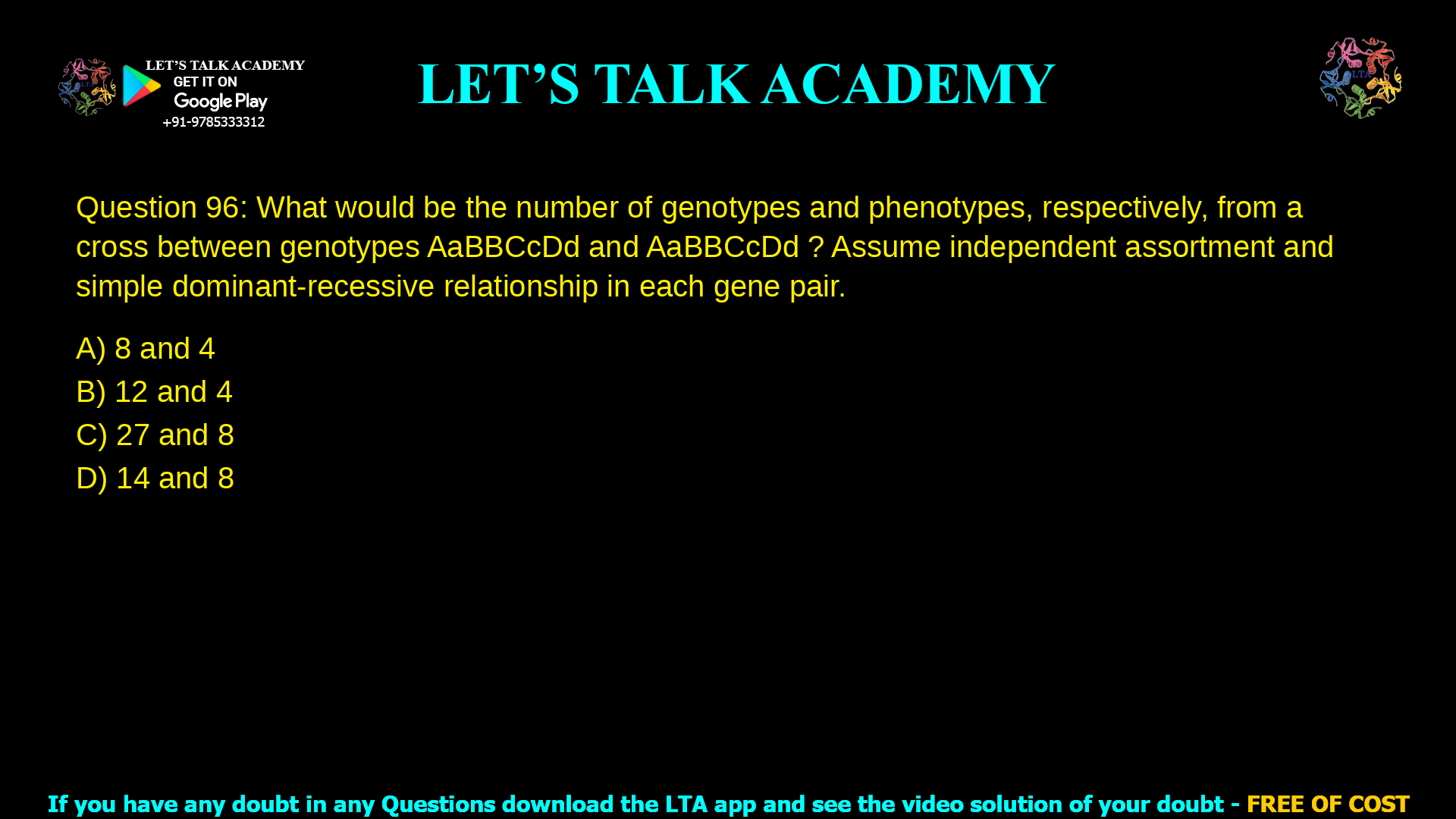
Q.96 What would be the number of genotypes and phenotypes, respectively, from a cross
between genotypes AaBBCcDd and AaBBCcDd ? Assume independent assortment
and simple dominant–recessive relationship in each gene pair.
(A) 8 and 4
(B) 12 and 4
(C) 27 and 8
(D) 14 and 8
The correct answer is (C) 27 and 8. This cross between AaBBCcDd × AaBBCcDd produces 27 distinct genotypes and 8 phenotypes under independent assortment and complete dominance.
Genotype Analysis
Each parent AaBBCcDd has three heterozygous gene pairs (A/a, C/c, D/d) and one homozygous dominant pair (B/B), yielding 8 gamete types per parent (2³ = 8). The offspring genotypes follow a (3:1) ratio per heterozygous gene: AA/Aa/aa for A, CC/Cc/cc for C, and DD/Dd/dd for D, while all offspring are BB. Thus, total genotypes = 3 × 1 × 3 × 3 = 27.
Phenotype Analysis
Phenotypes depend on dominance: 2 possibilities per heterozygous gene (dominant or recessive) across A, C, D, with B always dominant. Total phenotypes = 2 × 1 × 2 × 2 = 8, matching the 27:9:9:9:3:3:3:1 trihybrid ratio collapsed for fixed B.
Option Breakdown
-
(A) 8 and 4: Incorrect; confuses gametes (8) with offspring and undercounts phenotypes (treats as dihybrid).
-
(B) 12 and 4: Incorrect; no basis for 12 genotypes (possibly misreading two heterozygous genes).
-
(C) 27 and 8: Correct, as calculated for three heterozygous loci.
-
(D) 14 and 8: Incorrect; 14 lacks genetic justification (not 3ⁿ or 2ⁿ).
Introduction to Genotypes and Phenotypes in Multi-Gene Crosses
In genetics, determining the number of genotypes and phenotypes from crosses like AaBBCcDd × AaBBCcDd relies on Mendel’s laws of segregation and independent assortment. This trihybrid-style cross (three heterozygous loci) is common in CSIR NET Life Sciences exams, testing calculation of genotypic (3ⁿ) and phenotypic (2ⁿ) diversity where n = heterozygous pairs.
Step-by-Step Solution for AaBBCcDd Cross
Identify heterozygous loci: Aa (A), Cc (C), Dd (D) → n = 3; BB fixed.
Gametes per parent: 2³ = 8 (ABCd, ABCD, etc.).
Genotypes: Each heterozygous locus yields 3 outcomes (e.g., AA/Aa/aa), so 3³ × 1 = 27 total.
Phenotypes: Each gives 2 outcomes (dominant/recessive), so 2³ × 1 = 8 total.
| Locus | Genotypes | Phenotypes |
|---|---|---|
| A | 3 | 2 |
| B | 1 (BB) | 1 |
| C | 3 | 2 |
| D | 3 | 2 |
| Total | 27 | 8 |
Why CSIR NET Students Must Master This
For competitive exams, recognize fixed loci reduce complexity from full tetrahybrid (81 genotypes, 16 phenotypes) to effective trihybrid. Practice confirms option (C).
Common Mistakes in Such Questions
-
Ignoring homozygous BB (treats as 4 loci → 81/16).
-
Gamete count confusion (8 gametes ≠ 8 genotypes).
-
Forgetting simple dominance (phenotypes ≠ genotypes).


1 Comment
Pallavi gautam
January 3, 2026Done sir