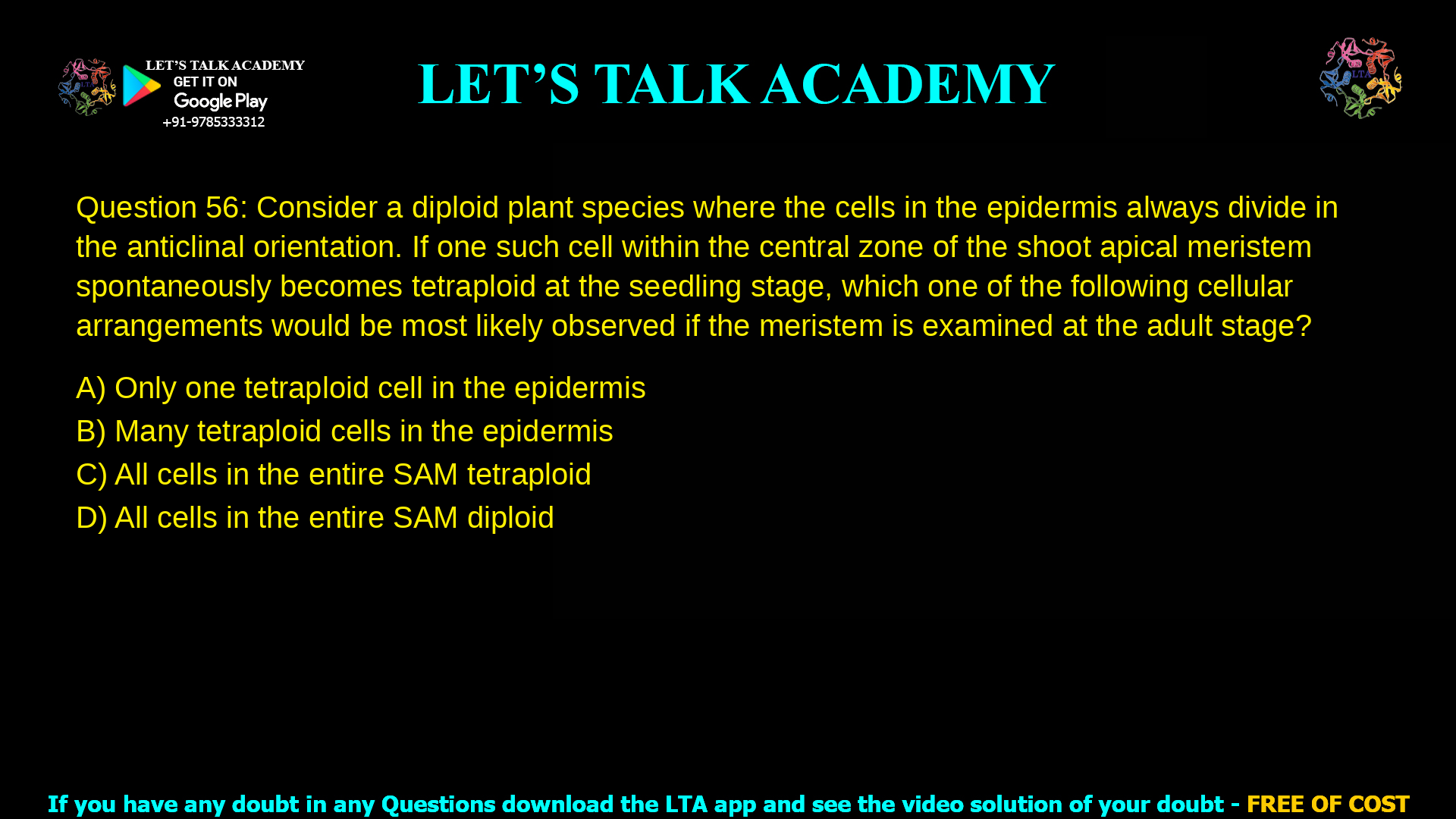
Q.56 Consider a diploid plant species where the cells in the epidermis (the outermost
single cell layer) always divide in the anticlinal orientation. If one such cell within
the central zone of the shoot apical meristem (SAM) spontaneously becomes
tetraploid at the seedling stage, which one of the following cellular arrangements
would be most likely observed if the meristem is examined at the adult stage?
(A) Only one tetraploid cell in the epidermis
(B) Many tetraploid cells in the epidermis
(C) All cells in the entire SAM tetraploid
(D) All cells in the entire SAM diploid
The shoot apical meristem (SAM) maintains layered structure with epidermis cells dividing anticlinally, preventing radial spread. A spontaneous tetraploid event in the central zone L1 epidermis leads to clonal expansion within that layer by adulthood. This results in multiple tetraploid epidermal cells due to persistent anticlinal divisions and stem cell-like renewal in the central zone.
SAM Structure and Layers
The SAM organizes into central zone (CZ) stem cells, peripheral zone for organ primordia, and three layers (L1, L2, L3). L1 forms epidermis and divides exclusively anticlinally—perpendicular to surface—for surface expansion without thickness increase. L2 and L3 allow periclinal divisions for internal tissues.
Anticlinal divisions in epidermis maintain clonal lineages; mutations or ploidy changes in L1 propagate laterally but stay confined to the layer. Central zone cells divide slowly, self-renewing like stem cells, producing daughter cells that amplify in peripheral zones.
Ploidy Change Mechanism
Tetraploidy doubles chromosomes, often from spindle failure during mitosis. In diploid SAM at seedling stage, a central zone epidermal (L1) cell becomes tetraploid spontaneously. This cell retains stem cell properties, dividing anticlinally to produce tetraploid daughters within L1.
By adult stage, repeated anticlinal divisions and central zone dynamics yield a sector of tetraploid cells in epidermis. Layers remain separate; no periclinal divisions mix ploidy between L1 and inner tissues.
Option Analysis
-
(A) Only one tetraploid cell in the epidermis: Incorrect, as central zone cells divide slowly but repeatedly anticlinally, expanding the clone over time to multiple cells.
-
(B) Many tetraploid cells in the epidermis: Correct; anticlinal divisions in L1 propagate the tetraploid clone laterally across epidermis by adult stage.
-
(C) All cells in the entire SAM tetraploid: Incorrect; no periclinal divisions from L1 invade L2/L3, and central zone event stays layer-specific.
-
(D) All cells in the entire SAM diploid: Incorrect; ignores clonal expansion of the tetraploid within L1 epidermis.
CSIR NET Implications
This question tests SAM tunica-corpus model, layer clonality, and anticlinal constraint on mutant/tetraploid fate—key for plant developmental biology. Periclinal chimeras form rarely via injury, but anticlinal rule predicts sectoral epidermis clones.


