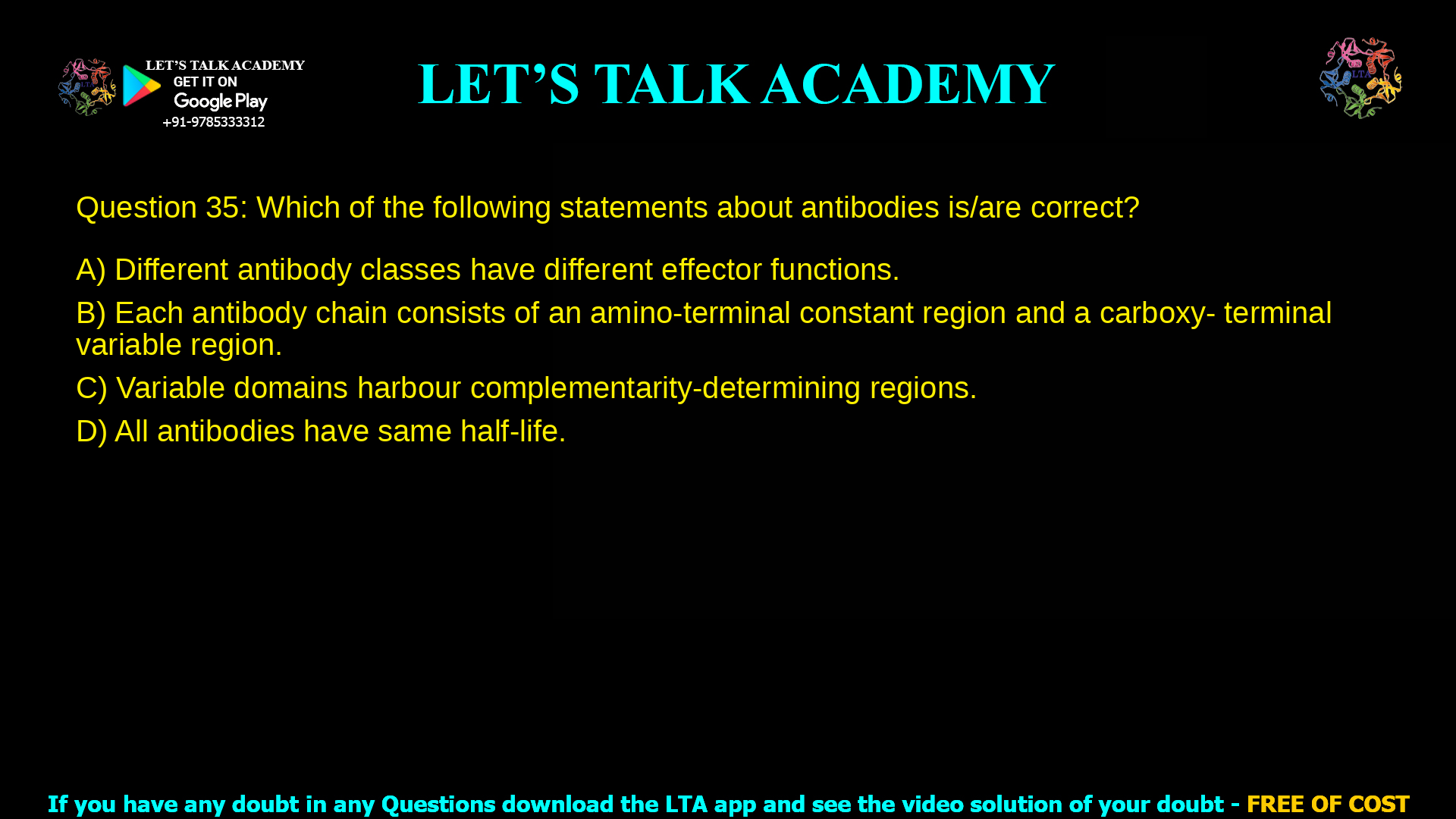
Q.35 Which of the following statements about antibodies is/are correct?
(A) Different antibody classes have different effector functions.
(B) Each antibody chain consists of an amino–terminal constant region and a carboxy–
terminal variable region.
(C) Variable domains harbour complementarity–determining regions.
(D) All antibodies have same half–life.
Correct answer: A and C
Different antibody classes exhibit unique roles in immunity, while variable domains contain key regions for antigen recognition.
Option Analysis
A: Correct
Different antibody classes (IgG, IgM, IgA, IgE, IgD) have distinct effector functions. IgG triggers phagocytosis and complement activation effectively, whereas IgM excels in early complement activation, and IgE mediates allergic responses.
B: Incorrect
Each antibody chain features an amino-terminal (N-terminal) variable region for antigen binding and a carboxy-terminal (C-terminal) constant region for effector functions. The statement reverses this arrangement.
C: Correct
Variable domains in heavy (VH) and light (VL) chains contain complementarity-determining regions (CDRs), hypervariable loops that form the antigen-binding site. Three CDRs per domain ensure specificity.
D: Incorrect
Antibodies do not share the same half-life; IgG lasts 21-25 days, IgM about 5 days, IgA 6 days, IgE 2 days, and IgD 3 days, influenced by FcRn binding and isotype.
Antibodies, essential Y-shaped glycoproteins in adaptive immunity, feature variable regions for antigen specificity and constant regions for diverse effector functions. This CSIR NET-style MCQ tests core concepts in antibody structure and function, crucial for immunology sections in competitive exams. Understanding these statements helps differentiate correct immunological principles from common misconceptions.
Antibody Classes and Effector Functions
Antibody classes, or isotypes, differ in constant regions, leading to specialized roles. IgG subclasses (IgG1-IgG4) vary in Fc receptor binding and complement activation, enabling phagocytosis, cytotoxicity, or subtle responses. IgM forms pentamers for potent early defense, while IgA protects mucosal surfaces.
Antibody Chain Structure
Heavy and light chains each have an N-terminal variable domain (VH or VL, ~110 amino acids) and C-terminal constant domains. Variable regions form the Fab fragment for binding, while constant regions create the Fc fragment for effector activities. The reversed orientation in option B misrepresents this polarity.
Complementarity-Determining Regions (CDRs)
CDRs, three hypervariable loops per variable domain (CDR1-3 in VH and VL), create the paratope that contacts antigens. Their sequence diversity enables recognition of vast epitopes, confirmed by crystallography.
Antibody Half-Life Variations
Half-life depends on isotype and neonatal Fc receptor (FcRn) recycling. IgG1 persists longest (~29 days), IgG3 shorter (~16 days), while IgM and IgE clear rapidly. Therapeutic engineering targets Fc for extended circulation.
| Feature | IgG | IgM | IgA | IgE | IgD |
|---|---|---|---|---|---|
| Half-life (days) | 21-30 | ~5 | ~6 | ~2 | ~3 |
| Main Effector Role | Opsonization, complement | Agglutination | Mucosal immunity | Degranulation | B-cell activation |


1 Comment
Sonal Nagar
January 6, 2026A&C