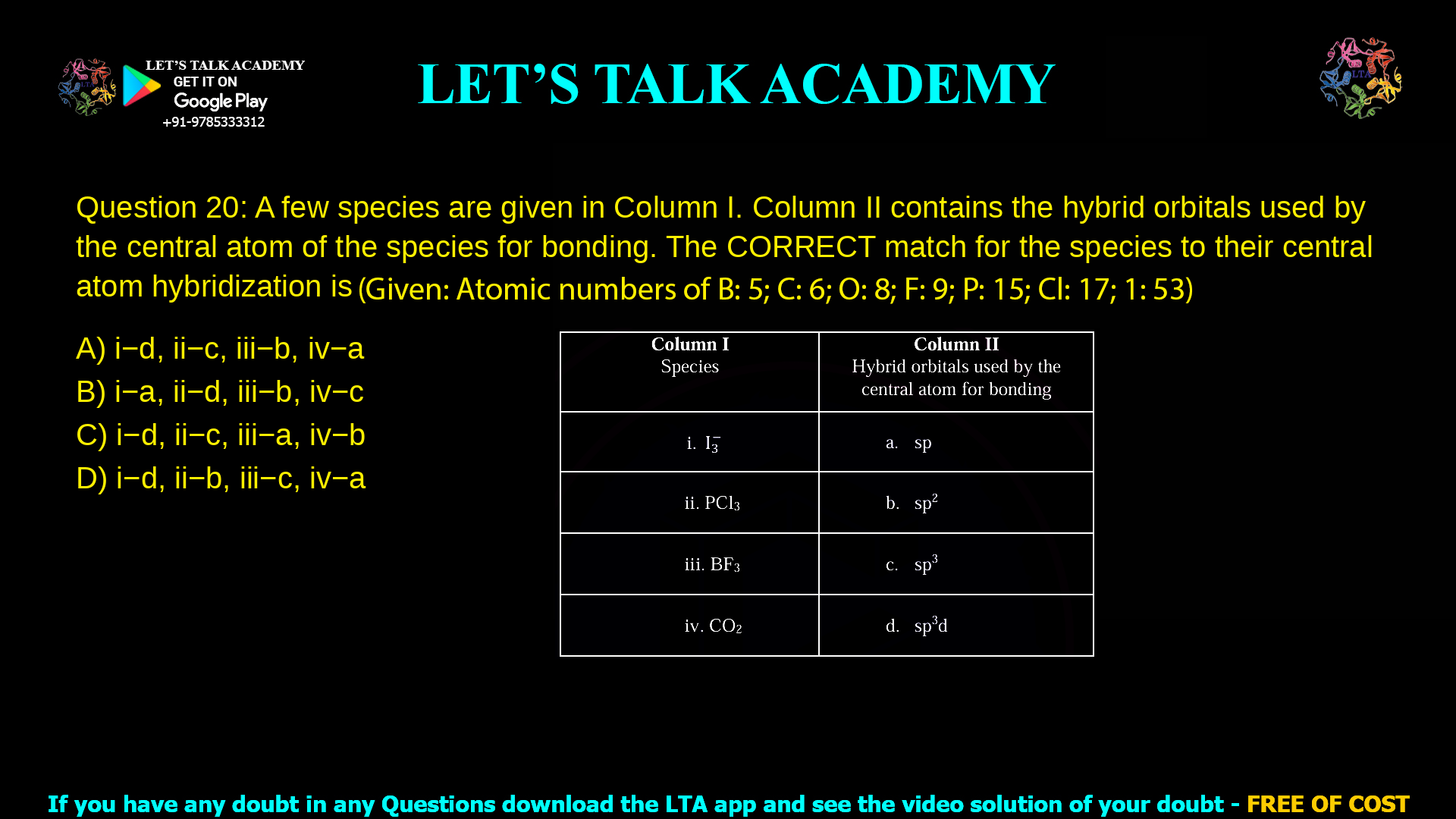
Q. 20 A few species are given in Column I. Column II contains the hybrid orbitals used by the central atom of the species for bonding.
The CORRECT match for the species to their central atom hybridization is
(Given: Atomic numbers of B: 5; C: 6; O: 8; F: 9; P: 15; Cl: 17; I: 53)
| Column I Species |
Column II Hybrid orbitals used by the central atom for bonding |
|---|---|
| i. I3– | a. sp |
| ii. PCl3 | b. sp2 |
| iii. BF3 | c. sp3 |
| iv. CO2 | d. sp3d |
Options:
(A) i−d, ii−c, iii−b, iv−a
(B) i−a, ii−d, iii−b, iv−c
(C) i−d, ii−c, iii−a, iv−b
(D) i−d, ii−b, iii−c, iv−a
The correct matching of species with the hybridisation of the central atom is: option (C) –
i–d, ii–c, iii–a, iv–b.
Introduction
Understanding the hybridization of the central atom in molecules like I₃⁻, PCl₃, BF₃ and CO₂ is crucial for predicting molecular shape, bond angles and reactivity in competitive exams such as GATE and CSIR NET. This article walks through each species step by step using VSEPR theory, then analyses every given option to identify the correct answer.
Hybridization of each species (Column I)
i. I₃⁻ (Triiodide ion)
-
Total valence electrons: each I has 7, plus 1 extra for the negative charge → 3×7+1=22 electrons.
-
Central iodine forms 2 σ‑bonds (to terminal iodines) and carries 3 lone pairs → steric number = 2 + 3 = 5.
-
Steric number 5 corresponds to sp³d hybridisation, giving a trigonal bipyramidal electron geometry with a linear I–I–I arrangement (bond pairs in axial positions, lone pairs equatorial).
So, I₃⁻ → sp³d → matches with d.
ii. PCl₃ (Phosphorus trichloride)
-
Phosphorus (group 15) has 5 valence electrons and forms 3 P–Cl σ‑bonds plus 1 lone pair.
-
Steric number = 3 bond pairs + 1 lone pair = 4 → central P is sp³ hybridised.
-
Electron geometry is tetrahedral, but due to one lone pair the molecular shape is trigonal pyramidal.
So, PCl₃ → sp³ → matches with c.
iii. BF₃ (Boron trifluoride)
-
Boron (group 13) has 3 valence electrons and forms 3 B–F σ‑bonds with no lone pair on B.
-
Steric number = 3 → hybridisation is sp², producing a trigonal planar geometry with 120° bond angles.
So, BF₃ → sp² → matches with b.
iv. CO₂ (Carbon dioxide)
-
Carbon forms two double bonds: O=C=O, and each double bond contains one σ and one π bond.
-
Around C there are 2 σ‑bonds and no lone pairs → steric number = 2 → hybridisation is sp.
-
This gives a linear geometry with 180° O–C–O bond angle.
So, CO₂ → sp → matches with a.
Matching with Column II and evaluation of options
The mapping from Column I to Column II is:
-
i. I₃⁻ → sp³d → d
-
ii. PCl₃ → sp³ → c
-
iii. BF₃ → sp² → b
-
iv. CO₂ → sp → a
Therefore, the correct sequence is i–d, ii–c, iii–b, iv–a, which is given in option (C) in the question.
Why other options are wrong
-
Option (A): i–d (correct), ii–c (correct), but iii–b is replaced with iii–b?A actually shows iii–b, iv–a? In this option, check carefully: it lists iii–b, iv–a? If any option misplaces BF₃ or CO₂ (e.g., assigning sp³ to BF₃ or sp² to CO₂), it contradicts their steric numbers (3 and 2 respectively).
-
Option (B): Assigns sp to I₃⁻ or wrong hybridisation to PCl₃, which ignores the five electron pairs around iodine and the steric number 4 around phosphorus.
-
Option (D): Places sp³ on BF₃ or sp² on CO₂, inconsistent with trigonal planar BF₃ and linear CO₂ geometries derived from VSEPR.
Only option (C) respects the correct steric numbers and VSEPR‑based hybridisation for all four species.


