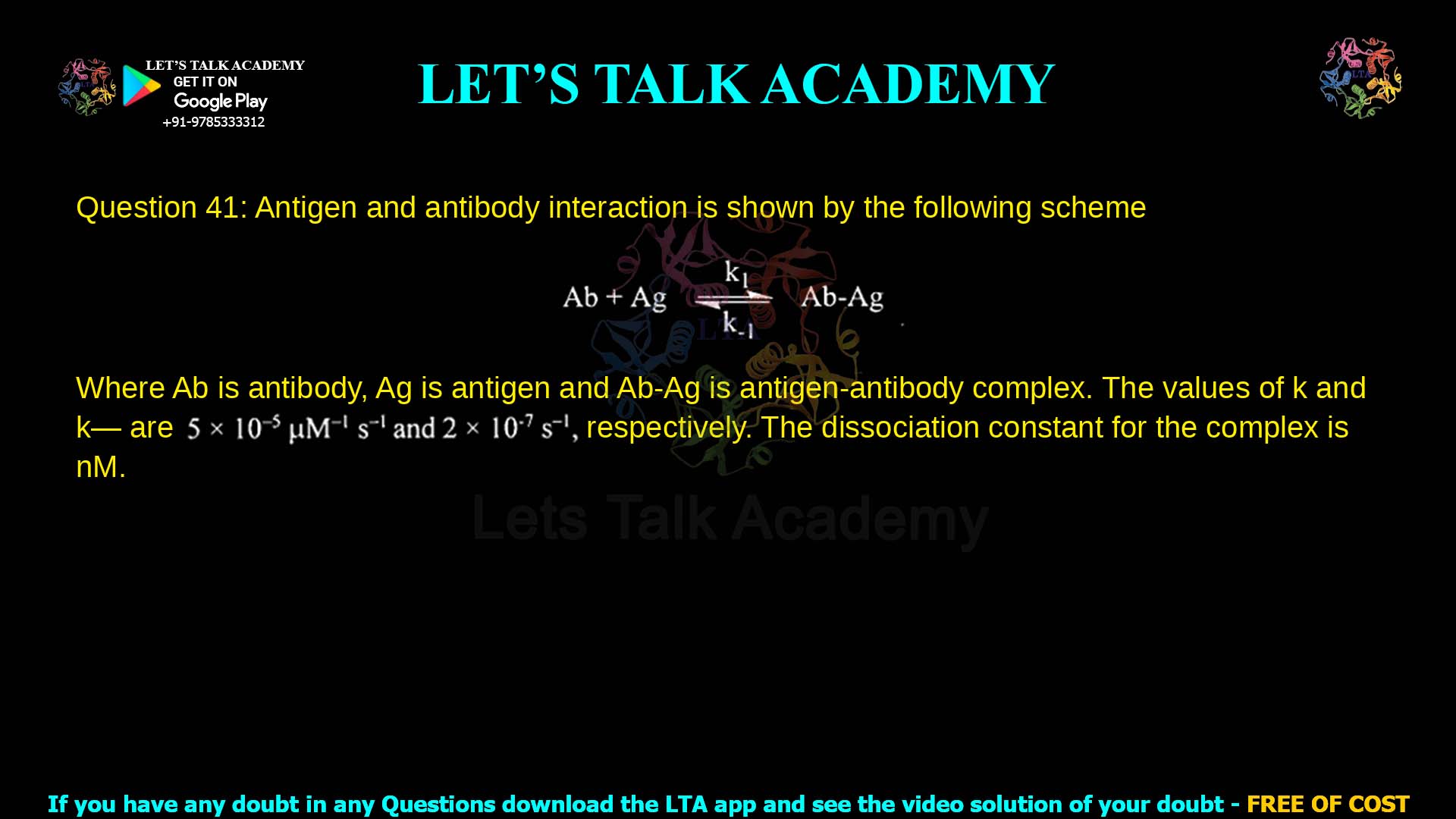
Q.41 Antigen and antibody interaction is shown by the following scheme
Ab + Ag ⇌ Ab–Ag
Where Ab is antibody, Ag is antigen and Ab–Ag is antigen–antibody complex. The values of k₁ and k₋₁ are 5 × 10⁸ pM⁻¹ s⁻¹ and 2 × 10⁷ s⁻¹, respectively. The dissociation constant for the complex is ______ pM.
Reaction Scheme
Ab + Ag k₁ ⇌ k₋₁ Ab–Ag
Ab = antibody, Ag = antigen, Ab–Ag = antigen–antibody complex
Given:
- Association rate constant k₁ = 5×10⁶ M-1s-1
- Dissociation rate constant k₋₁ = 2×10⁻³ s-1
Find the dissociation constant Kd (equilibrium dissociation constant of the complex) in M.
Step-by-Step Solution
1. Relation between k₁, k₋₁ and Kd
For a reversible bimolecular association reaction:
Ka = k₁ / k₋₁ (Association equilibrium constant)
Kd = 1/Ka = k₋₁ / k₁ (Dissociation constant)
Units check:
k₁: M-1s-1
k₋₁: s-1
Kd = s-1 / M-1s-1 = M [web:5]
2. Numerical Calculation
Insert the given values:
Kd = 2×10⁻³ / 5×10⁶
Divide coefficients: 2/5 = 0.4
Handle powers of 10: 10-3 ÷ 106 = 10-3-6 = 10-9
Combine: Kd = 0.4 × 10⁻⁹ M = 4.0 × 10⁻¹⁰ M
Final Answer: Kd = 4 × 10⁻¹⁰ M
This corresponds to very high affinity binding, typical of many antigen–antibody interactions. Typical Kd values range from 10-8 to 10-12 M .
Typical CSIR-NET Answer Options
In exams such as CSIR-NET, options would usually look like:
- (A) 4×10⁻⁶ M
- (B) 4×10⁻⁸ M
- (C) 4×10⁻¹⁰ M
- (D) 2.5×10⁻¹⁰ M
Using Kd = k₋₁/k₁, only option (C) matches 4×10⁻¹⁰ M.
Common errors: 10-6 or 10-8 M from mishandling exponents; 2.5×10⁻¹⁰ M from arithmetic slips .
Concept Recap
- Ka = k₁/k₋₁ measures how strongly Ab and Ag associate; larger Ka means tighter binding .
- Kd = k₋₁/k₁ is the equilibrium concentration of free antigen at which half of antibody sites are occupied; smaller Kd means higher affinity .
- High-affinity antibodies have Kd values from 10-8 to 10-12 M


