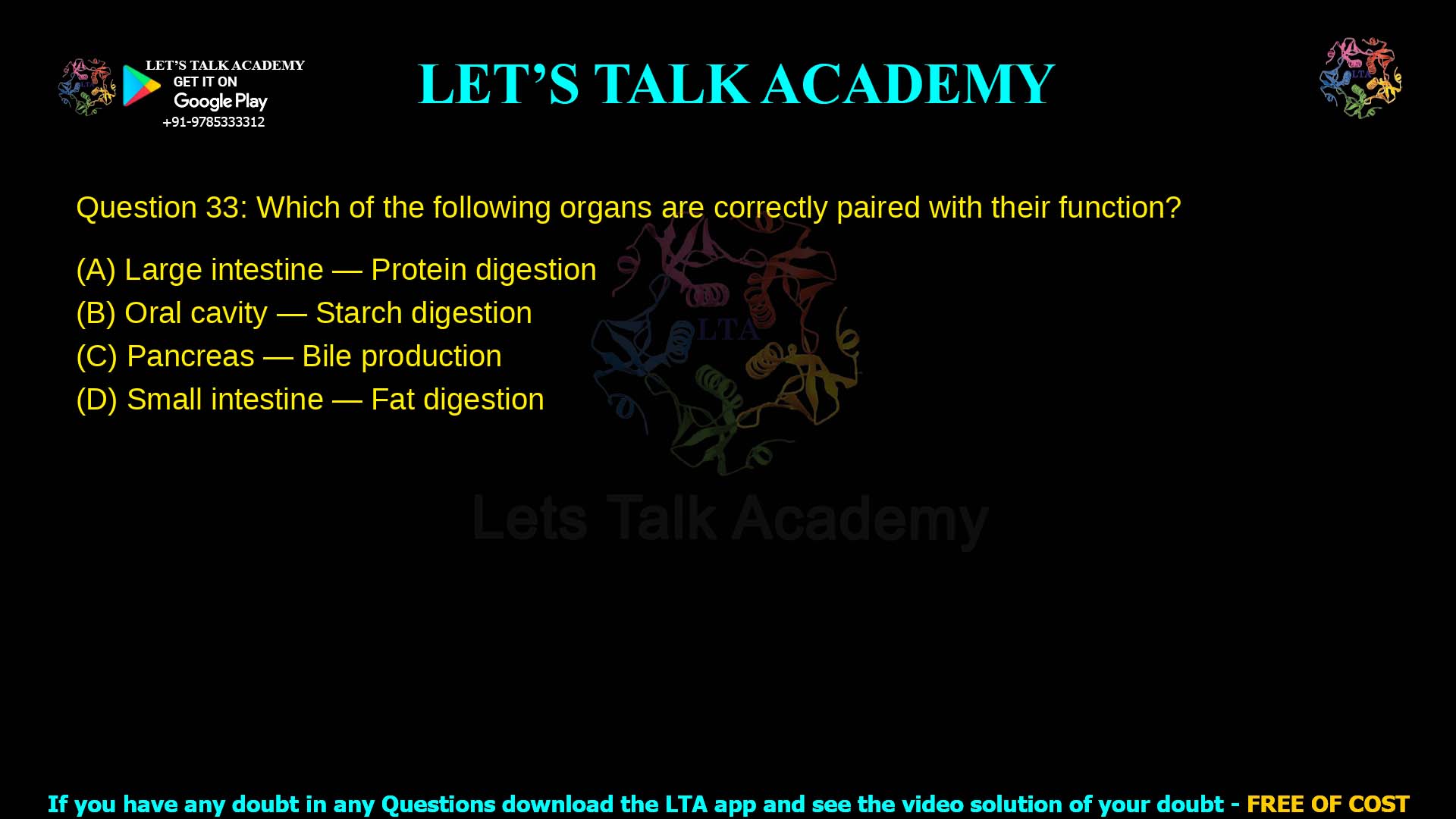
Q.33 Which of the following organs are correctly paired with their function?
(A) Large intestine — Protein digestion
(B) Oral cavity — Starch digestion
(C) Pancreas — Bile production
(D) Small intestine — Fat digestion
Oral cavity initiates starch digestion via salivary amylase. The correct pairing is option (B), as verified by digestive physiology. Other options misalign organ functions with specific digestion processes.
Option Analysis
-
(A) Large intestine — Protein digestion: Incorrect. The large intestine absorbs water, electrolytes, and forms feces from indigestible material after small intestine nutrient absorption. Protein digestion occurs mainly in the stomach and small intestine.
-
(B) Oral cavity — Starch digestion: Correct. Salivary amylase (ptyalin) in the oral cavity breaks down starch into maltose and dextrins during chewing, starting carbohydrate digestion.
-
(C) Pancreas — Bile production: Incorrect. The pancreas secretes digestive enzymes like amylase, lipase, and proteases into the small intestine. Bile, aiding fat emulsification, is produced by the liver and stored in the gallbladder.
-
(D) Small intestine — Fat digestion: Partially true but incomplete for exclusive pairing. Fat digestion completes here via pancreatic lipase and bile, but it begins in the mouth/stomach and relies on accessory organs. The question seeks the most direct match.
Starch digestion begins in the oral cavity, a key fact for CSIR NET life sciences aspirants studying digestive system organs paired with functions. This article breaks down pairings like large intestine protein digestion myths, pancreas bile production errors, and small intestine fat digestion processes for exam success.
Digestive System Overview
The human digestive tract processes carbohydrates, proteins, and fats across specialized organs. Oral cavity handles initial starch breakdown via amylase, while small intestine completes most enzymatic digestion with pancreatic aid. Large intestine focuses on water reabsorption, not active digestion.
Correct Pairing: Oral Cavity and Starch Digestion
Salivary glands secrete amylase in the oral cavity, hydrolyzing starch (amylose/amylopectin) into maltose during mastication. This pH-optimal process (6.7-7.0) halts in acidic stomach but sets up small intestine continuation. Essential for CSIR NET questions on enzyme sites.
Incorrect Pairings Explained
-
Large Intestine: Absorbs water/electrolytes and hosts bacteria for vitamin production; no protein digestion role.
-
Pancreas: Exocrine function releases lipase (fats), amylase (carbs), proteases (proteins); liver produces bile.
-
Small Intestine: Site for fat emulsification/absorption via bile and lipase, plus carb/protein completion—not exclusive to fats.
| Organ | Primary Function | Digestion Role | Correct for Query? |
|---|---|---|---|
| Large Intestine | Water absorption, feces formation | Minimal (bacterial fermentation) | No |
| Oral Cavity | Starch initiation via amylase | Carbohydrates | Yes |
| Pancreas | Enzyme secretion (lipase, amylase) | Aids all nutrients | No (bile) |
| Small Intestine | Nutrient absorption | Fats, carbs, proteins | Partial |
Master these for competitive exams like CSIR NET.


