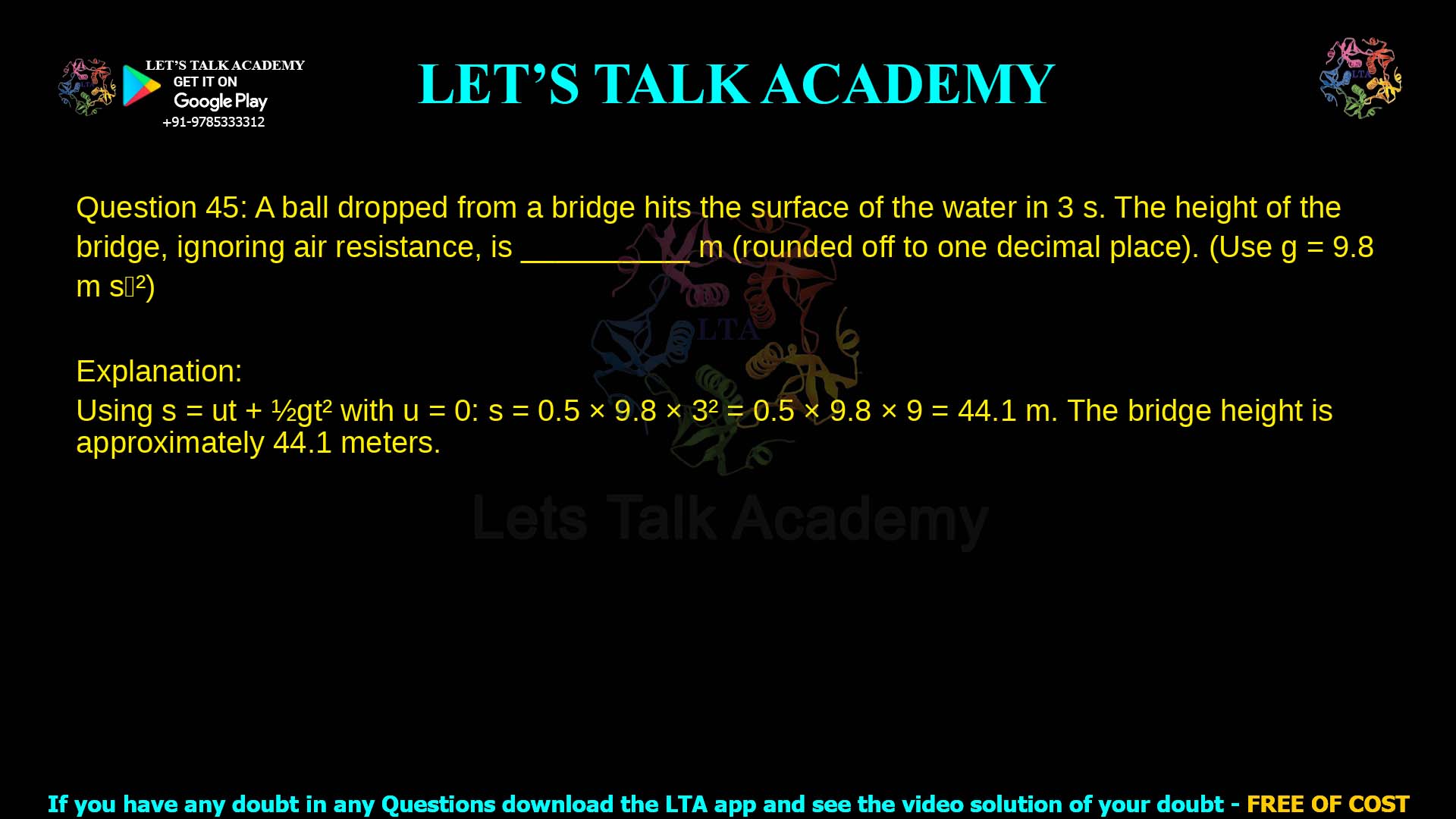
Q.45 A ball dropped from a bridge hits the surface of the water in 3 𝑠. The height of
the bridge, ignoring air resistance, is __________ 𝑚 (rounded off to one
decimal place).
(Use 𝑔 = 9.8 𝑚𝑠−2)
Understanding Free Fall Motion
Free fall occurs when an object moves solely under gravity’s influence, experiencing constant downward acceleration of 9.8 m/s² (neglecting air resistance). When a ball dropped from a bridge hits water in exactly 3 seconds, kinematic equations reveal the bridge height precisely .
The core equation for free fall from rest is \( h = \frac{1}{2} g t^2 \), where initial velocity u = 0, making calculations straightforward for CSIR NET physics problems .
Problem Data Analysis
- Time: \( t = 3 \) s
- Gravity: \( g = 9.8 \) m/s²
- Initial velocity: \( u = 0 \) m/s (dropped, not thrown)
- Find: Bridge height \( h \) (to 1 decimal place)
Key insight: “Dropped” means zero initial velocity, eliminating the ut term from kinematic equations .
Step-by-Step Calculation
- \( t^2 = 9 \) s²
- \( h = 4.9 \times 9 = 44.1 \) m
Why Other Answers Fail
29.4 m: Forgot ½ factor (\( h = g t^2 \) error)
88.2 m: Doubled correct answer (used \( h = g t^2 \))
22.05 m: Divided by 2 twice
49.0 m: Used \( g = 10 \) m/s² approximation
Only 44.1 m correctly applies \( \frac{1}{2} g t^2 \) with precise values .
Verification Methods
Check final velocity: \( v = g t = 9.8 \times 3 = 29.4 \) m/s
Using third equation: \( v^2 = 2 g h = 2 \times 9.8 \times 44.1 = 864.36 \), so \( v = \sqrt{864.36} = 29.4 \) m/s ✓
Reverse check: \( t = \sqrt{\frac{2h}{g}} = \sqrt{\frac{88.2}{9.8}} = 3 \) s ✓ .
Common Exam Mistakes
- Mistake 1: Ignoring ½ coefficient → double answer
- Mistake 2: Using \( g = 10 \) instead of 9.8 m/s²
- Mistake 3: Assuming thrown (u ≠ 0)
- Mistake 4: Wrong precision (not 1 decimal place)
CSIR NET tip: Always match given g value and verify with multiple equations .
Real-World Applications
- Bridge safety analysis (fall hazards)
- Infrastructure design calculations
- Physics lab dropped-object experiments


