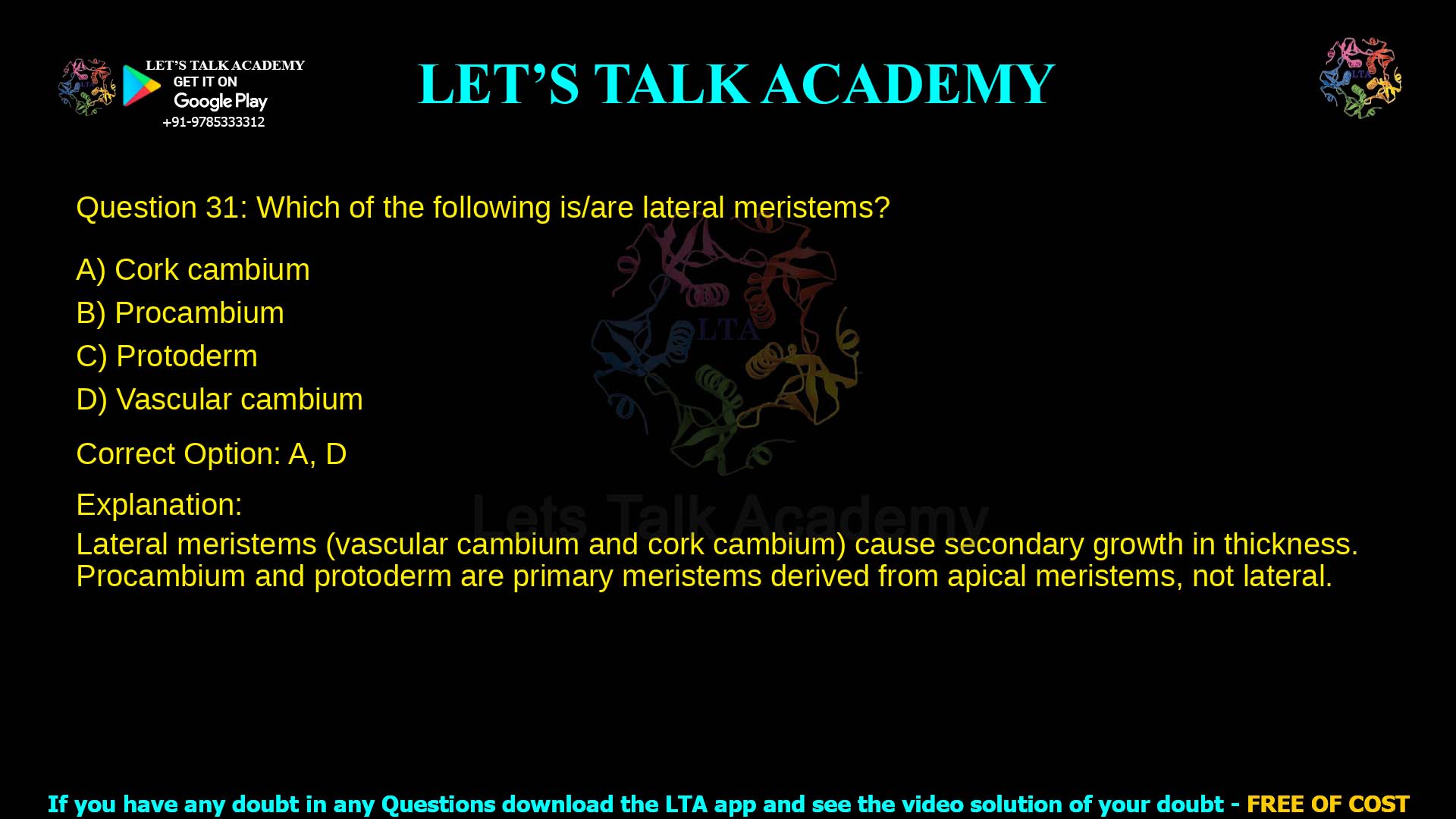
Q.31 Which of the following is/are lateral meristems?
(A) Cork cambium
(B) Procambium
(C) Protoderm
(D) Vascular cambium
Cork cambium and vascular cambium are lateral meristems responsible for secondary growth in plants, increasing girth in stems and roots. Procambium and protoderm are primary meristems involved in initial lengthwise growth. The correct answer for Q.31 is (A) and (D).
Option Analysis
-
(A) Cork cambium: This secondary meristem, also called phellogen, forms the periderm including cork (phellem) outward and phelloderm inward, providing protection during secondary growth.
-
(B) Procambium: A primary meristem from apical regions that differentiates into primary xylem and phloem for lengthwise primary growth, not lateral thickening.
-
(C) Protoderm: The outermost primary meristem that develops into the epidermis, including stomata and hairs, for surface protection in primary growth.
-
(D) Vascular cambium: This lateral meristem produces secondary xylem inward and secondary phloem outward, enabling girth increase in woody plants.
Lateral meristems drive secondary growth in plants, boosting stem and root thickness for structural support in dicots and gymnosperms. These tissues, including cork cambium and vascular cambium, form cylindrical layers unlike primary meristems focused on length.
Types of Meristems
Meristems divide into apical (length growth), intercalary (internode elongation), and lateral (girth increase). Lateral meristems arise later as secondary tissues from permanent cells.
-
Primary meristems: Protoderm (epidermis), procambium (vascular), ground meristem (cortex/pith).
-
Secondary/lateral: Vascular cambium, cork cambium.
Functions in Growth
Vascular cambium divides periclinally between xylem and phloem, adding annual rings visible in tree trunks. Cork cambium replaces epidermis with bark for wound healing and water impermeability.
| Meristem Type | Location | Growth Type | Key Products |
|---|---|---|---|
| Cork Cambium | Cortex/pericycle | Secondary (lateral) | Cork, phelloderm |
| Vascular Cambium | Between xylem/phloem | Secondary (lateral) | Secondary xylem, phloem |
| Procambium | Apical strands | Primary (length) | Primary vascular tissues |
| Protoderm | Outermost apical | Primary (length) | Epidermis |
This table highlights differences for CSIR NET preparation on plant anatomy. Monocots lack robust lateral meristems, limiting woodiness.


