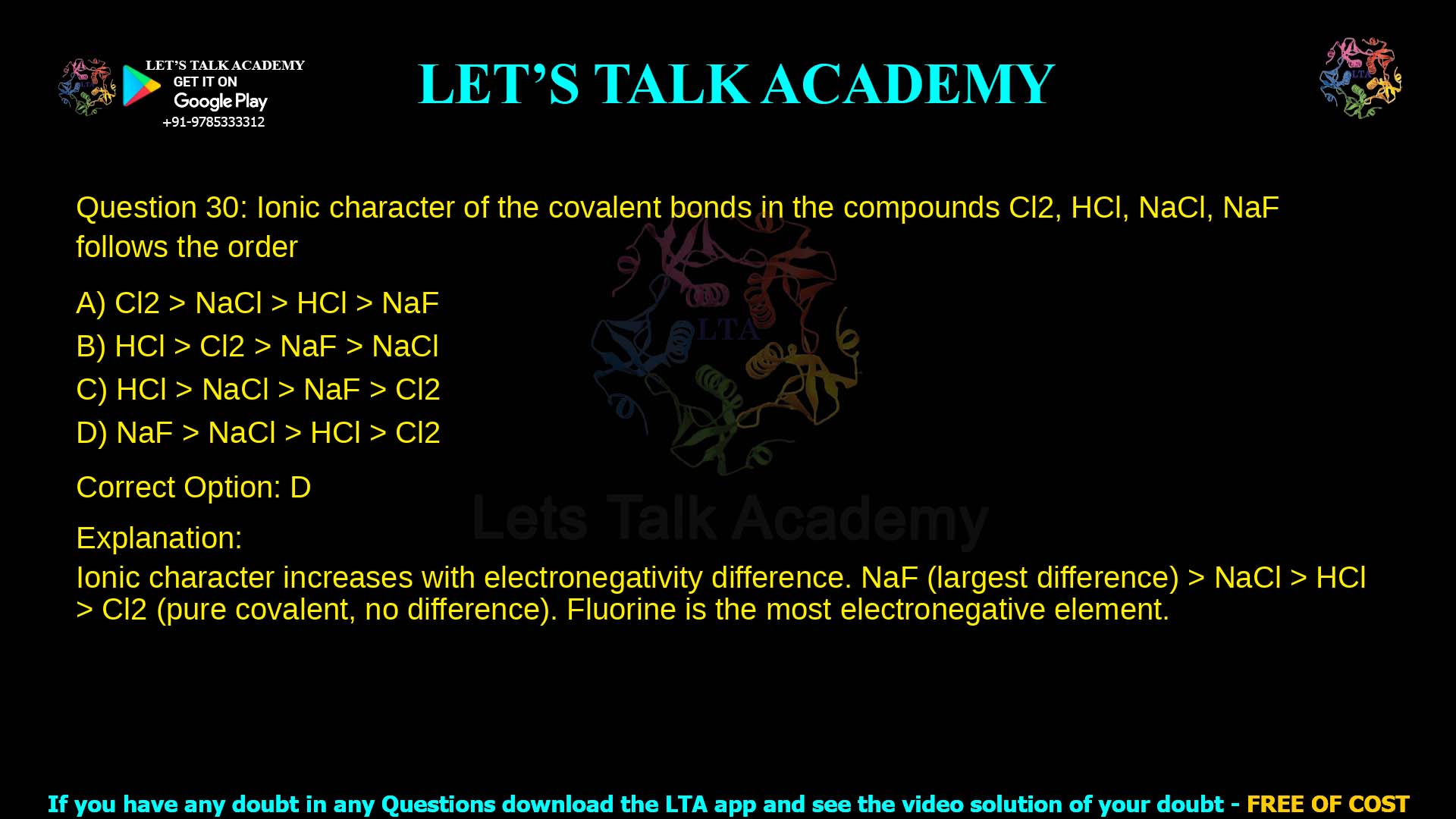
Q.30 Ionic character of the covalent bonds in the compounds Cl2, HCl, NaCl, NaF
follows the order
(A) Cl2 > NaCl > HCl > NaF
(B) HCl > Cl2 > NaF > NaCl
(C) HCl > NaCl > NaF > Cl2
(D) NaF > NaCl > HCl > Cl2
The correct answer is (D) NaF > NaCl > HCl > Cl₂.
Ionic character in bonds increases with greater electronegativity difference between atoms or reduced covalent character per Fajans’ rules.
Electronegativity Differences
Pauling electronegativity values are Na (0.9), H (2.1), Cl (3.0), F (4.0).
Differences: NaF (3.1), NaCl (2.1), HCl (0.9), Cl₂ (0).
Greater difference means higher ionic character, so NaF > NaCl > HCl > Cl₂.
Option Analysis
-
(A) Cl₂ > NaCl > HCl > NaF: Wrong; Cl₂ is purely covalent (0 difference).
-
(B) HCl > Cl₂ > NaF > NaCl: Wrong; ignores Na-F’s largest difference.
-
(C) HCl > NaCl > NaF > Cl₂: Wrong; NaF exceeds NaCl due to F’s higher electronegativity.
-
(D) NaF > NaCl > HCl > Cl₂: Correct; matches electronegativity trend and Fajans’ polarization (smaller F⁻ less polarizable than Cl⁻).
Fajans’ Rules Application
Fajans’ rules state small, high-charge cations polarize large anions, adding covalent character to ionic bonds.
Na⁺ (small cation) polarizes F⁻ (small anion) least, maximizing ionic character in NaF over NaCl.
HCl shows partial ionic character (~18%), Cl₂ none.
Ionic character of the covalent bonds in Cl2, HCl, NaCl, NaF follows a specific order critical for CSIR NET Life Sciences and JEE Chemistry preparation. Understanding this through electronegativity and Fajans’ rules clarifies bond polarity.
Core Concept
Bonds range from covalent (equal sharing) to ionic (electron transfer), with ionic character proportional to electronegativity difference (ΔEN).
ΔEN >1.7 typically ionic; 0.5-1.7 polar covalent; <0.5 nonpolar covalent.
Here, all bonds have some covalent nature, but ionic character varies.
Keyphrase Data Table
| Compound | Electronegativity Values | ΔEN | % Ionic Character (Approx.) | Bond Type |
|---|---|---|---|---|
| NaF | Na 0.9, F 4.0 | 3.1 | ~90% | Mostly ionic |
| NaCl | Na 0.9, Cl 3.0 | 2.1 | ~60-70% | Ionic with covalent |
| HCl | H 2.1, Cl 3.0 | 0.9 | ~18% | Polar covalent |
| Cl₂ | Cl 3.0, Cl 3.0 | 0.0 | 0% | Pure covalent |
Order: NaF > NaCl > HCl > Cl₂.
CSIR NET Exam Tips
-
Prioritize ΔEN for quick ranking; confirm with Fajans for borderline cases.
-
NaX series: Ionic character decreases NaF > NaCl > NaBr > NaI (anion size rises, polarization increases covalent nature).
-
Practice: HCl dipole moment implies 17-18% ionic character.
This resolves Q.30 precisely for exam success.


