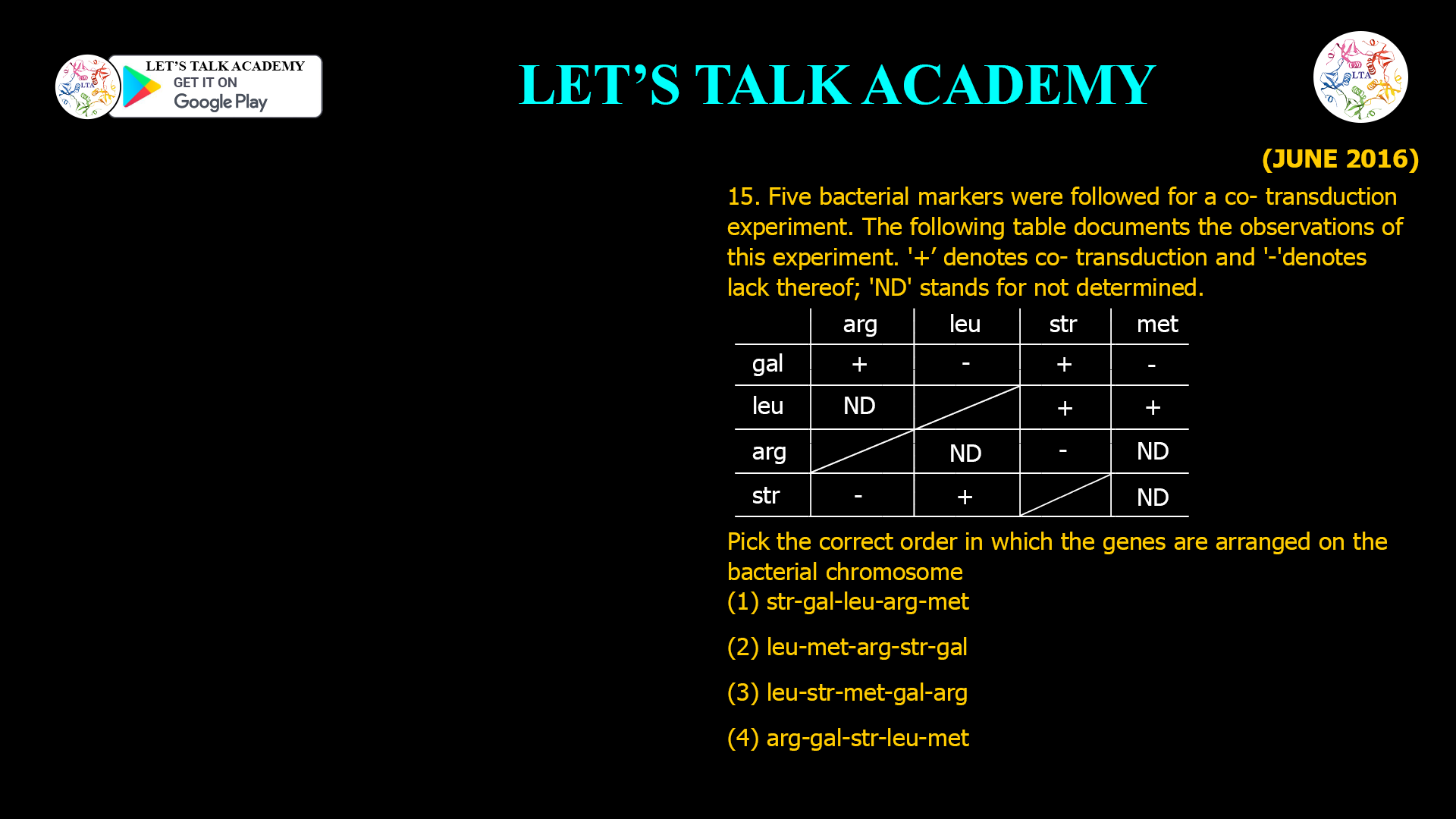
15. Five bacterial markers were followed for a co- transduction experiment. The following table documents the observations of this experiment. ‘+’ denotes co- transduction and ‘-‘ denotes lack thereof; ‘ND’ stands for not determined.
Pick the correct order in which the genes are arranged on the bacterial chromosome
(1) str-gal-leu-arg-met
(2) leu-met-arg-str-gal
(3) leu-str-met-gal-arg
(4) arg-gal-str-leu-met
The correct order of genes on the bacterial chromosome is arg – gal – str – leu – met.
Introduction
Co‑transduction mapping uses the fact that bacterial genes that lie close together on the chromosome are often transferred together in a single phage‑mediated transducing fragment, whereas widely separated genes show little or no co‑transduction. By analysing which pairs of markers show co‑transduction, the linear order of genes such as gal, leu, arg, str and met can be deduced, as tested in this classic CSIR NET Life Sciences problem.
Understanding the co‑transduction table
From the given table (gal, leu, arg, str, met), “+” means the two markers are co‑transduced (close), “−” means they are not co‑transduced (far apart), and “ND” is not determined.
Key observations from the table as described in standard solutions:
-
gal co‑transduces with arg and str, but not with leu or met.
-
arg co‑transduces with gal only (not with str or met; leu–arg is ND).
-
str co‑transduces with gal and leu, but not with arg; leu–str is “+”.
-
**leu co‑transduces with str and met, but not with gal; leu–met is “+”.
-
met co‑transduces with leu only (not with gal or arg; str–met is ND).
From these patterns:
-
gal must lie between arg and str, because it co‑transduces with both, while arg and str themselves do not co‑transduce.
-
leu must lie between str and met, because leu co‑transduces with both, while gal–met and (likely) str–met do not co‑transduce.
-
Combining these constraints gives a single consistent linear arrangement: arg – gal – str – leu – met.
Checking each option
The options given are:
-
str – gal – leu – arg – met
-
leu – met – arg – str – gal
-
leu – str – met – gal – arg
-
arg – gal – str – leu – met
Option (1): str – gal – leu – arg – met
In this order, gal lies between str and leu, so gal should co‑transduce with both str and leu. However, the table shows gal–leu is “−”, indicating they are not close enough to co‑transduce. Also, arg is far from gal (separated by leu) and far from str, yet arg–gal is “+”, which this order cannot explain. Therefore, option (1) is incorrect.
Option (2): leu – met – arg – str – gal
Here, met lies between leu and arg, so leu–met and met–arg should both show co‑transduction, but the data show leu–met is “+” while met–arg is “−”. Moreover, arg and gal are far apart (separated by met and str), so arg–gal should be “−”, yet the table shows arg–gal is “+”. Hence, option (2) is inconsistent with the observed co‑transduction and is wrong.
Option (3): leu – str – met – gal – arg
In this arrangement, str lies between leu and met, so both leu–str and str–met should show co‑transduction, but str–met is given as not determined or effectively not co‑transducing in solutions, while leu–met is “+” instead. In addition, gal lies between met and arg, which implies gal–met and gal–arg should both be “+”, but gal–met is “−” whereas gal–arg is “+”. Therefore, option (3) is also incorrect.
Option (4): arg – gal – str – leu – met
With this linear order:
-
gal lies between arg and str, so arg–gal and gal–str should be co‑transduced (+), while arg–str can be “−” because the distance arg–str is larger than either arg–gal or gal–str.
-
leu lies between str and met, so str–leu and leu–met should be “+”, while distant pairs like gal–met and arg–met remain “−”.
These predictions match the co‑transduction table exactly, and multiple solution references confirm this gene order. Thus, option (4) is the correct answer.
Why co‑transduction reflects gene distance
-
Generalized transducing phages package a limited length of bacterial DNA, so only genes within that physical span can be carried together in one transducing particle.
-
Therefore, higher co‑transduction frequency means smaller physical distance, and pairs that never co‑transduce must lie farther apart than the phage’s packaging capacity.
-
By finding markers that co‑transduce with two different neighbors (such as gal with arg and str, or leu with str and met), the marker in common is placed between its two partners, enabling construction of a linear gene map as in this question.


1 Comment
Juber Khan
February 21, 2026option (4) is Right