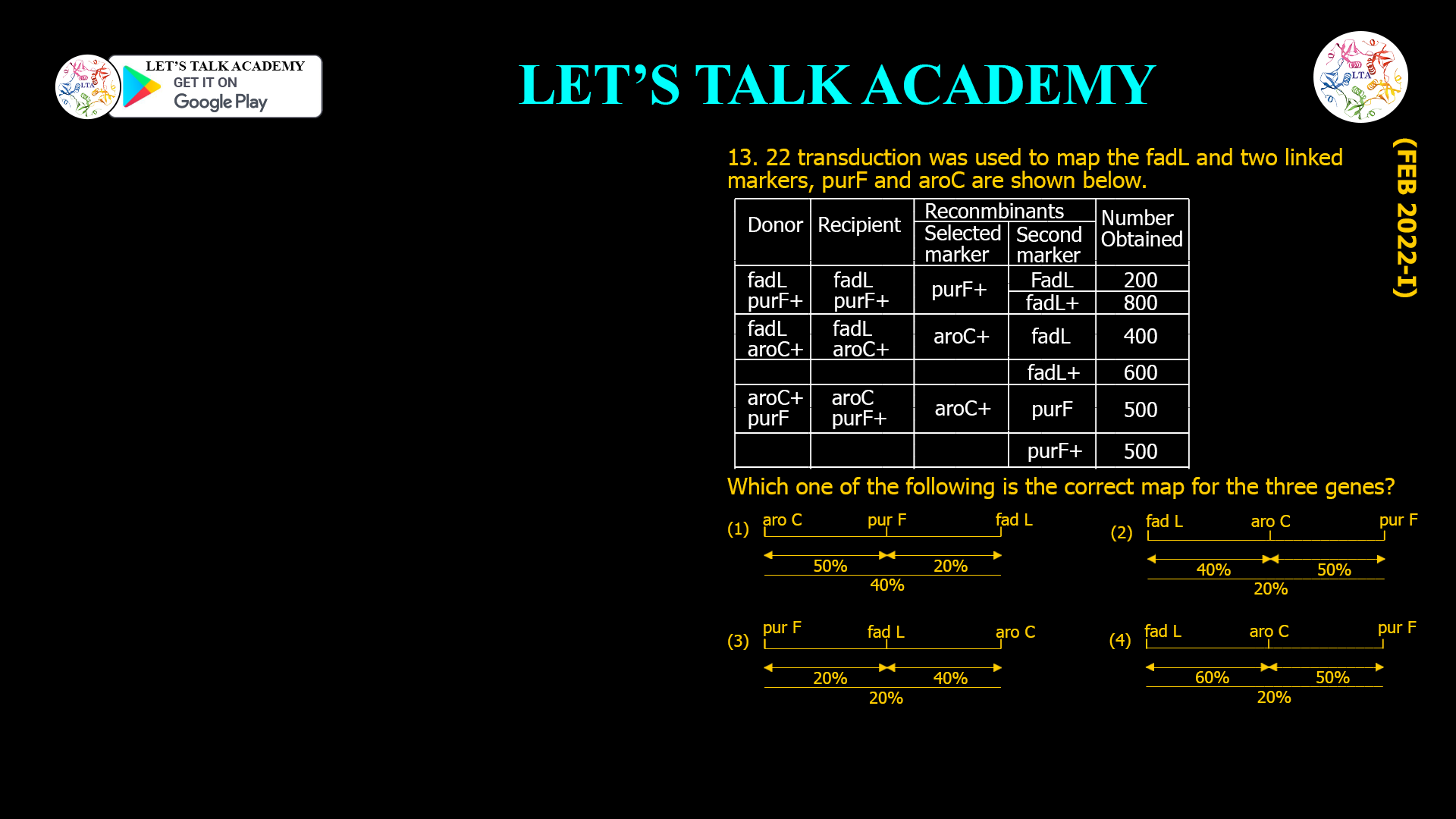
- 22 TRANSDUCTION WAS USED TO MAP THE fadL and two linked markers, purF and aroC are shown below.
Which one of the following is the correct map for the three genes?
The correct map of the three genes is: fadL – aroC – purF, corresponding to Option (2).
Introduction
This CSIR NET–style bacterial genetics question uses P1 transduction to map the chromosomal positions of fadL and two linked markers, purF and aroC. The solution depends on understanding how cotransduction frequency reflects gene distance and then using the given recombinant classes to deduce the most likely linear gene order. Such problems are common in microbial genetics and are essential for mastering linkage and mapping concepts for competitive exams.
Step 1: Extract cotransduction frequencies
From the table in the question (total recombinants in each cross = 1000):
-
fadL – purF cross
-
Cotransductants (purF⁺ fadL or fadL⁺ purF) = 200
-
Cotransduction frequency = 200/1000=0.2=20%.
-
-
fadL – aroC cross
-
Cotransductants = 400
-
Cotransduction frequency = 400/1000=0.4=40%.
-
-
aroC – purF cross
-
Cotransductants = 500
-
Cotransduction frequency = 500/1000=0.5=50%.
-
Higher cotransduction frequency means shorter distance between genes, because closely linked genes are more often carried together on the same P1 DNA fragment.
So the relative distances are:
-
Closest pair: aroC–purF (50%)
-
Intermediate: fadL–aroC (40%)
-
Farthest: fadL–purF (20%).
Step 2: Infer gene order from frequencies
For three linked genes A, B, C lying within one transducing fragment:
-
The most closely linked pair must be adjacent.
-
The least linked pair must be the outermost genes, because a larger distance between them reduces cotransduction.
Applying this logic:
-
aroC–purF is the closest pair → aroC and purF must be neighbors.
-
fadL–purF is the least linked pair → fadL and purF must be at the two ends of the three-gene block.
Therefore fadL must lie on one side of aroC, and purF on the other side, giving:
fadL − aroC − purF
This matches Option (2) in the figure.
Option-by-option explanation
Option (1): aroC – purF – fadL
This order places aroC–purF adjacent, consistent with their high cotransduction of 50%. However, in this arrangement fadL is adjacent only to purF, so the more distant pair should be fadL–aroC, not fadL–purF. The observed data show fadL–purF has the lowest cotransduction (20%), meaning they are farthest apart, which contradicts this map. Hence Option (1) is incorrect.
Option (2): fadL – aroC – purF ✅
In this arrangement:
-
Adjacent pairs: fadL–aroC and aroC–purF.
-
Outer pair: fadL–purF.
This fits the frequency pattern perfectly:
-
aroC–purF (neighbors) → highest cotransduction (50%).
-
fadL–aroC (neighbors but slightly further apart) → intermediate cotransduction (40%).
-
fadL–purF (outermost) → lowest cotransduction (20%).
Therefore Option (2) is the correct gene map.
Option (3): purF – fadL – aroC
Here, purF–fadL and fadL–aroC are adjacent; purF–aroC is the outer pair. If this were true, purF–aroC should show the lowest cotransduction frequency, yet the data show purF–aroC has the highest cotransduction (50%). This contradicts the requirement that the outermost pair have the least cotransduction, so Option (3) is wrong.
Option (4): fadL – aroC – purF (with wrong percentages)
Some versions of this question display Option (4) with the same linear order but with distances labelled so that fadL–aroC appears longer than fadL–purF, or that aroC–purF is not the closest pair. Those labels disagree with the measured cotransduction frequencies where aroC–purF (50%) is closest and fadL–purF (20%) farthest, so even if the order looks right, the indicated distances make this option incorrect.
Key exam takeaways
-
Rule 1: Higher cotransduction frequency → shorter gene distance, provided all genes lie within a single P1 fragment (~2% of the E. coli chromosome).
-
Rule 2: In three-gene transduction mapping:
-
Highest cotransduction pair = adjacent and closest.
-
Lowest cotransduction pair = outermost genes.
-
-
Applying these rules to the fadL, aroC and purF data gives the gene order fadL – aroC – purF, which corresponds to Option (2).


