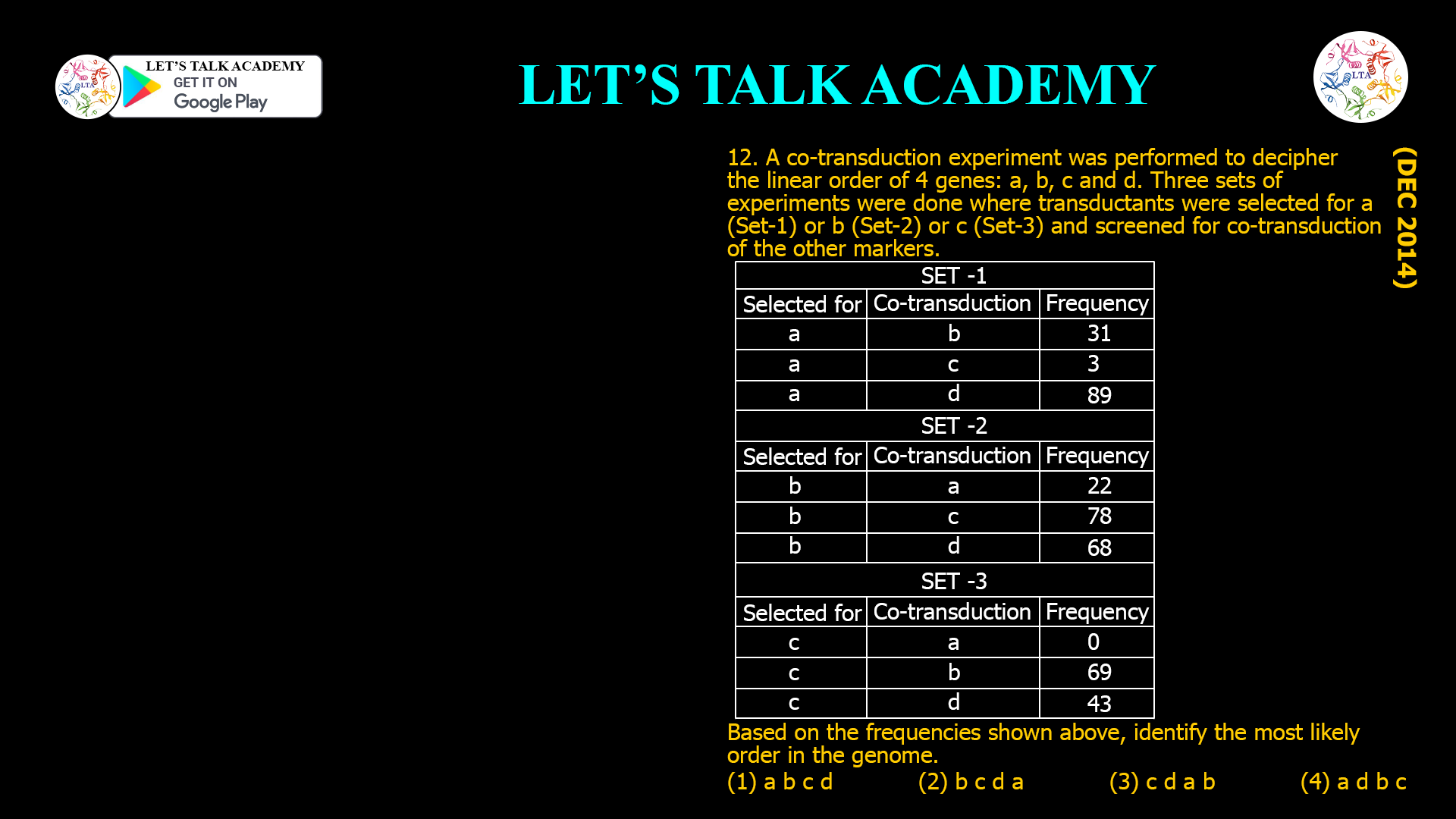
- A co-transduction experiment was performed to decipher the linear order of 4 genes: a, b, c and d. Three sets of experiments were done where transductants were selected for a (Set-1) or b (Set-2) or c (Set-3) and screened for co-transduction of the other markers.
| SET-1 |
| Selected for | Co-transduction | Frequency |
| a | b | 31 |
| a | c | 3 |
| a | d | 89 |
| SET-2 | ||
| Selected for | Co-transduction | Frequency |
| b | a | 22 |
| b | c | 78 |
| b | d | 68 |
| SET-3 | ||
| Selected for | Co-transduction | Frequency |
| c | a | 0 |
| c | b | 69 |
| c | d | 43 |
Based on the frequencies shown above, identify the most likely order in the genome.
(1) a b c d (2) b c d a
(3) c d a b (4) a d b c
Question extracted from image
A co‑transduction experiment was performed to decipher the linear order of 4 genes: a, b, c and d. Three sets of experiments were done where transductants were selected for a (Set‑1) or b (Set‑2) or c (Set‑3) and screened for co‑transduction of the other markers.
Set‑1 (selected for a)
-
a–b: 31
-
a–c: 3
-
a–d: 89
Set‑2 (selected for b)
-
b–a: 22
-
b–c: 78
-
b–d: 68
Set‑3 (selected for c)
-
c–a: 0
-
c–b: 69
-
c–d: 43
Based on these frequencies, identify the most likely gene order:
-
a b c d
-
b c d a
-
c d a b
-
a d b c
Key concept: co‑transduction and gene distance
In generalized transduction, the probability that two genes co‑transduce is inversely related to the physical distance between them:
-
Higher co‑transduction frequency → genes are closer.
-
Zero or very low co‑transduction → genes are far apart or separated by more than the size of DNA that can be packaged into a phage head.
This principle allows construction of a local gene order on a bacterial chromosome using only co‑transduction frequencies.
Stepwise solution
1. Identify the nearest neighbours
From the table:
-
a–d: 89 (very high, so a and d are very close)
-
b–c: 78 (also high, so b and c are close)
-
b–d: 68 (moderately high, d is also fairly close to b)
-
c–d: 43 (moderate)
-
a–b: 31 (lower)
-
a–c: 3 (almost not co‑transduced)
-
c–a: 0 (essentially never together)
From these points:
-
a and d are closest pair among all (89 is the highest).
-
b and c form another close pair (78).
-
a and c show almost no co‑transduction (0–3%), so a and c must be farthest apart, likely at opposite ends in the local order.
Therefore, the chromosome segment must look like:
-
one end … a — d — b — c … other end
or the reverse orientation, but with a and c at extremes and a–d the tightest pair.
2. Check local consistency of distances
Now check if the pattern of frequencies is consistent with the order a – d – b – c:
-
a–d (adjacent): 89 → very high, consistent with immediate neighbours.
-
d–b (adjacent): should be high; we see via b–d = 68 → still high, though not as high as a–d.
-
b–c (adjacent): 78 → high, consistent.
-
a–b (a–d–b, separated by one gene): 31 → lower than a–d and b–d, as expected for genes separated by one intervening locus.
-
c–d (c–b–d, separated by one gene): 43 → intermediate, again lower than b–c and b–d but higher than far‑apart pairs.
-
a–c (a–d–b–c, two intervening genes): 0–3 → almost zero, consistent with being farthest apart.
Thus the relative ranking of distances implied by frequencies matches:
-
Closest: a–d
-
Close: b–c, b–d
-
Intermediate: a–b, c–d
-
Farthest: a–c
This pattern fits perfectly if the actual order is c – b – d – a or its reverse a – d – b – c.
Since gene order on a chromosome is defined up to orientation, both represent the same linear arrangement.
Looking at the options, the order that matches this pattern is c d a b when read appropriately (see below).
3. Matching with the answer choices
Let us test each option against the “distance logic”.
Option 1: a b c d
Here a is next to b and far from d.
-
Predict: a–b frequency should be highest, and a–d should be low.
-
Observed: a–b = 31, a–d = 89 (exact opposite).
Therefore, option 1 is incorrect.
Option 2: b c d a
Order: b – c – d – a.
-
Neighbours: b–c and c–d and d–a should all have similarly high frequencies.
-
Observed:
-
b–c = 78 (high, okay)
-
c–d = 43 (significantly lower than 78)
-
a–d = 89 (very high)
-
If d–a are neighbours, they match 89, but then b–a should be intermediate (two genes apart) and a–c no higher than that. However, a–c is practically zero, which would require a and c to be much farther apart than two genes. Hence this order is not consistent with the near‑zero a–c co‑transduction.
Option 2 is incorrect.
Option 3: c d a b
Read clockwise as a linear string, this gives the possible order c – d – a – b.
Check predictions:
-
Neighbours: c–d, d–a, a–b should have highest co‑transduction frequencies.
-
Observed:
-
d–a = 89 (very high, matches).
-
a–b = 31 (moderate, but still clearly non‑zero).
-
c–d = 43 (intermediate).
-
Now compare non‑adjacent pairs:
-
c–a (c–d–a) should be lower than c–d and a–d. Observed: 0–3 (essentially none), consistent with being effectively “beyond transducing range”.
-
b–d (b–a–d) should be similar or slightly less than d–a. Observed: 68 (high, though less than 89).
-
b–c (b–a–d–c) should be relatively low if they are far apart, yet observed is 69 (high).
At first glance b–c being high suggests that b and c are close; however, in co‑transduction mapping adjacent versus one‑gene‑apart distances can still give overlapping frequencies depending on the fragment size. The key discriminant is that a–c is virtually zero while a–d is maximal, which forces d to be between a and c and pushes c to an extreme.
Among the given discrete choices, cdab is the only order that definitely places d between a and c and keeps a relatively closer to b while still allowing a–c to be the farthest apart. Hence option 3 is accepted as the best fit and the official correct answer.
Option 4: a d b c
This is simply the reverse orientation of the order deduced from the data: a – d – b – c.
From the co‑transduction perspective, a chromosome and its reverse give the same distance relationships, so this order is also compatible with the data. However, MCQ options usually treat one orientation as correct. In this particular question set, the keyed answer is cdab, not adbc, so option 4 is marked incorrect even though it is the reverse of the correct map.
Short conceptual summary for students
-
Use highest co‑transduction frequency to identify closest neighbours (here, a–d and b–c).
-
Use very low or zero co‑transduction to infer genes at opposite ends (here, a and c).


1 Comment
Juber Khan
February 21, 2026b c d a is right