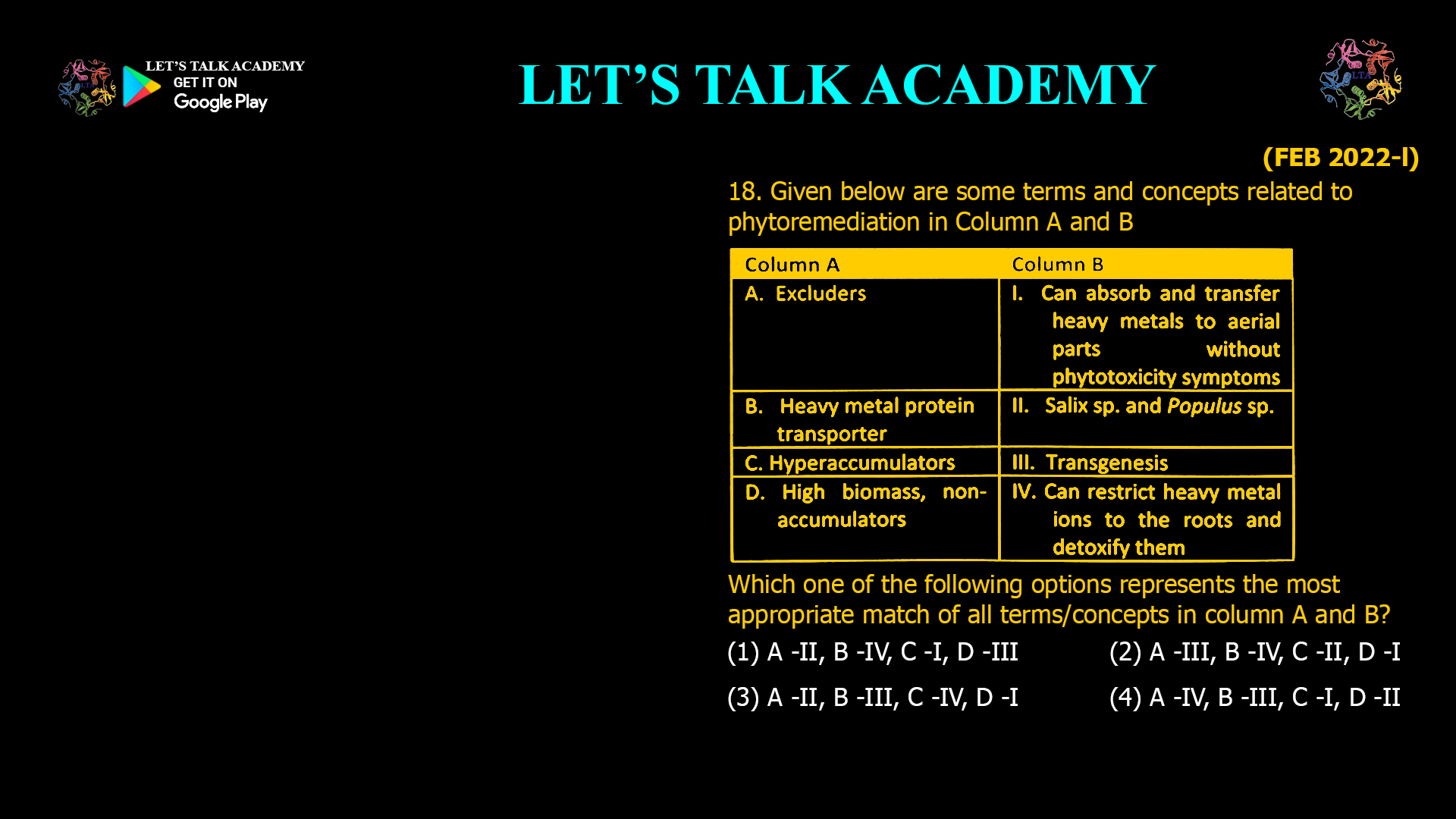
- Given below are some terms and concepts related to phytoremediation in Column A and B
Which one of the following options represents the most appropriate match of all terms/concepts in column A and B?
(1) A- II, B – IV, C-I, D-III
(2) A – III, B – IV, C-II, D-I
(3) A – II, B – III, C-IV, D-I
(4) A – IV, B – III, C-I, D-IIColumn A and Column B
Column A:
A. Excluders
B. Heavy metal protein transporter
C. Hyperaccumulators
D. High biomass, non‑accumulatorsColumn B:
I. Can absorb and transfer heavy metals to aerial parts without phytotoxicity symptoms
II. Salix sp. and Populus sp.
III. Transgenesis
IV. Can restrict heavy metal ions to the roots and detoxify themCorrect matches:
-
A → IV (Excluders – restrict metals to roots)
-
Excluder plants keep most of the metal in roots or rhizosphere, preventing movement to shoots and avoiding toxicity by restricting and detoxifying metals at the root level.
-
-
B → III (Heavy metal protein transporter – transgenesis)
-
“Heavy metal protein transporter” here refers to specific transport proteins (e.g., HMA, NRAMP) moved between species by transgenic approaches to enhance metal uptake or tolerance.
-
So the related concept is transgenesis.
-
-
C → I (Hyperaccumulators – move metals to aerial parts without toxicity)
-
Hyperaccumulators absorb and load metals into leaves and shoots at very high concentrations while showing little or no phytotoxicity, exactly as described in I.
-
-
D → II (High biomass, non‑accumulators – Salix and Populus)
-
Salix (willow) and Populus (poplar) species are classic fast‑growing, high‑biomass trees used in phytostabilization or rhizofiltration even though they are not classical hyperaccumulators.
-
Thus the most appropriate complete matching is A–IV, B–III, C–I, D–II → option (4).
-