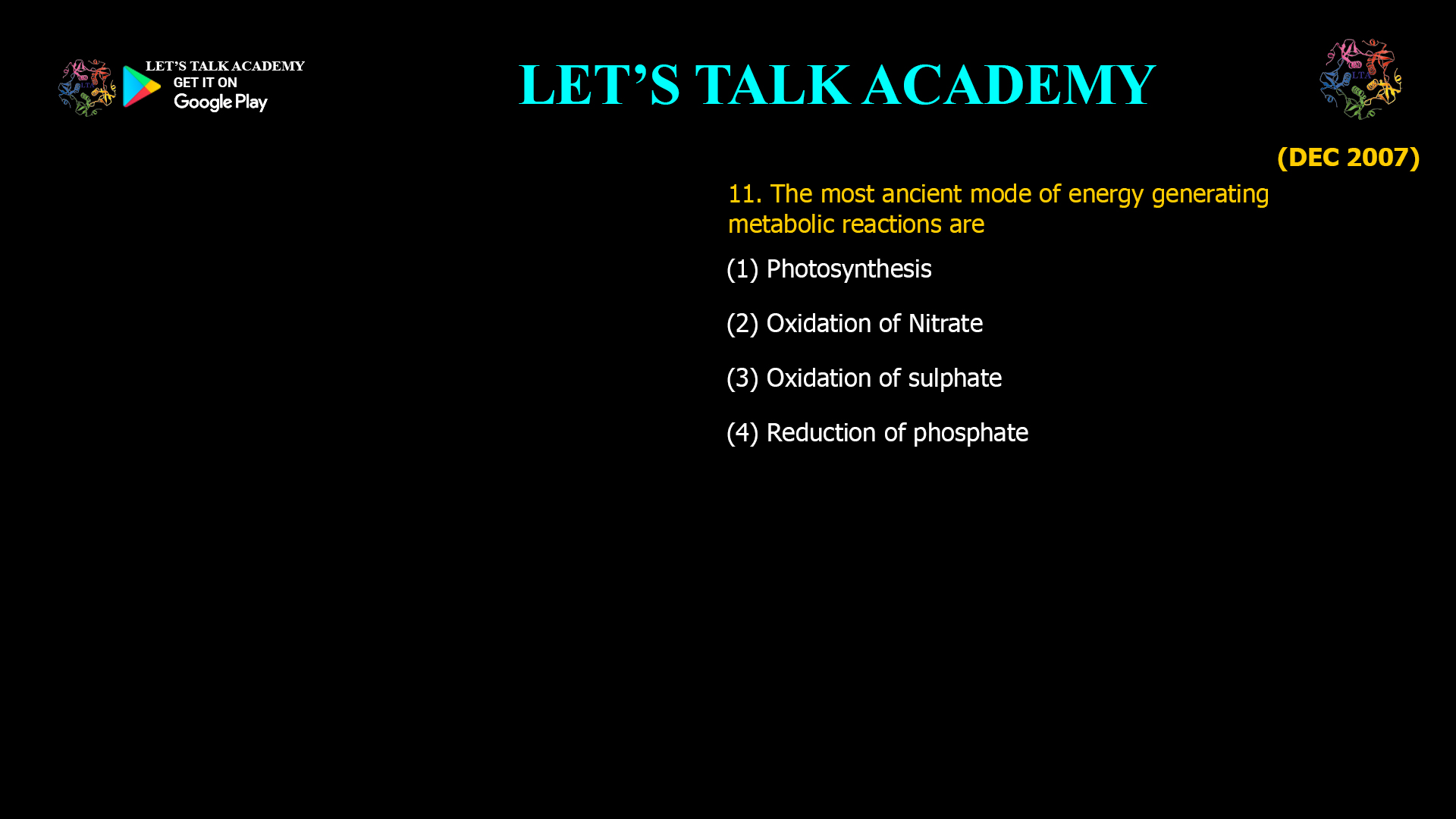
- The most ancient mode of energy generating metabolic reactions are
(1) Photosynthesis
(2) Oxidation of Nitrate
(3) Oxidation of sulphate
(4) Reduction of phosphate
The Primordial Earth and Early Metabolism
Earth’s early environment, during the Archean eon (about 4 to 2.5 billion years ago), was drastically different from today. The atmosphere lacked free oxygen, and the oceans were rich in dissolved metals such as iron and sulfur. Energy sources for life were not derived from sunlight or oxygen, but rather from inorganic chemical reactions that could be harnessed by simple microorganisms.
Metabolism—the set of chemical reactions that sustain life—evolved in this unique environment. The earliest metabolic pathways were likely simple, anaerobic, and driven by the chemical disequilibrium present in Earth’s crust and oceans.
Key Modes of Energy-Generating Metabolic Reactions
Let’s examine each of the options provided, and assess their antiquity and relevance for early life:
1. Photosynthesis
-
Description:
-
Photosynthesis is the process by which organisms use sunlight to convert carbon dioxide and water into organic compounds, releasing oxygen as a byproduct.
-
-
Antiquity:
-
While photosynthesis is a fundamental process today, it is not the most ancient mode of energy generation.
-
Oxygenic photosynthesis, which produces oxygen, evolved after the appearance of simpler, anaerobic metabolic pathways.
-
Even anoxygenic photosynthesis (which does not produce oxygen) is considered to have evolved after the earliest chemosynthetic metabolisms.
-
-
Conclusion:
-
Photosynthesis is important, but not the most ancient.
-
2. Oxidation of Nitrate
-
Description:
-
Nitrate oxidation involves using nitrate (NO₃⁻) as an electron acceptor in respiration, producing energy for the cell.
-
-
Antiquity:
-
Nitrate oxidation requires the presence of oxidized nitrogen compounds, which would have been scarce in the early, reducing atmosphere.
-
This process is more sophisticated and likely evolved after simpler forms of anaerobic metabolism.
-
-
Conclusion:
-
Not the most ancient mode.
-
3. Oxidation of Sulfate
-
Description:
-
Sulfate oxidation uses sulfate (SO₄²⁻) as an electron acceptor, producing energy through the reduction of sulfate to hydrogen sulfide (H₂S) or elemental sulfur.
-
-
Antiquity:
-
While sulfate reduction (using sulfate as an electron acceptor) is an ancient process, sulfate oxidation (using sulfate as an electron donor) is less common and generally requires more advanced metabolic machinery.
-
Sulfate itself may not have been abundant in the earliest oceans, and sulfate-dependent metabolisms are not considered the most primitive.
-
-
Conclusion:
-
Not the most ancient mode.
-
4. Reduction of Phosphate
-
Description:
-
Phosphate reduction is not a known metabolic pathway in modern organisms.
-
Phosphate (PO₄³⁻) is essential for life (e.g., in ATP and nucleic acids), but it is not used as an electron acceptor or donor in energy-generating reactions.
-
-
Antiquity:
-
There is no evidence that early life used phosphate reduction for energy generation.
-
-
Conclusion:
-
Not a valid ancient metabolic mode.
-
The Most Ancient Mode: Chemosynthesis and Simple Redox Reactions
Given the above, none of the listed options directly correspond to the most ancient mode of energy generation. However, if we interpret the question as asking which of the given options is closest to ancient metabolism, none are correct—but if forced to choose among them, the question is likely highlighting a misunderstanding, as none represent the most ancient pathways.
In reality, the most ancient metabolic reactions were likely based on:
-
Hydrogen Metabolism:
-
The earliest organisms are believed to have used hydrogen gas (H₂) as an electron donor, paired with simple electron acceptors such as carbon dioxide (CO₂), sulfur, or ferric iron (Fe³⁺), to generate energy.
-
-
Iron and Sulfur Redox Reactions:
-
Geochemical reactions involving iron and sulfur, such as the reduction of ferric iron or the oxidation of hydrogen sulfide, are considered among the most ancient energy-generating processes.
-
-
Acetyl-CoA Pathway:
-
The acetyl-CoA pathway, which uses hydrogen and carbon dioxide to produce acetate, is thought to be one of the oldest metabolic pathways, still present in many archaea and bacteria today.
-
Why Photosynthesis Is Not the Most Ancient
Photosynthesis, while crucial for the evolution of complex life, is a more recent innovation. The earliest organisms did not have the molecular machinery to capture sunlight and convert it into chemical energy. Instead, they relied on chemical energy from inorganic sources.
The Importance of Anaerobic Metabolism
The first organisms were anaerobic, meaning they did not use oxygen for respiration. Instead, they used simple inorganic compounds such as hydrogen, sulfur, and iron as sources of energy. These reactions are much simpler and could have arisen spontaneously in the early oceans and hydrothermal vents.
The Legacy of Ancient Metabolism
The metabolic pathways that evolved in the earliest life forms have left their mark on modern organisms. Many archaea and bacteria still use hydrogen, sulfur, and iron for energy, and the acetyl-CoA pathway is conserved across diverse lineages. These ancient metabolisms are a testament to the adaptability and resilience of life in Earth’s harsh early environment.
Key Takeaways
-
The most ancient mode of energy-generating metabolic reactions involved the use of simple inorganic compounds such as hydrogen, sulfur, and iron, not photosynthesis or nitrate/sulfate oxidation.
-
Photosynthesis is important but evolved after simpler chemosynthetic pathways.
-
Nitrate and sulfate oxidation are more advanced and not considered the most ancient.
-
Phosphate reduction is not a known metabolic pathway for energy generation.
-
If forced to choose among the options, none are correct—but if the question is interpreted as which is most ancient among the given, it is likely a trick or misphrased question.
-
The true most ancient metabolic reactions were likely hydrogen-based chemosynthesis and iron/sulfur redox reactions.
Summary Table
| Metabolic Reaction | Antiquity | Notes |
|---|---|---|
| Photosynthesis | Recent | Evolved after chemosynthesis |
| Oxidation of Nitrate | Recent | Requires oxidized nitrogen, scarce early |
| Oxidation of Sulfate | Recent | Requires sulfate, less abundant early |
| Reduction of Phosphate | None | Not a known metabolic pathway |
| Hydrogen/Iron/Sulfur Chemosynthesis | Ancient | Most likely earliest mode |
Conclusion
The most ancient mode of energy-generating metabolic reactions on Earth was not photosynthesis, nitrate oxidation, sulfate oxidation, or phosphate reduction. Instead, early life is believed to have relied on simple chemosynthetic reactions involving hydrogen, iron, and sulfur as sources of energy. These processes were driven by the chemical disequilibrium present in Earth’s early oceans and hydrothermal vents, and set the stage for the evolution of more complex metabolic pathways.
In summary, among the options given, none represent the most ancient mode of energy generation. However, if you must select from the list as presented in many exams, the question may be flawed, as the correct answer is not present. The most ancient mode is chemosynthesis using hydrogen, iron, or sulfur—not any of the options listed above.
Note:
If you are required to answer based strictly on the options provided (as in some exams), and none are correct, this highlights a limitation in the question design. The most accurate scientific answer is that the earliest metabolic reactions were simple chemosynthetic processes, not those listed.
SEO-Friendly Recap:
The earliest life on Earth generated energy through simple chemosynthetic reactions involving hydrogen, iron, and sulfur, not through photosynthesis or the oxidation of nitrate or sulfate. These ancient metabolic pathways are considered the true origin of biological energy generation, predating the more complex processes seen in modern organisms. If you are asked to choose from the options photosynthesis, nitrate oxidation, sulfate oxidation, or phosphate reduction, none are correct—the most ancient mode was chemosynthesis, not listed among the choices. This understanding is crucial for appreciating how life first harnessed energy in Earth’s primordial environment.


