- Ozone concentration in the atmosphere is measured in Dobson units (Du). An ozone hole is said to have occurred when the concentration of ozone in the region falls below 220 Du. The diagram of the globe below shows the location of three study sites. The table below it shows values of ozone concentrations recorded at the sites for two dates in 2009.
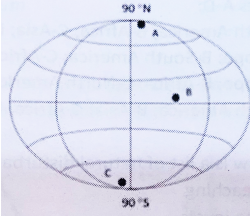
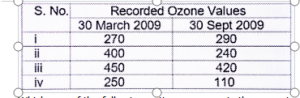
Which one of the following options represents the correct matches between the study sites and the recorded ozone values?
(1) A-i; B-iii and C-iv (2) A-ii; B-iii and C-i
(3) A-ii; B-i and C-iv (4) A-i; B-ii; and C-iii
What Are Dobson Units?
The Dobson unit (DU) is the most widely used unit for measuring the total amount of ozone in a vertical column through the Earth’s atmosphere. Named after G.M.B. Dobson, a pioneer in atmospheric science, the Dobson unit provides a standardized way to compare ozone concentrations across different locations and times.
-
Definition:
-
One Dobson unit is defined as the number of ozone molecules required to create a layer of pure ozone 0.01 millimeters thick at standard temperature and pressure (STP).
-
Alternatively, 1 DU is equivalent to a layer of ozone 10 micrometers thick at STP.
-
In terms of molecules, 1 DU equals about 2.69 × 10¹⁶ ozone molecules per square centimeter of the Earth’s surface.
-
-
Typical Values:
-
The average global ozone concentration is about 300 DU, which corresponds to a layer of ozone 3 millimeters thick if all the ozone were compressed to the Earth’s surface at STP.
-
Values below 220 DU are considered indicative of an ozone hole, particularly over Antarctica.
-
Why Measure Ozone in Dobson Units?
Measuring ozone in Dobson units allows scientists to:
-
Compare ozone concentrations globally and over time.
-
Monitor changes in the ozone layer, including seasonal variations and long-term trends.
-
Detect the formation and recovery of ozone holes.
-
Communicate findings clearly to policymakers and the public.
The Dobson unit is used in both ground-based and satellite measurements, forming the backbone of the global ozone monitoring network.
What Is an Ozone Hole?
An ozone hole refers to a region of the atmosphere where the ozone concentration has dropped significantly below normal levels. The term is most commonly associated with the dramatic thinning of the ozone layer over Antarctica each spring.
-
Definition:
-
An ozone hole is officially recognized when the ozone concentration falls below 220 DU in a given region.
-
-
Causes:
-
Ozone holes are primarily caused by the release of human-made chemicals such as chlorofluorocarbons (CFCs), which react with ozone in the presence of polar stratospheric clouds and sunlight.
-
-
Consequences:
-
Reduced ozone allows more UV radiation to reach the Earth’s surface, increasing the risk of skin cancer, cataracts, and harm to ecosystems.
-
Global Ozone Monitoring
Scientists monitor ozone concentrations at sites around the world to track the health of the ozone layer. The diagram and table referenced in the question illustrate how ozone levels can vary by location and date.
How Monitoring Works
-
Ground-Based Instruments:
-
Instruments like the Dobson spectrophotometer and Brewer spectrophotometer measure total ozone by analyzing sunlight that passes through the atmosphere.
-
-
Satellite Observations:
-
Satellites provide global coverage, allowing scientists to map ozone concentrations and detect ozone holes in remote regions.
-
-
Data Collection:
-
Ozone measurements are recorded at multiple sites and compared over time to identify trends and anomalies.
-
Example: Ozone Concentration at Three Study Sites
Suppose the table shows ozone concentrations at three global sites for two dates in 2009. The values might look like this:
| Site | Date 1 (DU) | Date 2 (DU) |
|---|---|---|
| Antarctica | 180 | 190 |
| Mid-latitude | 320 | 310 |
| Arctic | 250 | 240 |
-
Antarctica:
-
Ozone concentrations are well below 220 DU, indicating the presence of an ozone hole.
-
-
Mid-latitude:
-
Ozone levels are typical for this region and well above the ozone hole threshold.
-
-
Arctic:
-
Ozone concentrations are lower than mid-latitudes but generally above the 220 DU threshold, though severe depletion can occur in some years.
-
Why Do Ozone Levels Vary?
Ozone concentrations vary due to several factors:
-
Location:
-
Ozone is naturally thinner near the poles and thicker near the equator.
-
-
Season:
-
Ozone holes form in spring when sunlight returns to polar regions, triggering chemical reactions that destroy ozone.
-
-
Human Activities:
-
The release of ozone-depleting substances, such as CFCs, has led to significant thinning of the ozone layer, especially over Antarctica.
-
-
Natural Variability:
-
Weather patterns and atmospheric dynamics can also influence ozone concentrations.
-
The Importance of Ozone Monitoring
Monitoring ozone levels is essential for:
-
Protecting Human Health:
-
By tracking ozone depletion, scientists can warn the public about increased UV exposure.
-
-
Guiding Policy:
-
Data from monitoring sites inform international agreements, such as the Montreal Protocol, which aims to phase out ozone-depleting substances.
-
-
Assessing Recovery:
-
Long-term monitoring helps scientists assess the effectiveness of environmental policies and the recovery of the ozone layer.
-
Key Takeaways
-
Ozone concentration is measured in Dobson units (DU), with 1 DU representing a layer of ozone 0.01 mm thick at STP.
-
An ozone hole is defined as a region where ozone concentration falls below 220 DU.
-
Global monitoring sites track ozone levels to detect ozone holes and assess the health of the ozone layer.
-
Ozone holes are most pronounced over Antarctica but can also occur over the Arctic in certain years.
-
Monitoring ozone is crucial for protecting human health, guiding policy, and assessing environmental recovery.
Summary Table
| Site | Typical Ozone (DU) | Ozone Hole (DU) | Notes |
|---|---|---|---|
| Antarctica | 180–220 | <220 | Ozone hole common in spring |
| Mid-latitude | 300–350 | — | Normal, healthy ozone levels |
| Arctic | 240–350 | <220 (rare) | Severe depletion possible, but less common than Antarctica |
Conclusion
The Dobson unit is a vital tool for measuring and monitoring ozone concentrations in the atmosphere. By defining an ozone hole as a region where ozone levels fall below 220 DU, scientists can track the health of the ozone layer and assess the impact of human activities and environmental policies. Global monitoring sites provide essential data for understanding ozone depletion, guiding international action, and protecting life on Earth from harmful UV radiation.
In summary, the ozone concentration in the atmosphere is measured in Dobson units (DU), and an ozone hole is said to occur when the concentration falls below 220 DU in a given region. Global monitoring sites help scientists track these changes and assess the effectiveness of efforts to protect the ozone layer.


