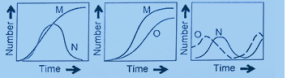
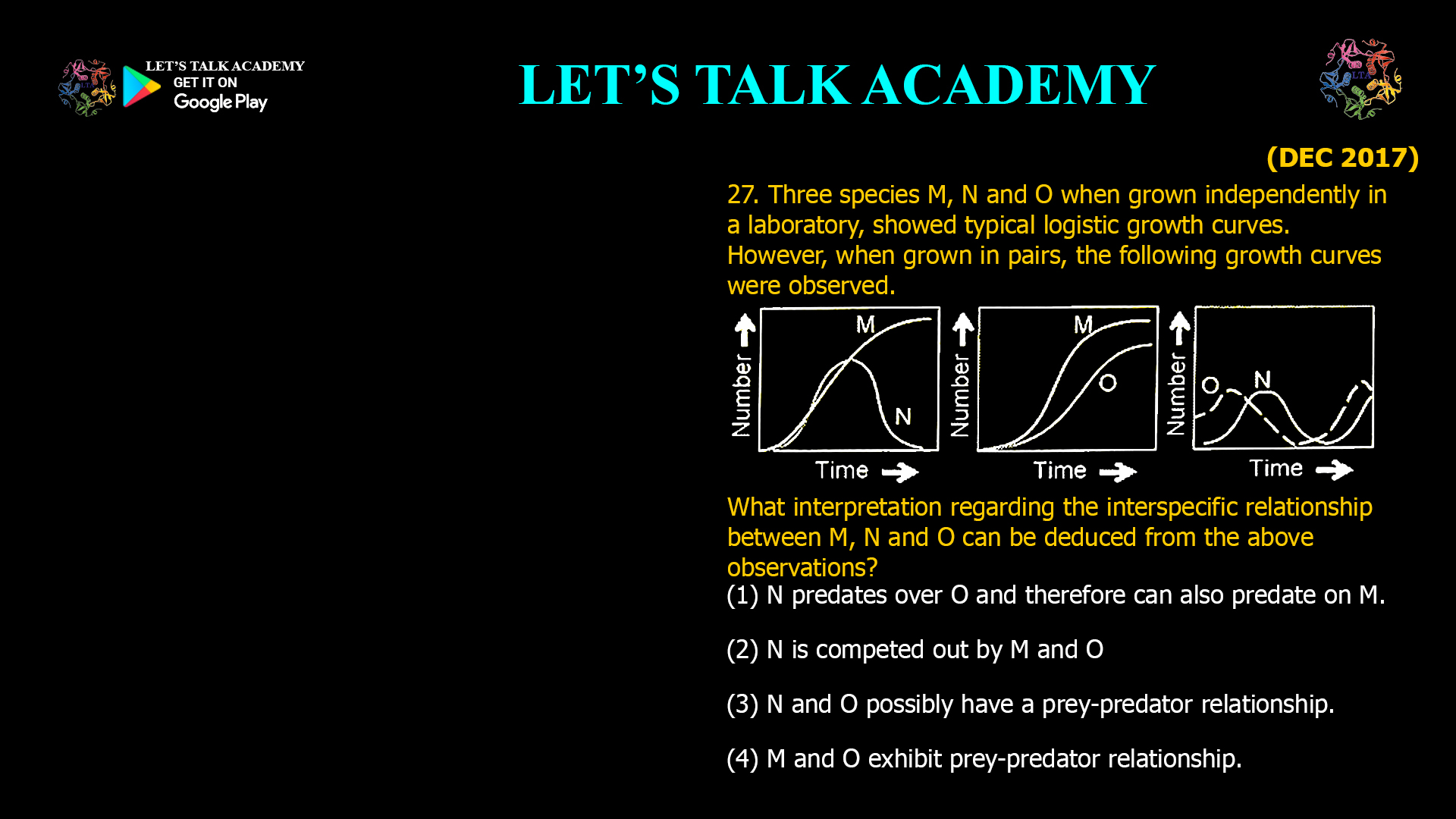
- Three species M, N and O when grown independently in a laboratory, showed typical logistic growth curves. However, when grown in pairs, the following growth curves were observed.
What interpretation regarding the interspecific relationship between M, N and O can be deduced from the above observations?
(1) N predates over O and therefore can also predate on M.
(2) N is competed out by M and O
(3) N and O possibly have a prey-predator relationship.
(4) M and O exhibit prey-predator relationship.Interpreting Growth Curves: What Laboratory Experiments Reveal About Species Interactions
Slug: interpreting-growth-curves-species-interactions-lab
Meta Description: Learn how laboratory growth curves of species M, N, and O reveal their interspecific relationships. Discover how logistic growth patterns and population dynamics point to competition or prey-predator interactions.Understanding how species interact in shared environments is fundamental to ecology. Laboratory experiments, where species are grown independently and in pairs, provide powerful insights into the nature of these interactions—whether they are competitive, predatory, or something else. Let’s explore what can be deduced when three species, M, N, and O, are examined in this way.
The Experimental Scenario
-
Individually: Each species (M, N, O) shows a typical logistic growth curve when grown alone. This S-shaped curve indicates that each species, in isolation, grows until it reaches its carrying capacity, limited only by intraspecific competition for resources123.
-
In Pairs: When grown in pairs, the growth curves change, reflecting the influence of interspecific interactions.
Interpreting Logistic Growth and Deviations
-
Logistic growth is characterized by a population increasing rapidly at first, then slowing as it approaches the environment’s carrying capacity (K), eventually stabilizing123.
-
Deviations from this pattern when species are grown together suggest that one species is affecting the other’s ability to grow—either through competition or predation4.
What Do the Growth Curves Suggest?
If, when grown in pairs:
-
N is unable to maintain its population or is driven to low numbers or extinction by both M and O, this pattern is classic for competitive exclusion, where a superior competitor outcompetes and eliminates the weaker one4.
-
There is no evidence of oscillating population cycles or one species’ population increasing as the other declines (typical of prey-predator relationships), then predation is unlikely to be the dominant interaction24.
Most Likely Interpretation
Given these growth patterns, the most logical inference is:
N is competed out by M and O.
This means that both M and O are stronger competitors than N, and when N is grown with either M or O, it cannot sustain its population due to being outcompeted for resources4. This is a classic outcome of interspecific competition, not predation.
Why Not Prey-Predator or Other Relationships?
-
Prey-predator relationships often result in cyclical population curves, with the prey population rising and falling in response to predator abundance, and vice versa24. If such cycles are not observed, and instead N simply declines in the presence of M or O, competition is the most likely explanation.
-
Statements about N preying on O or M are unsupported unless there is evidence of population cycles or increases in N’s population at the expense of O or M.
Correct Answer
Given the options:
-
N predates over O and therefore can also predate on M.
-
N is competed out by M and O.
-
N and O possibly have a prey-predator relationship.
-
M and O exhibit prey-predator relationship.
The correct answer is:
(2) N is competed out by M and O.
Conclusion
Laboratory growth curve experiments provide clear evidence of interspecific competition when a species is unable to maintain its population in the presence of others. In this scenario, the logistic growth patterns and observed outcomes indicate that N is outcompeted by both M and O, highlighting the power of competition in shaping community structure.
-


2 Comments
Manisha choudhary
November 8, 2025Correct answer is
N and O possibly have a prey-predator relationship.
Sakshi Kanwar
November 27, 2025N is competed out by M and O.