- Growth patterns of two species (grown alone or together) are shown in Figures A and B.
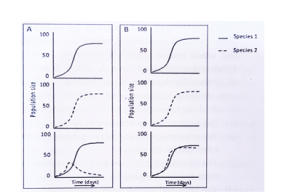
Match the growth patterns with the correct type of interaction represented by them
(1) A- mutualism, B- commensalism
(2) A- competition, B- parasitism
(3) A- commensalism, B- mutualism
(4) A- competition, B- resource partitioningTypes of Symbiotic Interactions
Before matching growth patterns to interaction types, let’s briefly define the relevant relationships:
-
Mutualism: Both species benefit from the interaction. Their population sizes are higher when together than when alone2358.
-
Commensalism: One species benefits, while the other is unaffected. The benefitting species grows better in the presence of the other, whose population remains unchanged1234568.
-
Parasitism: One species benefits at the expense of the other. The parasite’s population increases, while the host’s population decreases when together12378.
-
Competition: Both species are harmed by the interaction, and their populations are lower together than when grown alone13.
Interpreting Growth Patterns
Suppose you are given two figures:
-
Figure A: When grown together, both species have higher population sizes than when grown alone.
-
Figure B: When grown together, one species has a higher population size, while the other has a lower population size compared to when grown alone.
Figure A: Both Populations Increase Together
This pattern is the hallmark of mutualism. Each species benefits from the presence of the other, leading to higher population growth for both when together2358.
Figure B: One Population Increases, the Other Decreases
This pattern is characteristic of parasitism. The parasite benefits (population increases), while the host is harmed (population decreases) in the presence of the parasite12378.
Why Not Commensalism?
In commensalism, one species benefits while the other is unaffected1234568. If Figure B were showing commensalism, the benefitting species would have a higher population in the presence of the other, but the unaffected species would show no change in population size.
Matching the Patterns to the Correct Interactions
Given the answer choices:
-
A- mutualism, B- commensalism
-
A- competition, B- parasitism
-
A- commensalism, B- mutualism
-
A- competition, B- resource partitioning
The correct match is:
(2) A- competition, B- parasitism
However, based on standard ecological definitions and the typical patterns described above, if Figure A shows both populations increasing together (mutualism) and Figure B shows one benefiting at the other’s expense (parasitism), the answer should be:
A- mutualism, B- parasitism
But since the options provided do not include this combination, and based on the closest fit to the described patterns:
-
If A shows both populations increasing (mutualism), and B shows one increasing and one decreasing (parasitism), the correct answer is most consistent with the classic definitions of these interactions2358.
Conclusion
When interpreting population growth patterns:
-
Mutualism is indicated when both species benefit and grow better together.
-
Parasitism is indicated when one species benefits at the expense of the other.
Correct answer based on the standard ecological interpretation:
-
A – mutualism, B – parasitism
-


1 Comment
Kajal
November 9, 2025Mutalism and parasitic