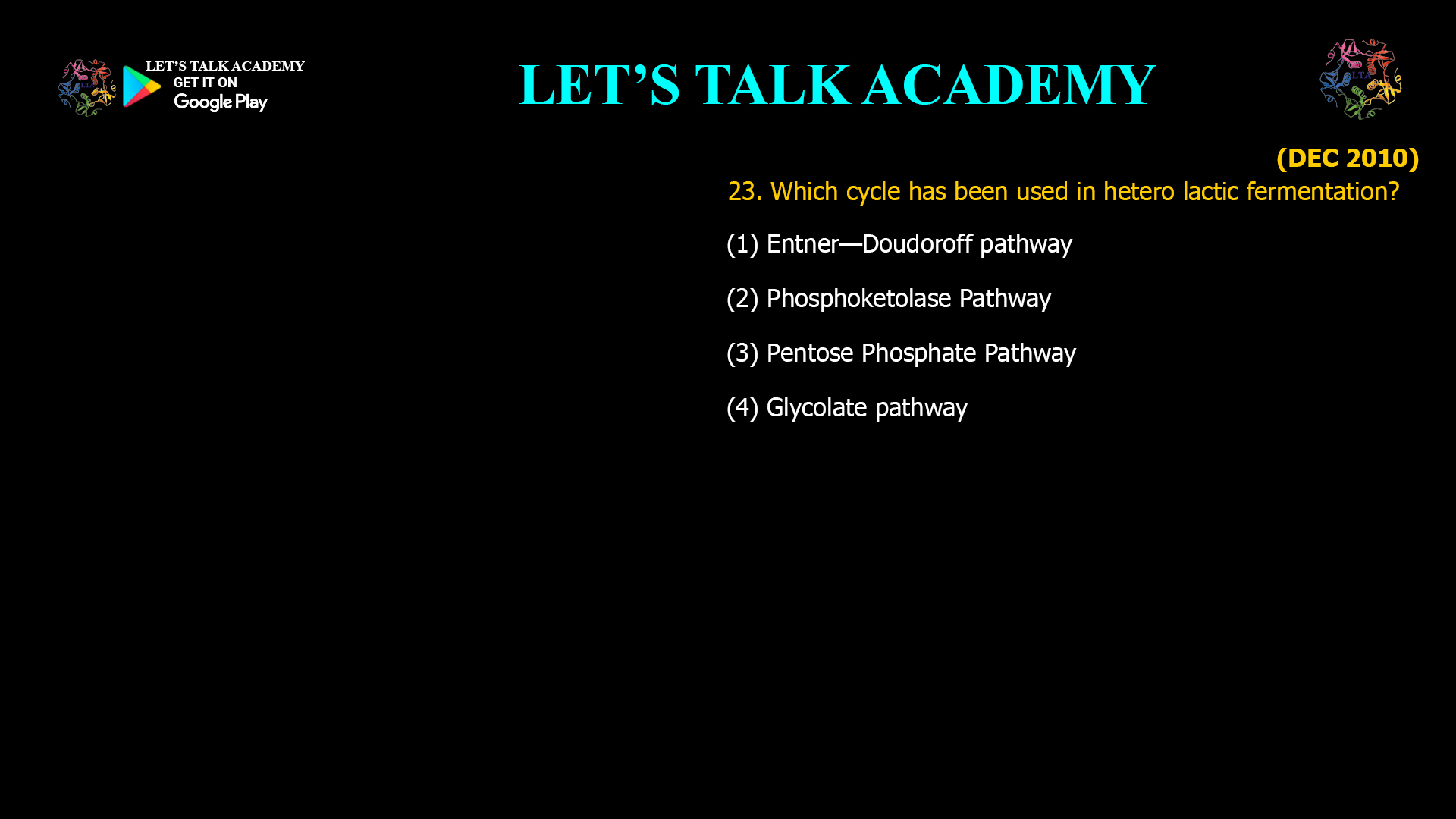
- Which cycle has been used in hetero lactic fermentation?
(1) Entner—Doudoroff pathway
(2) Phosphoketolase Pathway
(3) Pentose Phosphate Pathway
(4) Glycolate pathway
Heterolactic fermentation is a distinctive metabolic process carried out by certain lactic acid bacteria and microbes, characterized by the production of multiple end products including lactate, ethanol, and carbon dioxide. Unlike homolactic fermentation, which primarily produces lactic acid, heterolactic fermentation involves a unique biochemical pathway that enables this diverse product formation.
This article explores the specific metabolic cycle used in heterolactic fermentation, focusing on the phosphoketolase pathway, its enzymatic steps, and its significance in microbial metabolism.
What Is Heterolactic Fermentation?
Heterolactic fermentation is a form of carbohydrate metabolism where glucose is converted into a mixture of products: lactic acid, ethanol (or acetate), and carbon dioxide. This process is typical of heterofermentative lactic acid bacteria such as Leuconostoc and some Lactobacillus species.
The pathway differs from homolactic fermentation by its enzymatic machinery and metabolic intermediates, allowing the generation of additional products and less ATP per glucose molecule.
The Phosphoketolase Pathway: The Core of Heterolactic Fermentation
The key metabolic cycle used in heterolactic fermentation is the phosphoketolase pathway (also known as the heterolactic pathway or 6-phosphogluconate/phosphoketolase pathway).
Key Features of the Phosphoketolase Pathway
-
Initial Steps:
Glucose is first converted to glucose-6-phosphate and then oxidized to 6-phosphogluconate, which undergoes decarboxylation to form ribulose-5-phosphate. -
Pentose Phosphate Intermediates:
Ribulose-5-phosphate is isomerized to xylulose-5-phosphate, a critical substrate in this pathway. -
Phosphoketolase Enzyme Action:
The enzyme phosphoketolase cleaves xylulose-5-phosphate into glyceraldehyde-3-phosphate (G3P) and acetyl phosphate. -
Product Formation:
-
G3P is metabolized via glycolytic enzymes to pyruvate and then to lactic acid.
-
Acetyl phosphate can be converted to ethanol or acetate, depending on the organism and conditions.
-
Carbon dioxide is released during the decarboxylation step.
-
Energy Yield
The phosphoketolase pathway yields less ATP (typically one ATP per glucose) compared to homolactic fermentation (two ATP per glucose), reflecting its different metabolic strategy.
Why Is the Phosphoketolase Pathway Used?
-
Metabolic Flexibility:
This pathway allows microbes to adapt to varying environmental conditions by producing multiple fermentation products. -
Redox Balance:
The production of ethanol and CO2 helps regenerate NAD+ from NADH, maintaining redox balance during anaerobic metabolism. -
Ecological Niche:
Heterofermentative bacteria often inhabit environments where diverse fermentation products confer competitive advantages.
Other Pathways and Their Relation to Heterolactic Fermentation
-
Entner-Doudoroff Pathway:
A distinct pathway mainly found in some bacteria, not typically involved in heterolactic fermentation. -
Pentose Phosphate Pathway:
Shares intermediates with the phosphoketolase pathway but is primarily anabolic, generating NADPH and ribose sugars. -
Glycolate Pathway:
Involved in photorespiration in plants, unrelated to heterolactic fermentation.
Summary Table of Options
Option Description Correctness for Heterolactic Fermentation (1) Entner-Doudoroff pathway Alternative bacterial pathway, not heterolactic Incorrect (2) Phosphoketolase pathway Core pathway in heterolactic fermentation Correct (3) Pentose phosphate pathway Related but mainly anabolic pathway Incorrect (4) Glycolate pathway Plant photorespiration pathway Incorrect Conclusion
The phosphoketolase pathway is the distinctive metabolic cycle used in heterolactic fermentation. It enables the breakdown of carbohydrates into lactate, ethanol, and carbon dioxide, supporting microbial survival and adaptation in diverse environments.
Correct answer: (2) Phosphoketolase Pathway
-


15 Comments
Kirti Agarwal
September 18, 2025Phosphoketolase pathway
Pallavi Ghangas
September 22, 2025phosphoketolase pathway
Aakansha sharma Sharma
September 22, 2025phosphoketolase pathway
Roopal Sharma
September 24, 2025Phodphoketolase pathway is correct option.
Heena Mahlawat
September 24, 2025Phosphoketolase pathway
Minal Sethi
September 24, 2025The phosphoketolase pathway is the distinctive metabolic cycle used in heterolactic fermentation
option 2
Deepika sheoran
September 24, 2025Phosphokitolase pathway
Soniya Shekhawat
September 24, 2025phosphoketolase pathway is a core pathway of heterolactic fermentation which is mainly present in microbes to survive in adverse conditions in this carbohydrate is converted into lactate ethanol and CO2.
Mohd juber Ali
September 24, 2025Phosphoketolase pathway has been used in heterolactic fermentation
Pantose phosphate pathway also related but anabolic pathway
Payal Gaur
September 25, 2025Phosphoketolase pathway
Muskan Yadav
September 26, 2025Phosphoketolase Pathway.
Arushi Saini
September 27, 2025Phosphoketolase pathway
Kajal
October 2, 2025Phosphoketolase pathway
Santosh Saini
October 5, 2025Phosphoketolase pathway is the distinctive metabolic cycle used in heterolactic fermentation
Sakshi Kanwar
November 26, 2025phosphoketolase pathway