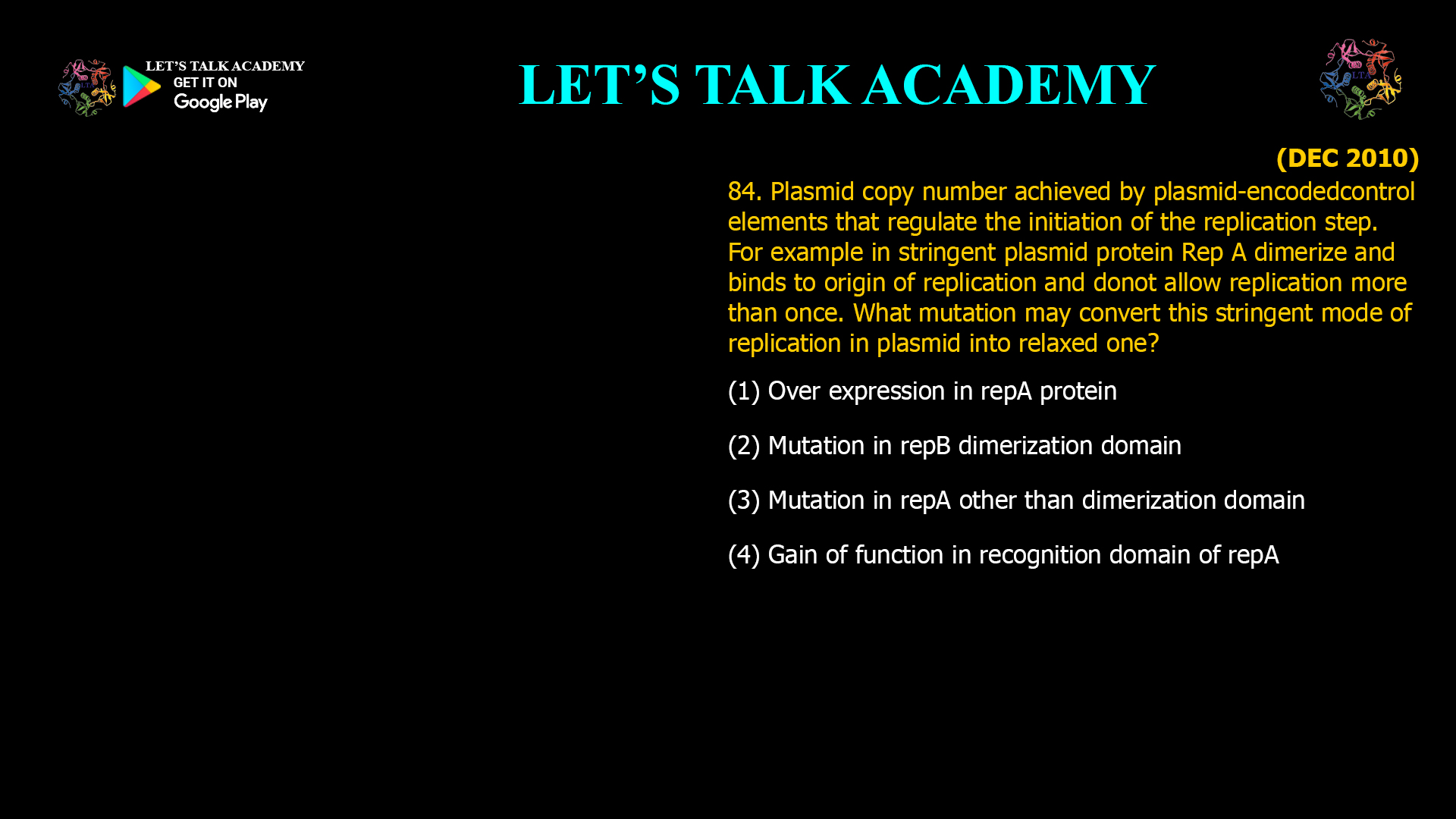
- Plasmid copy number achieved by plasmid-encoded control elements that regulate the initiation of the replication step. For example in stringent plasmid protein Rep A dimerize and binds to origin of replication and donot allow replication more than once.
What mutation may convert this stringent mode of replication in plasmid into relaxed one?
(1) Over expression in repA protein
(2) Mutation in repB dimerization domain
(3) Mutation in repA other than dimerization domain
(4) Gain of function in recognition domain of repA
Background: Stringent vs Relaxed Plasmid Replication Control
Plasmids maintain their copy number in bacterial cells through tightly regulated replication initiation mechanisms.
-
Stringent plasmids replicate in coordination with the host chromosome, maintaining a low copy number.
-
Relaxed plasmids replicate independently and often achieve high copy numbers.
In stringent plasmids, RepA protein plays a critical role by dimerizing and binding to the origin of replication (ori), inhibiting multiple initiations per cell cycle, thus enforcing low copy number.
Role of RepA Dimerization in Stringent Control
-
RepA dimers bind ori DNA, preventing over-initiation of replication.
-
This negative feedback ensures replication occurs only once per cell cycle per plasmid copy.
-
Dimerization is essential for this inhibitory function.
Effect of Mutations on Replication Control
-
Mutation in the RepA dimerization domain disrupts the ability of RepA to form dimers.
-
Without dimerization, RepA cannot effectively bind ori to inhibit replication initiation.
-
This loss of negative regulation converts the plasmid from a stringent to a relaxed replication mode, allowing multiple rounds of replication and increasing plasmid copy number.
Why Other Mutations Are Less Likely to Cause Relaxed Replication
-
Overexpression of RepA protein would likely enhance repression, maintaining or strengthening stringent control.
-
Mutation in RepA outside the dimerization domain may not affect dimer formation or ori binding significantly.
-
Gain of function in RepA recognition domain would likely increase binding and repression, not reduce it.
Summary Table
| Mutation Type | Effect on Replication Control |
|---|---|
| Overexpression of RepA | Maintains or strengthens stringent control |
| Mutation in RepA dimerization domain | Disrupts dimer formation, converts to relaxed |
| Mutation in RepA outside dimerization | Usually no effect on stringent control |
| Gain of function in recognition domain | Likely enhances repression, not relaxation |
Conclusion
The mutation that most likely converts stringent plasmid replication into relaxed replication is a mutation in the RepA dimerization domain. This mutation prevents RepA from forming dimers that inhibit replication initiation, leading to increased plasmid copy number and relaxed control.
Keywords
plasmid replication, stringent control, relaxed control, RepA protein, dimerization domain, plasmid copy number, replication initiation, bacterial plasmids, mutation effects
Correct answer:
(2) Mutation in repB dimerization domain


6 Comments
Shivani Panwar
July 29, 2025C..🤔 sure nhi h sir..
Mahima Sharma
August 3, 2025Ye smj nhi aa ya sir
Manisha choudhary
August 3, 2025Doen sir 👍🏻
Rep-A protein dimer bnati h dimer form m ori s bind krti h and ensure karwati h ki replication ek baar ho
Agr dimerization daomin m hi mutation ho jaayega too ori s bind nhi kr paayegi or regulate nhi kr paayegi ki ek baar replication ho
Plasmid ki multiple copy bnegi
Aafreen Khan
August 23, 2025Mutation in Rep-B dimerization domain if RepB’s dimerization domain is involved in the interaction with RepA or directly, a mutation in the dimerization domain of RepA itself which is implied as the part of RepA’s stringent function
Komal Sharma
October 2, 2025The mutation that most likely converts stringent plasmid replication into relaxed replication is a mutation in the RepA dimerization domain. This mutation prevents RepA from forming dimers that inhibit replication initiation, leading to increased plasmid copy number and relaxed control.
Deepika Sheoran
November 7, 2025Mutation in rep B dimerization domain