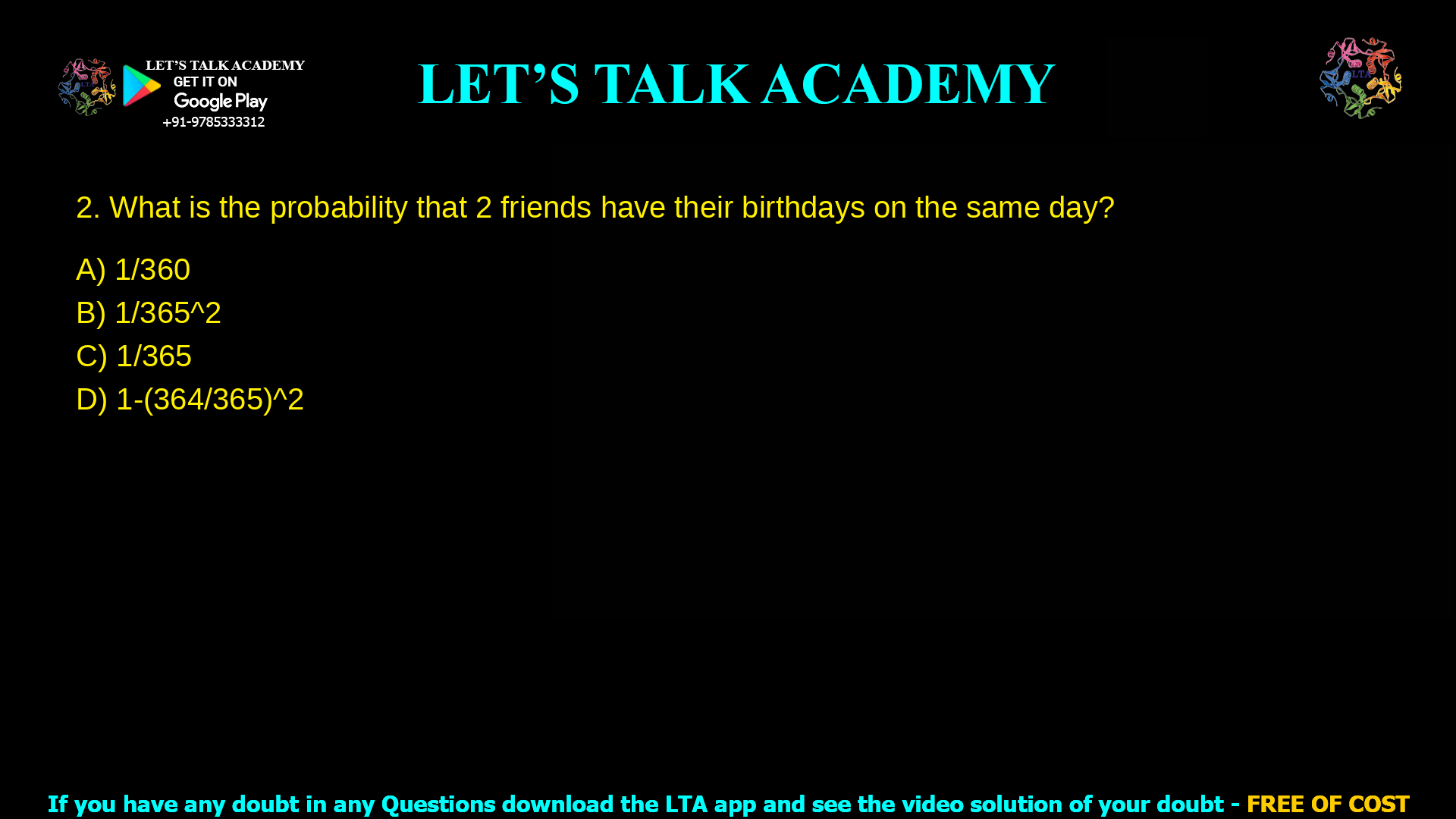
What is the probability that 2 friends have their birthdays on the same day?
1/360
1/3652
1/365
1-(364/365)2
Core Calculation
Fix one friend’s birthday on a specific day. The second friend’s birthday matches on any of the 365 days with probability 1/365, as total outcomes are 365 × 365 = 365² and favorable outcomes (both on same day) number 365[web:15]. This direct approach yields approximately 0.00274, or 0.274%.
Option Analysis
Each multiple-choice option represents a common misconception in the birthday problem for exactly two people.
| Option | Expression | Value | Explanation |
|---|---|---|---|
| A | 1/360 | ≈0.00278 | Incorrect; uses 360 days, possibly approximating a year without February but ignores standard 365-day model. |
| B | 1/365² | ≈0.0000075 | Wrong; this is probability both birthdays fall on one specific day (e.g., January 1), not any matching day. |
| C | 1/365 | ≈0.00274 | Correct; matches the fixed-first-person calculation for any shared day. |
| D | 1 – (364/365)² | ≈0.00547 | Incorrect for two people; this approximates probability at least one match in larger groups but overestimates here by considering ordered non-matches squared. |
Why Not the Paradox Formula?
The expression 1 – (364/365)² arises from complement: probability both birthdays differ is 364/365 (second avoids first’s day), so match probability is 1 – 364/365 = 1/365. For two people, this simplifies exactly to 1/365, as 1 – 364/365 = 1/365.
Option D erroneously squares the non-match term, which applies to pairwise comparisons in groups larger than two (e.g., 23 people yield ~50% match chance). For exactly two friends, no squaring needed—direct match suffices.


