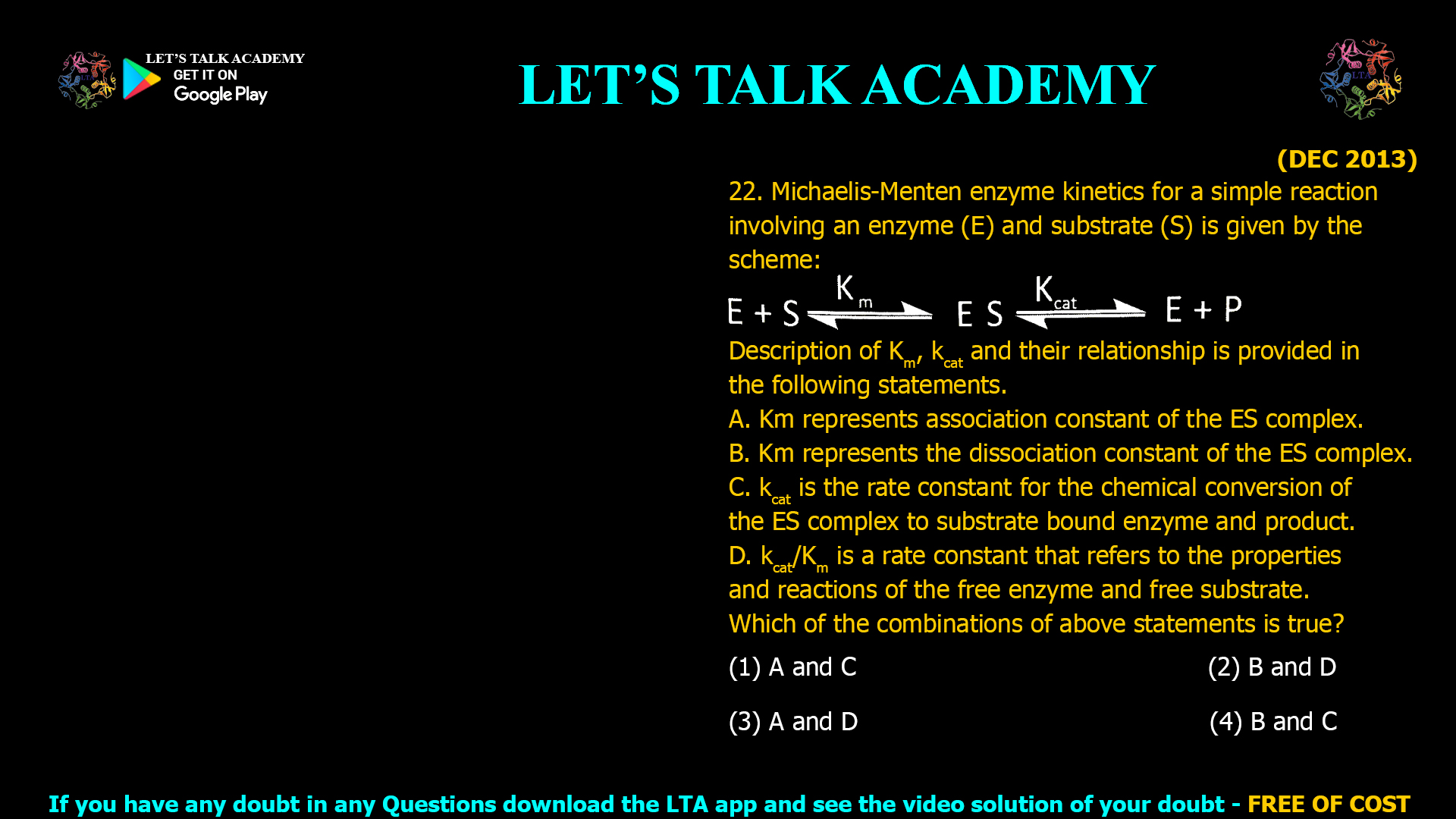
The correct answer is (2) B and D.
Introduction
Michaelis-Menten kinetics is essential for understanding how enzymes catalyze biochemical reactions. Two critical parameters—Km (Michaelis constant) and kcat (turnover number)—describe how efficiently an enzyme converts substrate to product. These parameters have specific interpretations derived from kinetic models and are crucial for enzyme characterization in biochemistry, molecular biology, and biotechnology.
Statement Analysis
Statement A: Km represents association constant of ES complex.
-
Incorrect.
-
Km does not denote the association constant of the enzyme-substrate (ES) complex.
-
Instead, it’s related to enzyme-substrate affinity, but technically reflects the dissociation tendency.
Statement B: Km represents the dissociation constant of ES complex.
-
Correct.
-
Km is interpreted as the dissociation constant, representing how readily the ES complex dissociates into enzyme and substrate.
-
A low Km means high affinity (less likely to dissociate), while a high Km means low affinity.
Statement C: kcat is the rate constant for the chemical conversion of ES complex to substrate bound enzyme and product.
-
Incorrect.
-
kcat is the turnover number, the rate constant that represents conversion of the ES complex to free enzyme and product, not substrate bound enzyme and product.
-
It quantifies the number of substrate molecules converted per enzyme molecule per second at saturation.
Statement D: kcat/Km is a rate constant that refers to the properties and reactions of the free enzyme and free substrate.
-
Correct.
-
kcat/Km measures enzyme efficiency, representing the second-order rate constant for the reaction between free enzyme and free substrate.
-
This ratio describes catalytic perfection and specificity, as it incorporates both binding and chemical conversion.
Michaelis-Menten Parameters Explained
Km (Michaelis Constant)
Km=k−1+kcatk1
-
Reflects the substrate concentration at which half-maximal enzyme velocity is achieved.
-
Indicates ES complex stability—essentially the dissociation constant.
kcat (Turnover Number)
kcat=maximal number of substrate molecules converted into product per enzyme per second
-
Represents the rate-limiting step of catalysis for the ES complex, leading to free enzyme and product.
kcat/Km (Catalytic Efficiency)
-
Useful for comparing enzymes, especially when substrate concentrations are low.
-
A higher value means a more efficient enzyme, approaching “catalytic perfection” if diffusion limits the reaction rate.
Application in Enzyme Engineering and Research
-
Understanding Km and kcat is vital in clinical diagnosis, drug design, and metabolic studies.
-
Manipulating these values can help design more efficient biocatalysts, develop enzyme inhibitors, and predict enzyme behavior in various cellular conditions.
-
Evaluating enzymatic efficiency by kcat/Km helps identify optimal conditions for industrial and therapeutic applications.
Summary Table
| Statement | True/False | Explanation |
|---|---|---|
| A. Association const | False | Km is not association, but dissociation constant |
| B. Dissociation const | True | Km reflects ease of ES complex breakdown |
| C. Conversion to bound enzyme | False | kcat is for conversion to free enzyme and product |
| D. kcat/Km: efficiency | True | Describes catalytic efficiency, free enzyme & substrate |
Conclusion
B and D are correct:
-
Km represents the dissociation constant of the ES complex.
-
kcat/Km is the rate constant for reactions involving free enzyme and free substrate, defining enzyme specificity and catalytic efficiency.
Understanding these definitions is fundamental for interpreting enzyme kinetics and optimizing reactions for research, clinical, and industrial settings


41 Comments
HIMANI FAUJDAR
September 12, 2025Ans B and D because km reflects the dissociation of ES complex and kcat/km efficiency describes catalytic efficiency free enzyme and substrate.
Sakshi yadav
September 12, 2025Km represent dissociation constant of the ES complex and km/ cat refers the reaction of free enzyme and substrate
Aakansha sharma Sharma
September 12, 2025Ans B and D because km reflects the dissociation of ES complex and kcat/km efficiency describes catalytic efficiency free enzyme and substrate.
Reply
Priya dhakad
September 12, 2025Option Band d ,Km represents the dissociation constant and kcat/Km is the rate constant for reactions involving free enzyme and free substrate.
Varsha Tatla
September 12, 2025Option B, is correct 💯 D
Varsha Tatla
September 12, 2025Option B,D correct 💯
Mohd juber Ali
September 13, 2025Statement B abd D is right
Dharmpal Swami
September 13, 2025Km =show dissociation of ES complex
And option d are write statement
Mansukh Kapoor
September 13, 2025The correct answer is option 2nd
B and D
Kanica Sunwalka
September 13, 2025* km represents dissociation constant of ES complex
*kcat / km describes catalytic efficiency free enzyme and free substrate
option 2 is correct
Kirti Agarwal
September 13, 2025Statement B and D
Bhawna Choudhary
September 13, 2025B and D is the correct option
Santosh Saini
September 13, 2025KM=dissociation constant of the ES complex , Kcat/km is the rate constant for reaction involving free enzyme and free substrate
Sakshi Kanwar
September 13, 2025Km represents dissociation constant that the ES complex dissociates into enzyme and substrate.
Where as kcat/Km measures enzyme efficiency, the reaction between free enzyme and free substrate.
B and D statements are true
Soniya Shekhawat
September 14, 2025Kcat and km is rate constant that properties and reaction of free enzyme and free substrate and km is dissociation constant for ES complex so option b and d is right
Aafreen Khan
September 14, 2025B and D statements are correct
Km = dissociation constants of ES complex
Kcat/Km= rate constant for reaction of free enzyme and free substrate
Pooja
September 14, 2025B and D statement is correct
Ayush Dubey
September 14, 2025B and D.
Tanvi Panwar
September 14, 2025Km represents dissociation constant and Kcat/Km represents the catalytic efficiency and properties and reactions of free enzymes and substrates.
Payal Gaur
September 14, 2025Option B and D
Khushi Agarwal
September 14, 2025The correct answer is 2
B and D
Kajal
September 14, 2025Option 2 and statement B and D are correct
Anurag Giri
September 14, 2025Km represents dissociation constant that the ES complex dissociates into enzyme and substrate.
Where as kcat/Km measures enzyme efficiency, the reaction between free enzyme and free substrate.
B and D statements are true
Neha Yadav
September 14, 2025Km represent the dissociation constant of the ES complex
Kcat/km measure the catalytic efficiency the reaction b/w free enzyme and free substrate
So, option B and D are correct
Mitali saini
September 14, 2025Ans B and D because km reflects the dissociation of ES complex and kcat/km efficiency describes catalytic efficiency free enzyme and substrate.
Avni
September 14, 2025the Correct answer is (2) B and D
Pallavi Ghangas
September 14, 2025Band d
Heena Mahlawat
September 14, 2025Km is dissociation constant and kcat- rate constant and shows properties and reaction of free enzyme and free substrate
Deepika sheoran
September 15, 2025Option B&D
Asha Gurzzar
September 15, 2025Option b and d are correct
Simran Saini
September 15, 2025Option b and d is right.
Khushi Vaishnav
September 15, 2025B and D are the correct option
Arushi Saini
September 15, 2025Option 2 is correct
Km represent dissociation constant of the ES complex and km/ cat refers the reaction of free enzyme and substrate
Anjana sharma
September 16, 2025Correct.
Km is interpreted as the dissociation constant, representing how readily the ES complex dissociates into enzyme and substrate.
Sonal nagar
September 16, 2025Option 2
(B and D).
Minal Sethi
September 16, 2025B and D
Km represents the dissociation constant of the ES complex and kcat/km is the enzyme efficiency which is the property of free enzyme and substrate
Deepika sheoran
September 16, 2025Option b &d is correct
Palak Sharma
September 16, 2025B and D are correct:
Km represents the dissociation constant of the ES complex.
kcat/Km is the rate constant for reactions involving free enzyme and free substrate, defining enzyme specificity and catalytic efficiency.
Muskan Yadav
September 17, 2025B and D are correct because
Km represents the dissociation constant of the ES complex.
kcat/Km is the rate constant for reactions involving free enzyme and free substrate, defining enzyme specificity and catalytic efficiency.
Yogita
September 17, 2025B & D is correct answer
Khushi Singh
September 25, 2025B and D is correct