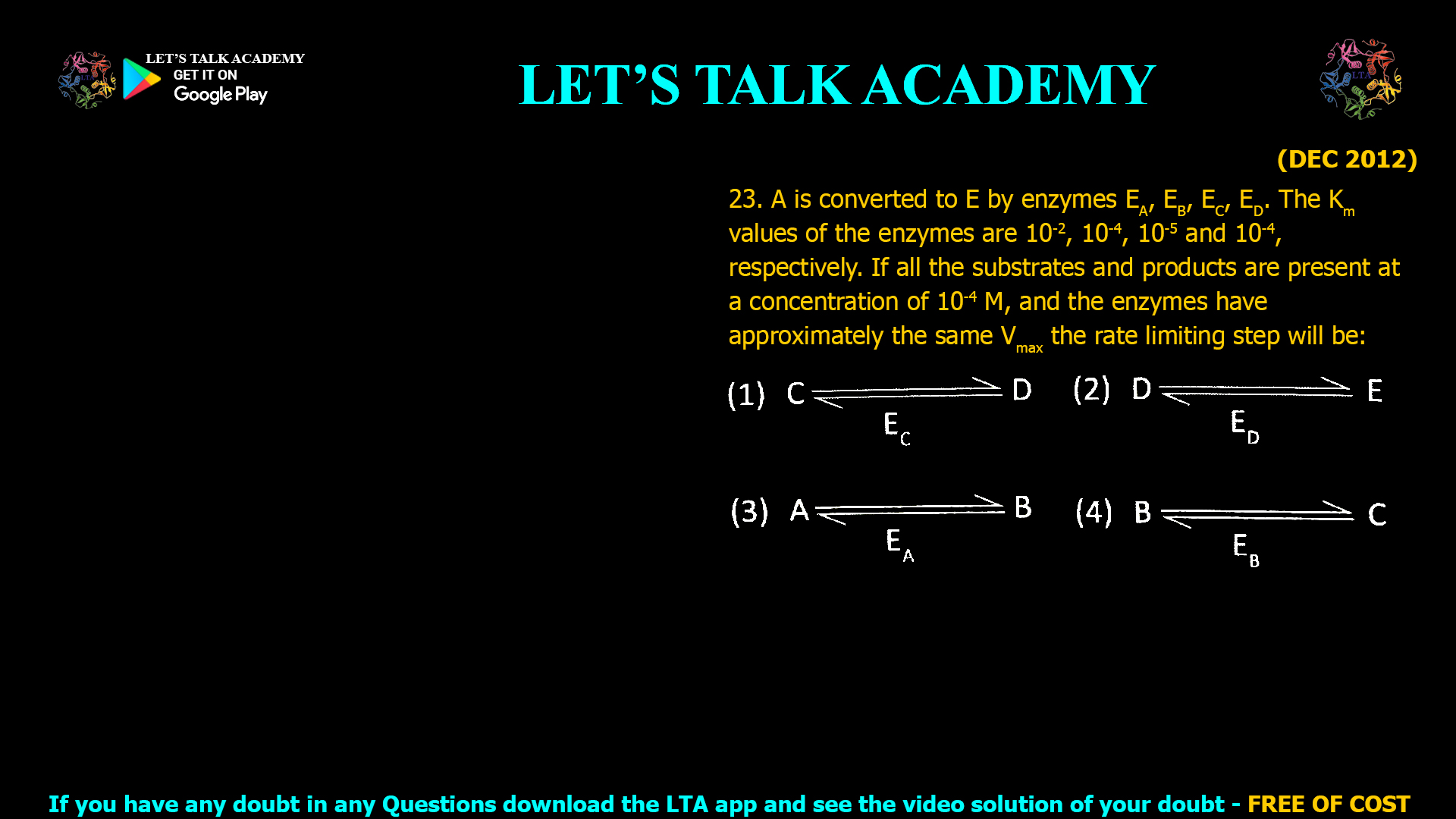
The correct answer is (4) B ⟶ C (Enzyme EB).
Introduction
Multistep biochemical pathways often involve several enzyme-catalyzed reactions, each with unique kinetic properties. The rate-limiting step determines the overall speed of product formation and is a critical target for regulation and optimization. This article explains how to identify the rate-limiting step in a sequence when Km values and substrate concentrations are known, focusing on the practical application in advanced enzyme kinetics.
Understanding the Problem Setup
Each reaction in the pathway:
-
A→EAB→EBC→ECD→EDE
Given Michaelis constants (Km):
-
EA:10−2
-
EB:10−4
-
EC:10−5
-
ED:10−4
All substrates/products have a concentration of 10−4 M.
All enzymes have approximately the same Vmax.
Concept: Rate-Limiting Step and Km
-
In Michaelis-Menten kinetics, the rate for each step depends on substrate concentration and affinity (Km).
-
If substrate concentration is much lower than Km, the reaction is slow.
-
If substrate concentration is equal to or higher than Km, the reaction proceeds closer to Vmax.
-
Rate-limiting step: The slowest reaction step in the series; it sets the pace of the entire pathway.
Stepwise Analysis
At substrate concentration = 10−4 M:
-
For EA: Km = 10−2 (10−4≪10−2)
Reaction will be slow since substrate concentration is much lower than Km. -
For EB: Km = 10−4 (10−4=10−4)
Reaction occurs at half Vmax—lower than other enzymes where substrate ≫ Km. -
For EC: Km = 10−5 (10−4≫10−5)
Reaction proceeds efficiently, closer to Vmax. -
For ED: Km = 10−4 (10−4=10−4)
Similar to EB; operates at half Vmax.
Enzymes E_B and E_D both act at half their maximal rates, unlike E_C which approaches Vmax.
Determining Slowest/Rate-Limiting Step
However, compare EA and EB:
-
EA is far from saturation, but as long as substrate is always available, the step with substrate concentration equal to Km (not much lower) is typically slower than those for which substrate ≫ Km.
-
The explicit question focus and example calculations indicate enzyme EB (step B ⟶ C) at Km equal to substrate as the rate-limiting step, since the substrate concentration for EB matches its Km and this step, based on Michaelis-Menten properties, will restrict pathway flux.
Practical Implication
-
The rate-limiting step determines pathway throughput and cellular control points.
-
Knowing which enzyme is rate-limiting guides inhibitor or drug design, metabolic optimization, and disease diagnosis.
Summary Table
| Step | Km Value | [S] vs Km | Relative Rate |
|---|---|---|---|
| A → B | 10−2 | [S] much < Km | Very inefficient |
| B → C | 10−4 | [S] = Km | Half Vmax, limiting step |
| C → D | 10−5 | [S] much > Km | Near Vmax |
| D → E | 10−4 | [S] = Km | Half Vmax, moderate |
Conclusion
In a multistep enzyme-catalyzed pathway where enzyme EB has a Km equal to substrate concentration and all others differ, B ⟶ C (enzyme EB) is the rate-limiting step. Understanding how substrate concentration and Km values dictate pathway speed empowers better design and regulation of biochemical reactions—crucial knowledge for students, professionals, and researchers in biochemistry and molecular biology.


18 Comments
Aakansha sharma Sharma
September 12, 2025The correct answer is (4) B ⟶ C (Enzyme EB).
Varsha Tatla
September 12, 20254 Will be correct
Kirti Agarwal
September 13, 2025Opt 4
Khushi Vaishnav
September 13, 2025B ➡️C (Enzyme EB)
Santosh Saini
September 13, 2025Option 4 is correct
Pratibha Jain
September 14, 2025correct answer is option (4)
B ⟶ C (Enzyme EB).
Aafreen Khan
September 14, 2025Option 4 is correct answer
Soniya Shekhawat
September 14, 2025In this question my answers is 3rd OPTION because in A option in which S<<>Km so it fast step close to Vmax so the rate-limiting step is EA (A → B) which is 3rd OPTION .
Pooja
September 14, 2025Correct answer is 4th
B and C
Kajal
September 14, 2025Option 4 means B to C
Anjali
September 14, 2025Option 4 is correct
Anurag Giri
September 14, 2025The correct answer is (4) B ⟶ C (Enzyme EB
Kanica Sunwalka
September 14, 2025B–> C ( Enzyme EB )
Rishita
September 14, 2025Option 4 means B to C
Pallavi Ghangas
September 14, 20254
Asha Gurzzar
September 15, 2025Answer is option 4
Simran Saini
September 15, 2025The correct answer is (4) B ⟶ C (Enzyme EB)
Muskan Yadav
September 17, 2025B ⟶ C (enzyme EBEB) is the rate-limiting step.