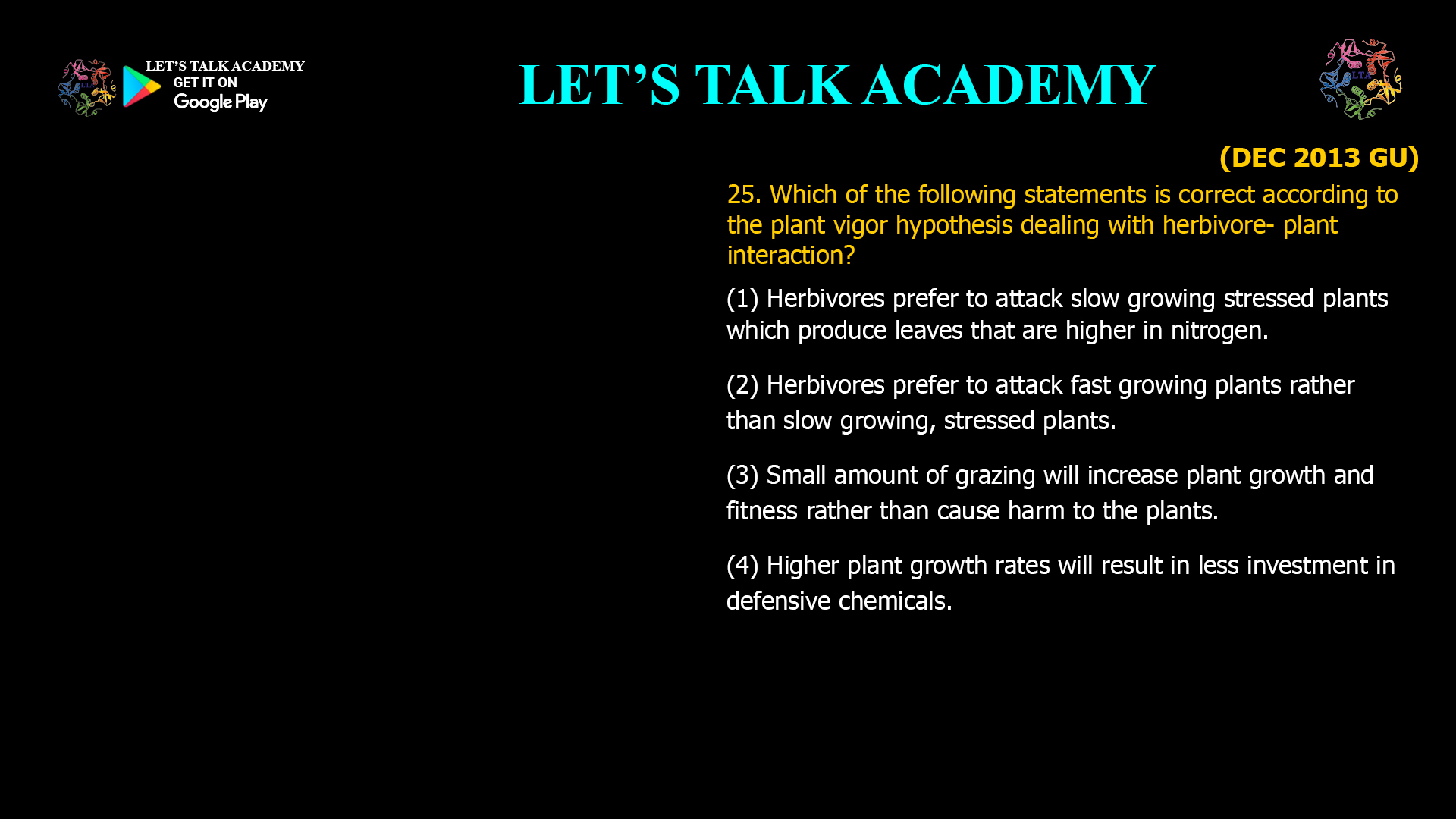
- Which of the following statements is correct according to the plant vigor hypothesis dealing with herbivore- plant interaction?
(1) Herbivores prefer to attack slow growing stressed plants which produce leaves that are higher in nitrogen.
(2) Herbivores prefer to attack fast growing plants rather than slow growing, stressed plants.
(3) Small amount of grazing will increase plant growth and fitness rather than cause harm to the plants.
(4) Higher plant growth rates will result in less investment in defensive chemicals.The interaction between herbivores and plants is a central theme in ecology, shaping plant communities and influencing evolutionary strategies. Among the leading explanations for patterns of herbivore attack is the plant vigor hypothesis. But what does this hypothesis actually predict about herbivore preferences?
What Is the Plant Vigor Hypothesis?
The plant vigor hypothesis posits that herbivores preferentially attack and thrive on the most vigorously growing plants or plant modules. This idea contrasts with the plant stress hypothesis, which suggests that stressed or slow-growing plants are more susceptible to herbivore attack due to changes in their chemistry or reduced defenses.
Key Points:
-
Vigorous plants are typically healthier, grow faster, and have more resources (like water, sunlight, and nutrients).
-
These plants often offer higher nutritional quality and more abundant food for herbivores, leading to better survival and growth for the insects or animals that feed on them1234567.
Evidence Supporting the Plant Vigor Hypothesis
-
Meta-analyses and field studies have shown that many herbivores, especially insects like gall-formers, leaf-miners, and sap-suckers, are significantly more abundant on vigorous plants or shoots than on stressed or slow-growing ones2345.
-
Vigorous plant parts are often less defended chemically and physically, making them easier for herbivores to exploit467.
-
The hypothesis is particularly well-supported for herbivores closely associated with plant growth processes, such as endophytic gallers and shoot borers467.
What Does the Hypothesis NOT Say?
-
It does not claim that herbivores prefer slow-growing or stressed plants with higher nitrogen content; this is the plant stress hypothesis, which is less widely supported for most herbivores15.
-
It does not suggest that small amounts of grazing increase plant fitness (that’s the compensatory growth hypothesis).
-
It does not directly address plant investment in defensive chemicals as a function of growth rate.
Correct Statement According to the Plant Vigor Hypothesis
Given the options:
-
Herbivores prefer to attack slow growing stressed plants which produce leaves that are higher in nitrogen.
-
Herbivores prefer to attack fast growing plants rather than slow growing, stressed plants.
-
Small amount of grazing will increase plant growth and fitness rather than cause harm to the plants.
-
Higher plant growth rates will result in less investment in defensive chemicals.
The correct answer is:
(2) Herbivores prefer to attack fast growing plants rather than slow growing, stressed plants.
This is the central prediction of the plant vigor hypothesis, supported by extensive ecological research and field evidence1234567.
Ecological Implications
Understanding the plant vigor hypothesis helps explain:
-
Why outbreaks of certain herbivores often occur on the healthiest, most productive plants.
-
How plant breeding for high yield or rapid growth can inadvertently increase vulnerability to pests.
-
The importance of considering plant vigor in pest management and conservation strategies.
Conclusion
The plant vigor hypothesis fundamentally changes how we view plant-herbivore interactions, emphasizing that herbivores often target the most vigorous, fast-growing plants. This insight is crucial for ecologists, agronomists, and anyone interested in managing plant health and productivity in natural or agricultural systems.
-


3 Comments
Manisha choudhary
November 8, 2025Plant vigor hypothesis=herbivores often target the most vigorous, fast-growing plants.
Herbivores prefer to attack fast growing plants rather than slow growing, stressed plants.
Kajal
November 9, 2025Option 2
Sakshi Kanwar
November 27, 2025Herbivores prefer to attack fast growing plants rather than slow growing, stressed plants.