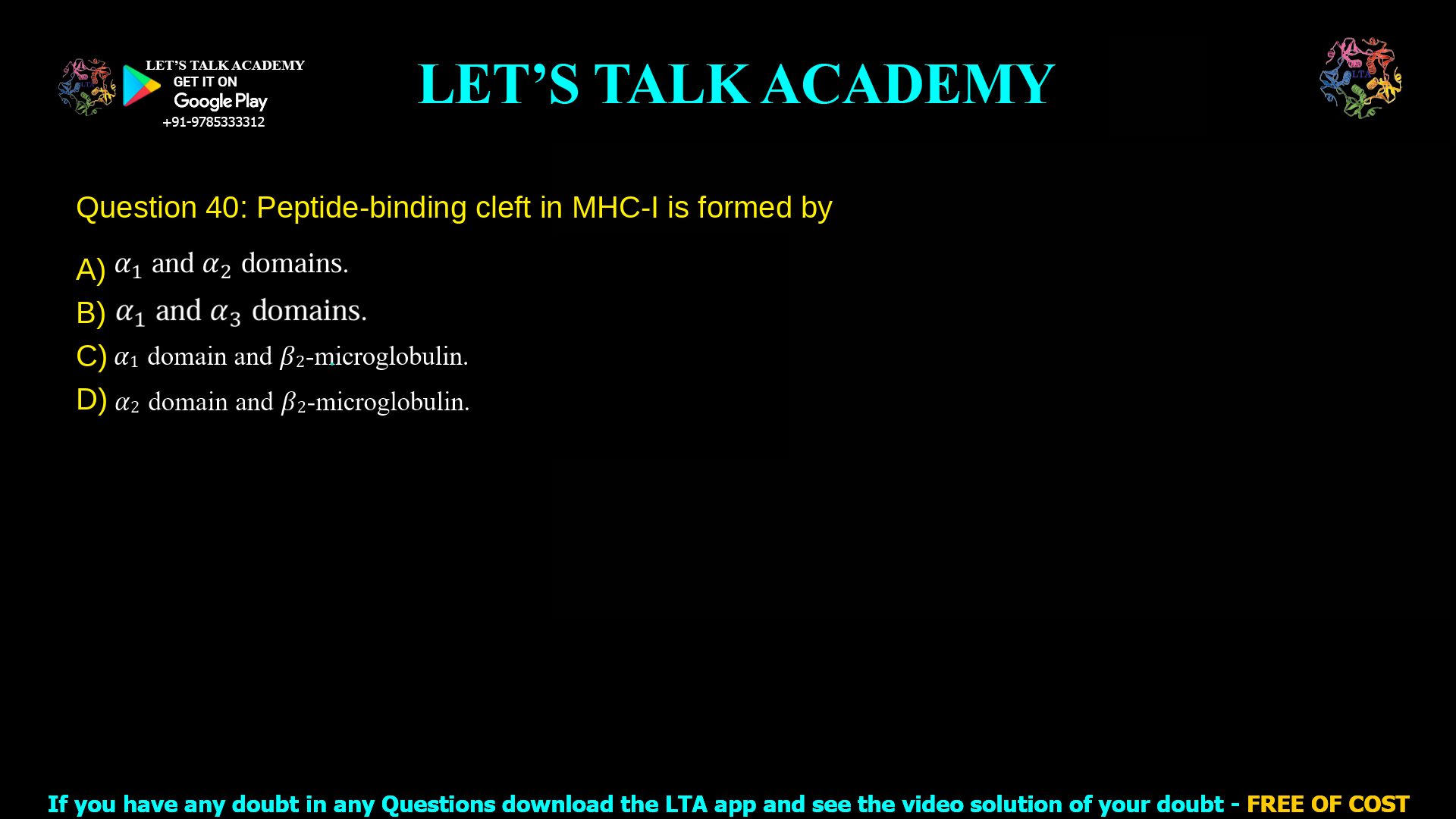
Q.40 Peptide–binding cleft in MHC–I is formed by
(A) 𝛼1 and 𝛼2 domains.
(B) 𝛼1 and 𝛼3 domains.
(C) 𝛼1 domain and 𝛽2–microglobulin.
(D) 𝛼2 domain and 𝛽2–microglobulin.
The peptide-binding cleft in MHC class I molecules is formed by the α1 and α2 domains of the heavy chain. This structure is critical for presenting intracellular peptides to CD8+ T cells during immune surveillance.
Question Analysis
MHC class I molecules consist of a polymorphic α-chain (with α1, α2, and α3 domains) non-covalently associated with β2-microglobulin. The peptide-binding cleft, or groove, accommodates 8-10 residue peptides and is formed specifically by the membrane-distal α1 and α2 domains folding into a β-sheet floor topped by two α-helices.
Option Breakdown
-
(A) α1 and α2 domains: Correct. These domains create the peptide-binding groove through their structural interaction, enabling peptide anchoring at both ends via conserved pockets (A and F pockets).
-
(B) α1 and α3 domains: Incorrect. The α3 domain is an Ig-like structure that interacts with CD8+ T cells and β2-microglobulin but does not contribute to the peptide cleft.
-
(C) α1 domain and β2-microglobulin: Incorrect. β2-microglobulin stabilizes the overall MHC I structure and supports the α3 domain but plays no direct role in forming the cleft.
-
(D) α2 domain and β2-microglobulin: Incorrect. While the α2 domain forms one helix of the groove, β2-microglobulin is distant from the binding site and aids platform stability instead.
The peptide-binding cleft in MHC class I (MHC-I) serves as the key site for antigen presentation, binding short peptides (8-10 amino acids) derived from intracellular proteins to alert cytotoxic T cells. Understanding its formation by α1 and α2 domains is essential for exams like CSIR NET Life Sciences, where questions test MHC structure and function.
MHC Class I Structure Overview
MHC-I molecules are heterodimers comprising a heavy α-chain (~45 kDa) with three extracellular domains (α1, α2, α3), a transmembrane region, and non-covalent β2-microglobulin (~12 kDa). The peptide-binding cleft in MHC-I arises from the α1 (N-terminal, ~90 residues) and α2 domains folding into an open-ended groove: a platform of eight antiparallel β-strands flanked by two α-helices. This architecture anchors peptides via hydrogen bonds at the N- and C-termini.
Role of α1 and α2 Domains
The α1 domain contributes the N-terminal helix and β-strands, while α2 provides the C-terminal helix. Together, they form the closed-ended cleft specific to MHC-I (unlike the open-ended MHC-II groove). Polymorphism in these domains dictates peptide specificity, crucial for immune recognition.
-
α1: Forms A-pocket for peptide N-terminus.
-
α2: Forms F-pocket for C-terminus and influences T-cell receptor contact.
Why Not Other Components?
β2-microglobulin stabilizes the platform by associating with α3 (Ig-like domain for CD8 binding), but mutations here disrupt folding without affecting the cleft directly. α3 interacts with CD8 but lies below the groove.
Exam Relevance for CSIR NET
In MCQs like “Peptide-binding cleft in MHC-I is formed by,” option (A) α1 and α2 domains is standard. Compare with MHC-II (α1 + β1 domains) to avoid confusion.


1 Comment
Bhanwar
January 25, 2026α1 and α2 domain