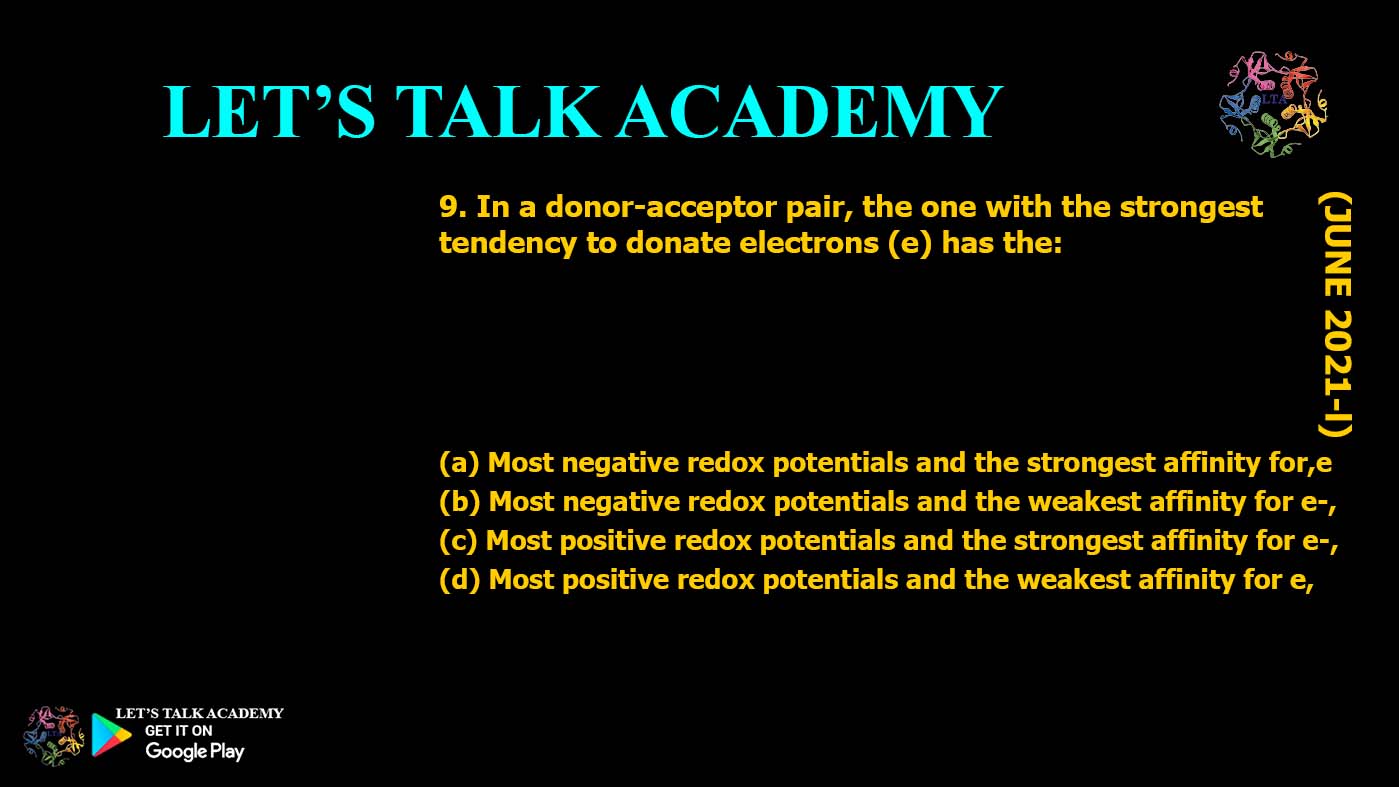
9. In a donor-acceptor pair, the one with the strongest tendency to donate electrons (e) has the:
(a) Most negative redox potentials and the strongest affinity for,e
(b) Most negative redox potentials and the weakest affinity for e-,
(c) Most positive redox potentials and the strongest affinity for e-,
(d) Most positive redox potentials and the weakest affinity for e,
Article:
Introduction
In the study of redox reactions, understanding the behavior of electron donors and acceptors is crucial. A common question in biochemistry and chemistry exams is: Which type of redox potential indicates the strongest tendency to donate electrons?
This article dives deep into the relationship between redox potential, electron affinity, and the role of molecules in donor-acceptor pairs.
Question Recap
Q9. In a donor-acceptor pair, the one with the strongest tendency to donate electrons (e⁻) has the:
(a) Most negative redox potentials and the strongest affinity for e⁻
(b) Most negative redox potentials and the weakest affinity for e⁻
(c) Most positive redox potentials and the strongest affinity for e⁻
(d) Most positive redox potentials and the weakest affinity for e⁻
✅ Correct Answer: (b) Most negative redox potentials and the weakest affinity for e⁻
Understanding Redox Potentials
What is Redox Potential?
Redox potential (also called reduction potential, E°) is a measure of a molecule’s tendency to gain electrons. It’s expressed in volts (V):
-
Positive redox potential → Strong tendency to accept electrons
-
Negative redox potential → Strong tendency to donate electrons
Electron Donors vs. Electron Acceptors
-
Electron Donors: Have more negative redox potentials. They give up electrons easily and are often oxidized in reactions.
-
Electron Acceptors: Have more positive redox potentials. They have a strong affinity for electrons and are reduced during the reaction.
Why the Most Negative Redox Potentials Matter
In a donor-acceptor pair, the molecule with the most negative redox potential acts as the best electron donor because:
-
It has low electron affinity—meaning it doesn’t “hold on” to its electrons tightly.
-
It is energetically favorable for it to give away electrons.
-
These electrons flow to the molecule with a higher (more positive) redox potential, which is more “electron-hungry.”
Real-Life Examples of Redox Pairs
| Donor | Redox Potential (E° in V) | Acceptor |
|---|---|---|
| NADH | –0.32 | Oxygen (O₂) |
| Ferredoxin (plant cells) | ~–0.43 | NADP⁺ |
| Fe²⁺ | +0.77 | Fe³⁺ |
In all these cases, electrons flow from the more negative to the more positive redox potential.
Conclusion
The correct answer to the question lies in understanding the fundamentals of redox chemistry:
A molecule with the most negative redox potential and the weakest electron affinity is the strongest electron donor.
So, if you’re studying redox biology, metabolism, or electrochemistry, remember: negative redox potential = eager electron donor.


3 Comments
Pallavi gautam
April 22, 2025✅
Vaidehi Sharma
April 30, 2025✅✅Done
yogesh sharma
May 8, 2025Done sir