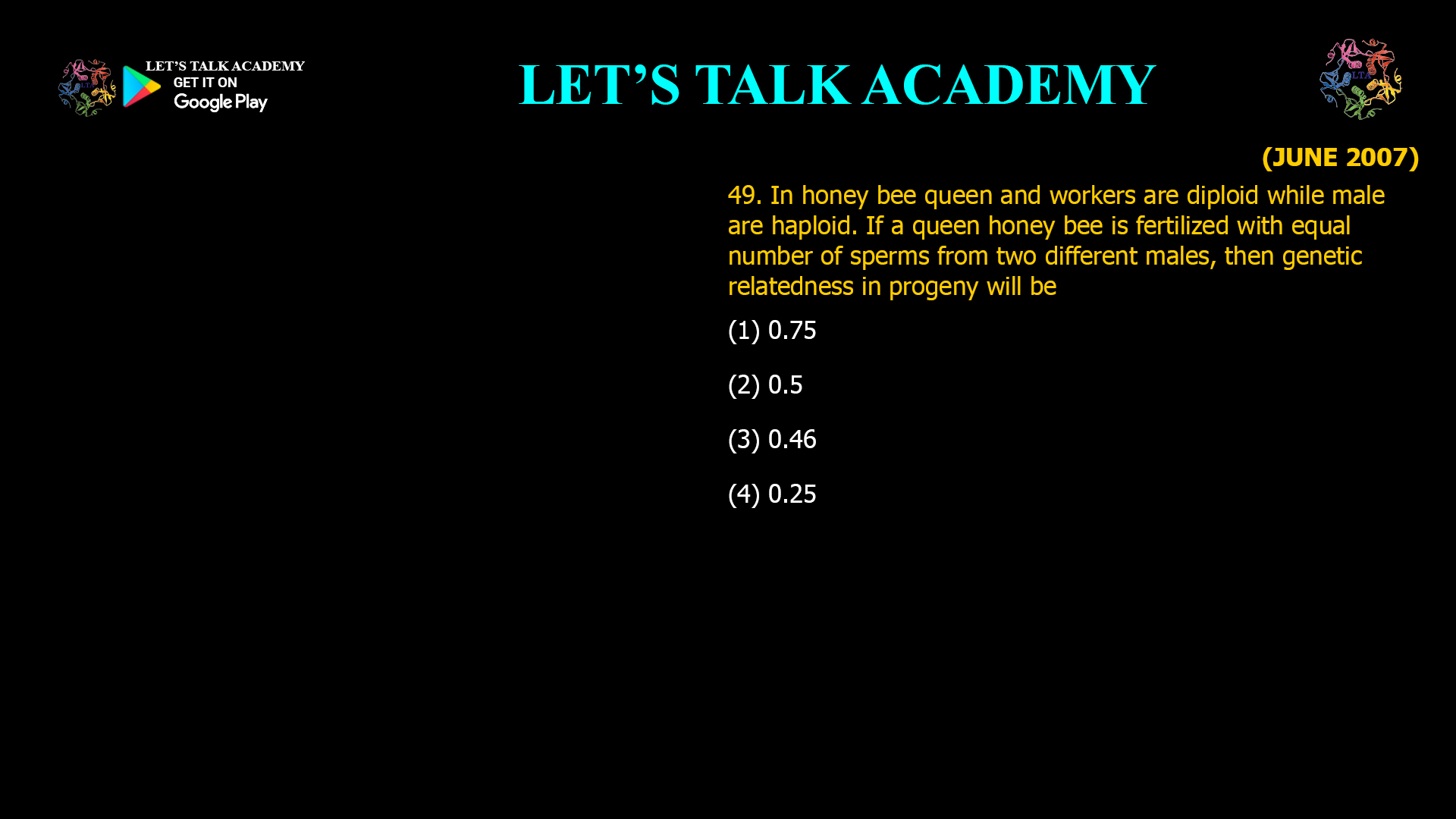
- In honey bee queen and workers are diploid while male are haploid. If a queen honey bee is fertilized with equal number of sperms from two different males, then genetic relatedness in progeny will be
(1) 0.75 (2) 0.5
(3) 0.46 (4) 0.25The Basics of Honey Bee Genetics
-
Females (workers and queens): Develop from fertilized eggs (diploid).
-
Males (drones): Develop from unfertilized eggs (haploid), carrying only the queen’s genes.
When a queen mates with a single male, all her daughters (workers) are full sisters and share, on average, 75% of their genes. This high relatedness is due to the haplodiploid sex determination system: sisters get 50% of their genes from their mother and 100% from their haploid father.
What Happens When the Queen Mates with Two Males?
If a queen is fertilized with equal numbers of sperm from two different males, her female offspring will be a mix of:
-
Full sisters (“supersisters”): Share the same mother and father (r = 0.75).
-
Half-sisters: Share the same mother but different fathers (r = 0.25).
The average relatedness among all female progeny (workers) is calculated by considering both full and half-sister relationships. With equal sperm from two males, half the workers are full sisters, and half are half-sisters.
Calculation:
-
Probability of being full sisters: 1/2
-
Probability of being half-sisters: 1/2
Average relatedness (ravg):
ravg=(0.5×0.75)+(0.5×0.25)=0.375+0.125=0.5
Therefore, the genetic relatedness in the progeny is 0.5.
Why Does This Matter?
This reduction in relatedness (from 0.75 in single-mated queens to 0.5 in double-mated queens) impacts the evolution of cooperation and altruism in honey bee colonies. Lower relatedness can reduce the incentive for worker bees to act altruistically, as they are less genetically invested in their half-sisters.
Conclusion
When a honey bee queen is fertilized with equal numbers of sperm from two different males, the genetic relatedness among her progeny is 0.5.
Correct answer: (2) 0.5
-


1 Comment
Kajal
October 15, 2025.5