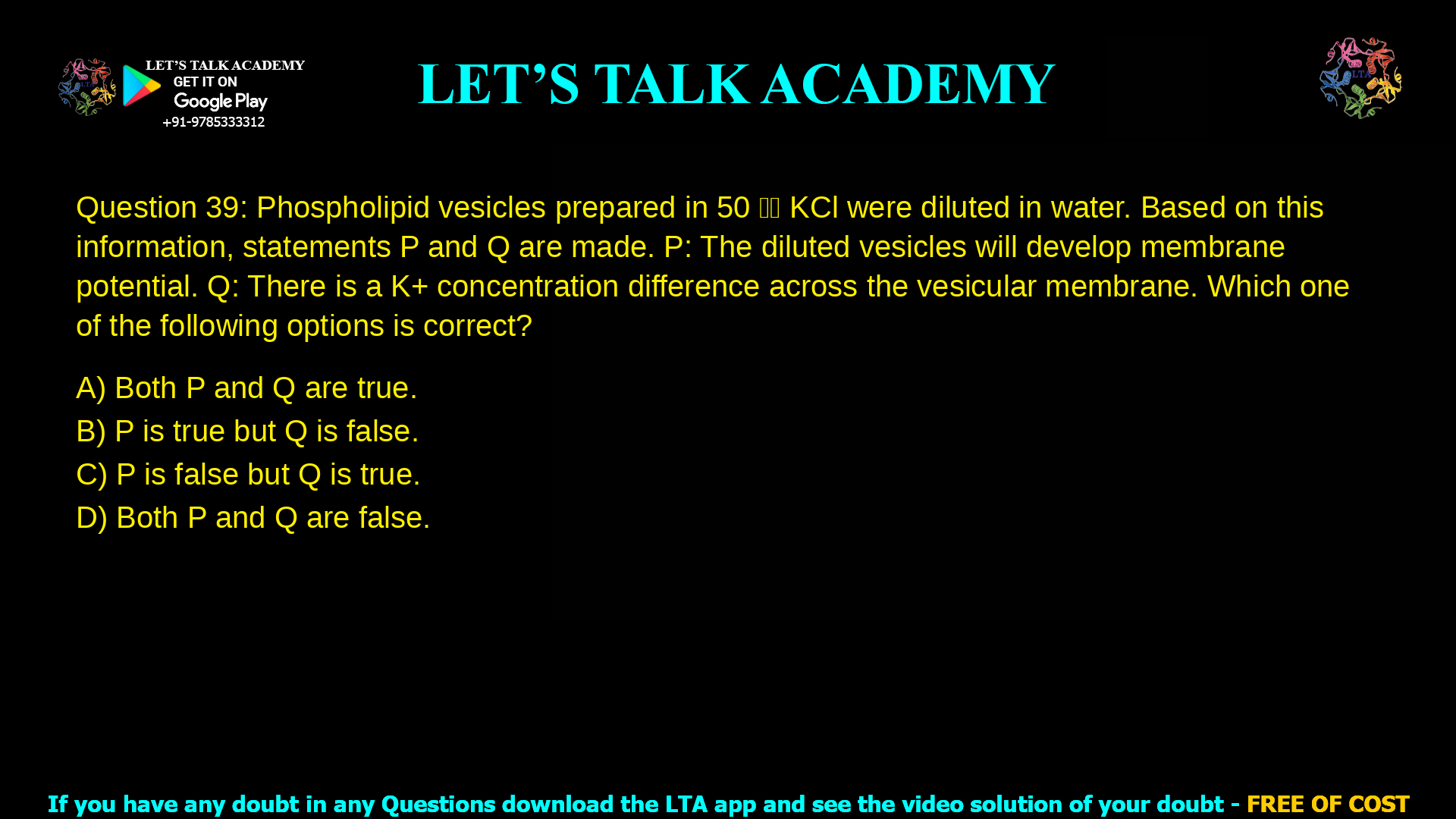
Q.39 Phospholipid vesicles prepared in 50 𝑚𝑀 KCl were diluted in water. Based on
this information, statements P and Q are made.
P: The diluted vesicles will develop membrane potential.
Q: There is a K+ concentration difference across the vesicular membrane.
Which one of the following options is correct?
(A) Both P and Q are true.
(B) P is true but Q is false.
(C) P is false but Q is true.
(D) Both P and Q are false.
Phospholipid vesicles prepared in 50 mM KCl and diluted in water create a K+ concentration gradient across the membrane, but no membrane potential develops due to the impermeability of pure phospholipid bilayers to ions. The correct answer is option (C): P is false but Q is true.
Key Concept
Pure phospholipid vesicles (liposomes) form sealed bilayer structures with no ion channels. When prepared in 50 mM KCl (inside) and diluted into water (~0 mM KCl outside), a K+ gradient exists immediately, satisfying statement Q. However, without selective permeability to K+, no net ion movement or charge separation occurs, so no diffusion potential (via Nernst equation) develops, making statement P false.
Option Analysis
- (A) Both P and Q true: Incorrect. Q holds due to the gradient (50 mM inside vs. ~0 mM outside), but P fails as bilayers block K+ efflux.
- (B) P true, Q false: Incorrect. No gradient exists initially during preparation (equilibrated in KCl), but dilution creates one; still, no potential forms.
- (C) P false, Q true: Correct. Gradient present post-dilution, but phospholipid membranes lack K+ permeability for potential generation.
- (D) Both false: Incorrect. Q is definitively true from the hypoosmotic dilution.
Introduction to Phospholipid Vesicles KCl Dilution
In phospholipid vesicles KCl diluted water experiments, liposomes prepared in 50 mM KCl and diluted into hypotonic water form a classic setup for studying ion gradients and membrane potential in model membranes. This CSIR NET/GATE-style question tests bilayer permeability: vesicles trap 50 mM K+ inside, creating a concentration difference (Q true), but pure phospholipid bilayers impermeant to K+ prevent charge buildup (P false). Ideal for CSIR NET life sciences prep.
Membrane Potential Mechanism
Membrane potential requires (1) ion gradient and (2) selective permeability. Here, dilution imposes ~50 mM inside vs. 0 mM outside K+ gradient (driving force via Nernst:
(EK =RT/Fln [k]+out/ [k]+in ≈ -100mV theoretically).
However, no channels mean no K+ efflux, no interior-negative potential.
- Vesicles swell osmotically but remain sealed.
- Contrast: Valinomycin (K+ ionophore) would enable potential.
Why No Potential in Pure Vesicles?
Phospholipid bilayers have high impedance (~108 Ω·cm²) to hydrated K+ (dehydration energy barrier). Studies confirm rapid K+/H+ exchange only in stressed or channel-containing vesicles, not plain ones.
| Aspect | With Gradient (Q) | Potential Development (P) |
|---|---|---|
| Present? | Yes (50 mM → 0 mM) | No (impermeable bilayer) |
| Requirement | Dilution suffices | Selective K+ conductance needed |
| Outcome | Donnan-like setup, no charge separation | Swelling, no voltage |
Exam Relevance
Common in CSIR NET/GATE biochemistry, tests Donnan equilibrium vs. diffusion potential. Related: Valinomycin induces potential in such vesicles. Practice: What if vesicles had K+ channels? (P becomes true).


