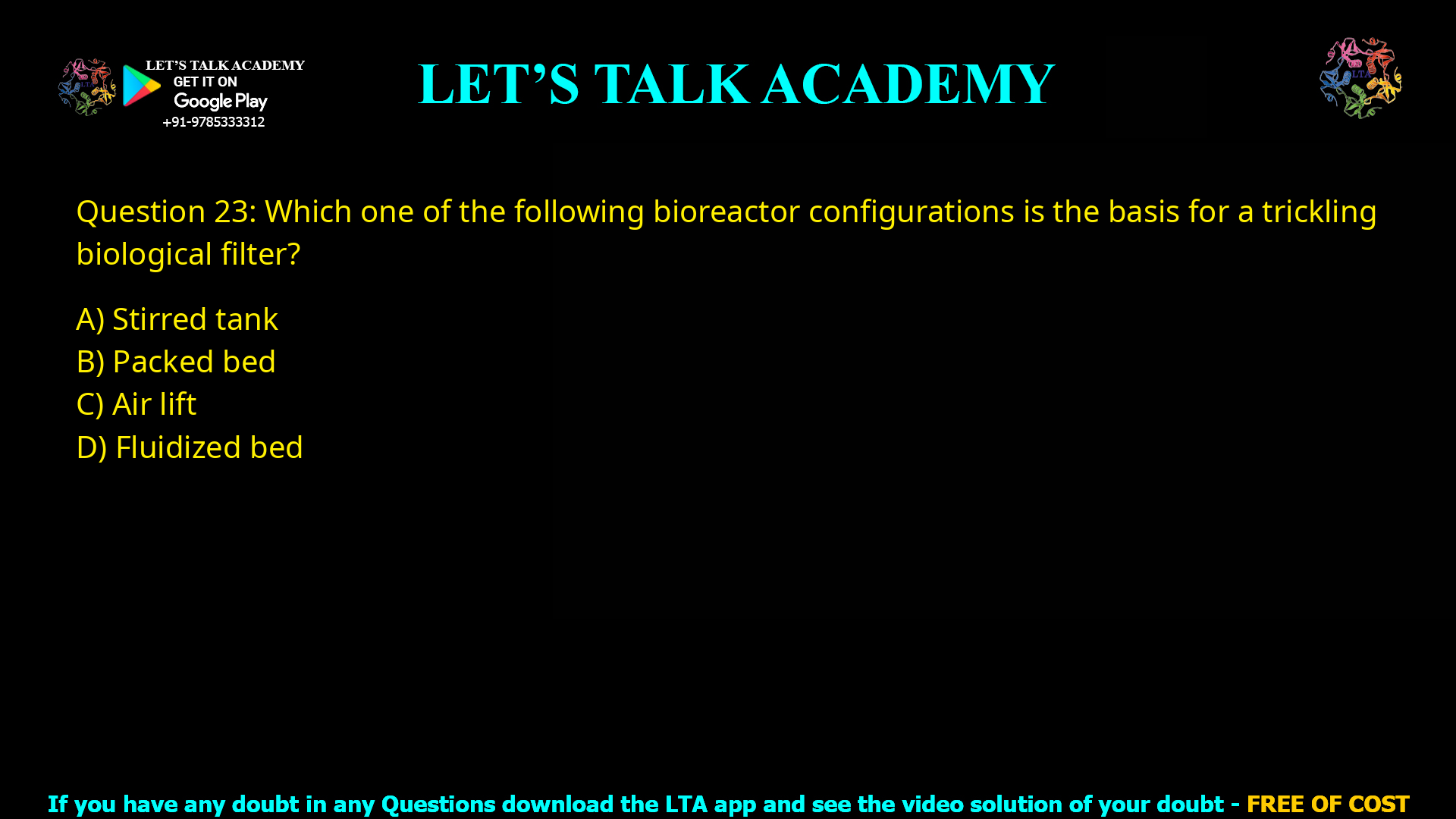
Q.23 Which one of the following bioreactor configurations is the basis for a trickling biological
filter?
(A) Stirred tank (B) Packed bed
(C) Air lift (D) Fluidized bed
Trickling Biological Filter Bioreactor Configuration Explained
A trickling biological filter, commonly used in wastewater treatment, relies on wastewater trickling over a stationary bed of packing material where microorganisms form a biofilm to degrade organic matter. The correct answer is (B) Packed bed, as this configuration matches the fixed media structure essential for biofilm attachment and treatment.
Option Analysis
Stirred Tank (A):
This involves mechanical agitation in a suspended growth system, like activated sludge processes, where biomass floats freely without fixed media. It differs from trickling filters, which use no stirring and depend on gravity flow over static packing.
Packed Bed (B):
Wastewater flows downward over inert packing (rocks or plastic) colonized by biofilm, enabling aerobic degradation via natural air circulation. This fixed-film setup defines trickling filters, confirming it as the basis.
Air Lift (C):
This uses air injection to circulate liquid in a tall vessel for gas transfer, suited for algal or gas-sparged cultures, not fixed-media trickling.
Fluidized Bed (D):
Particles are suspended by upward fluid flow, promoting high biomass but requiring energy input unlike passive trickling over stationary beds.
Introduction to Trickling Biological Filters
In wastewater treatment and biotechnology, the trickling biological filter bioreactor configuration stands out for efficient organic pollutant removal through biofilm processes. This packed bed system distributes wastewater over fixed media, fostering microbial growth without mechanical mixing, ideal for large-scale applications.
How Packed Bed Drives Trickling Filters
The packed bed configuration uses stationary media like plastic modules or rocks, where influent trickles down, contacting oxygen and biofilm. Recirculation enhances performance, achieving high BOD removal at low energy cost compared to dynamic systems.
-
Modular cross-flow media for standard use; vertical-flow for high-strength waste.
-
Natural aeration via void spaces supports nitrification and denitrification.
-
Hydraulic loading rates (0.1-3 m³/m²·d) optimize wetting without flooding.
Comparing Bioreactor Types in Wastewater Biotech
| Configuration | Growth Type | Key Feature | Trickling Filter Match? |
|---|---|---|---|
| Stirred Tank | Suspended | Mechanical mixing | No – Lacks fixed media |
| Packed Bed | Attached | Gravity flow over packing | Yes – Core design |
| Air Lift | Suspended | Air-driven circulation | No – No packing |
| Fluidized Bed | Attached/Fluidized | Particle suspension | No – Active fluidization |
Packed beds excel in simplicity and scalability for trickling biological filter applications.
Applications and Exam Tips
Trickling biological filter bioreactor configurations appear in biotech exams like GATE, emphasizing attached growth over suspended systems. For researchers in Jaipur’s biotech hubs, these suit industrial effluent treatment with minimal maintenance.


