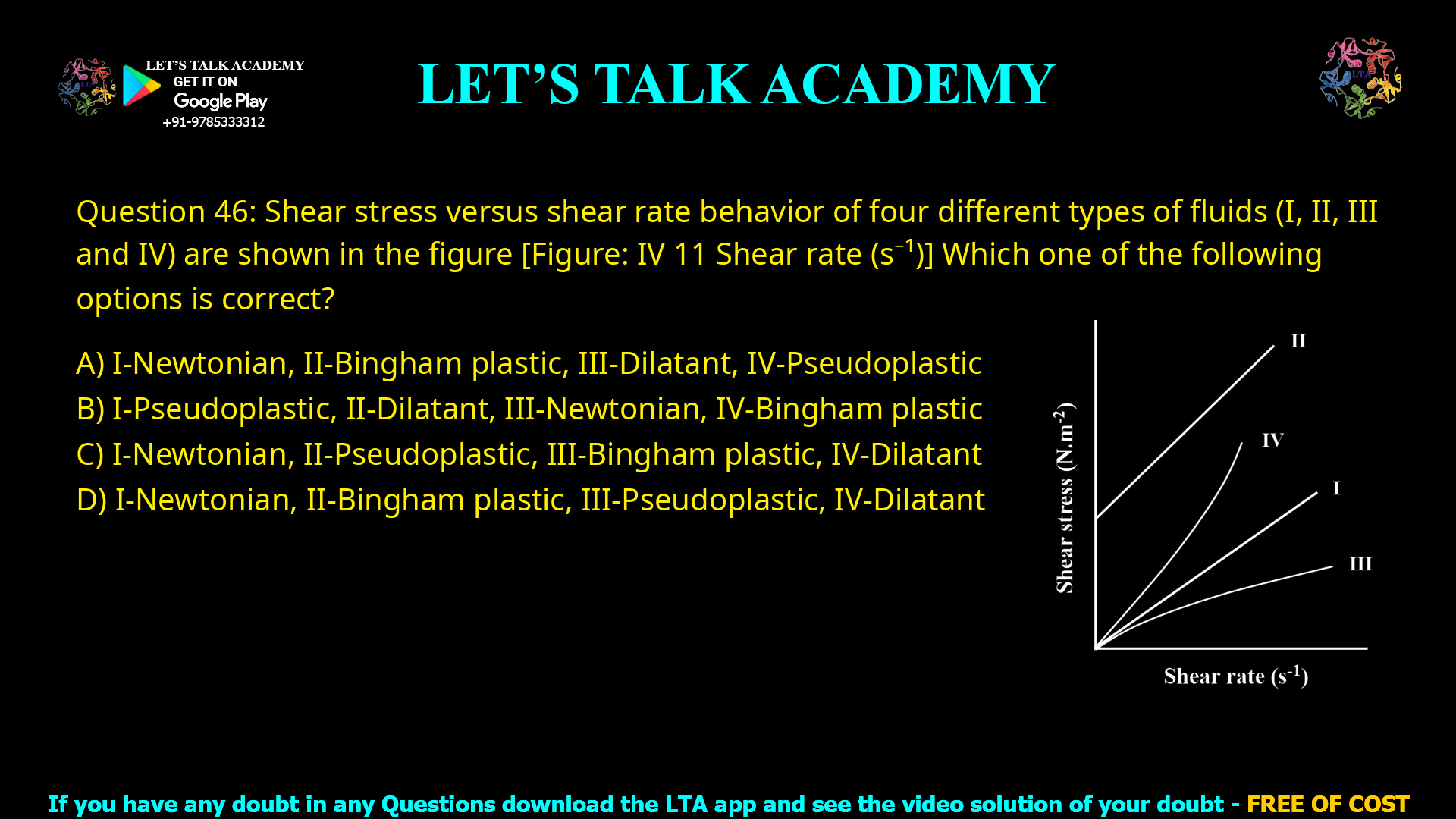
Q.46 Shear stress versus shear rate behavior of four different types of fluids (I, II, III and IV) are
shown in the figure below.
Which one of the following options is correct?
(A) I-Newtonian, II-Bingham plastic, III-Dilatant, IV-Pseudoplastic
(B) I-Pseudoplastic, II-Dilatant, III-Newtonian, IV-Bingham plastic
(C) I-Newtonian, II-Pseudoplastic, III-Bingham plastic, IV-Dilatant
(D) I-Newtonian, II-Bingham plastic, III-Pseudoplastic, IV-Dilatant
✅ Correct Answer: (D)
I–Newtonian, II–Bingham plastic, III–Pseudoplastic, IV–Dilatant
📌 Understanding the Graph
A shear stress vs shear rate graph helps identify fluid types based on how viscosity changes with increasing shear.
The four behaviors:
-
Newtonian – constant viscosity, straight line through origin
-
Bingham Plastic – requires yield stress, then linear
-
Pseudoplastic (Shear-thinning) – curve bending downward
-
Dilatant (Shear-thickening) – curve bending upward
🧪 Analysis of Curves
I – Newtonian Fluid
-
Straight line
-
Passes through origin
-
Constant viscosity
🔹Examples: Water, milk, dilute sugar solutions
II – Bingham Plastic
-
Line does not start at origin
-
Needs minimum stress (yield stress) to flow
🔹Examples: Toothpaste, mayonnaise, mud
III – Pseudoplastic Fluid
-
Curve with decreasing slope
-
Shear-thinning → viscosity decreases as shear increases
🔹Examples: Blood, paint, ketchup
IV – Dilatant Fluid
-
Curve with increasing slope
-
Shear-thickening → viscosity increases under stress
🔹Examples: Corn starch in water (oobleck)
✔️ Why Option (D) is Correct
Option (D) assigns:
-
I → Newtonian ✔️
-
II → Bingham plastic ✔️
-
III → Pseudoplastic ✔️
-
IV → Dilatant ✔️
All match the graphical behavior.
❌ Explanation of Incorrect Options
(A)
-
II marked Bingham is correct
-
But III is not Dilatant — it is pseudoplastic ❌
-
IV is not pseudoplastic ❌
(B)
-
I is Newtonian, not Pseudoplastic ❌
-
II Dilatant is wrong, III Newtonian wrong ❌
(C)
-
II is not pseudoplastic ❌
-
III is not Bingham ❌
-
IV is not dilatant in this order ❌
🎯 Conclusion
The graph clearly identifies four fluid behaviors, and Option (D) correctly matches each curve with its respective fluid type.
Final Correct Answer: (D)
I-Newtonian, II-Bingham plastic, III-Pseudoplastic, IV-Dilatant


