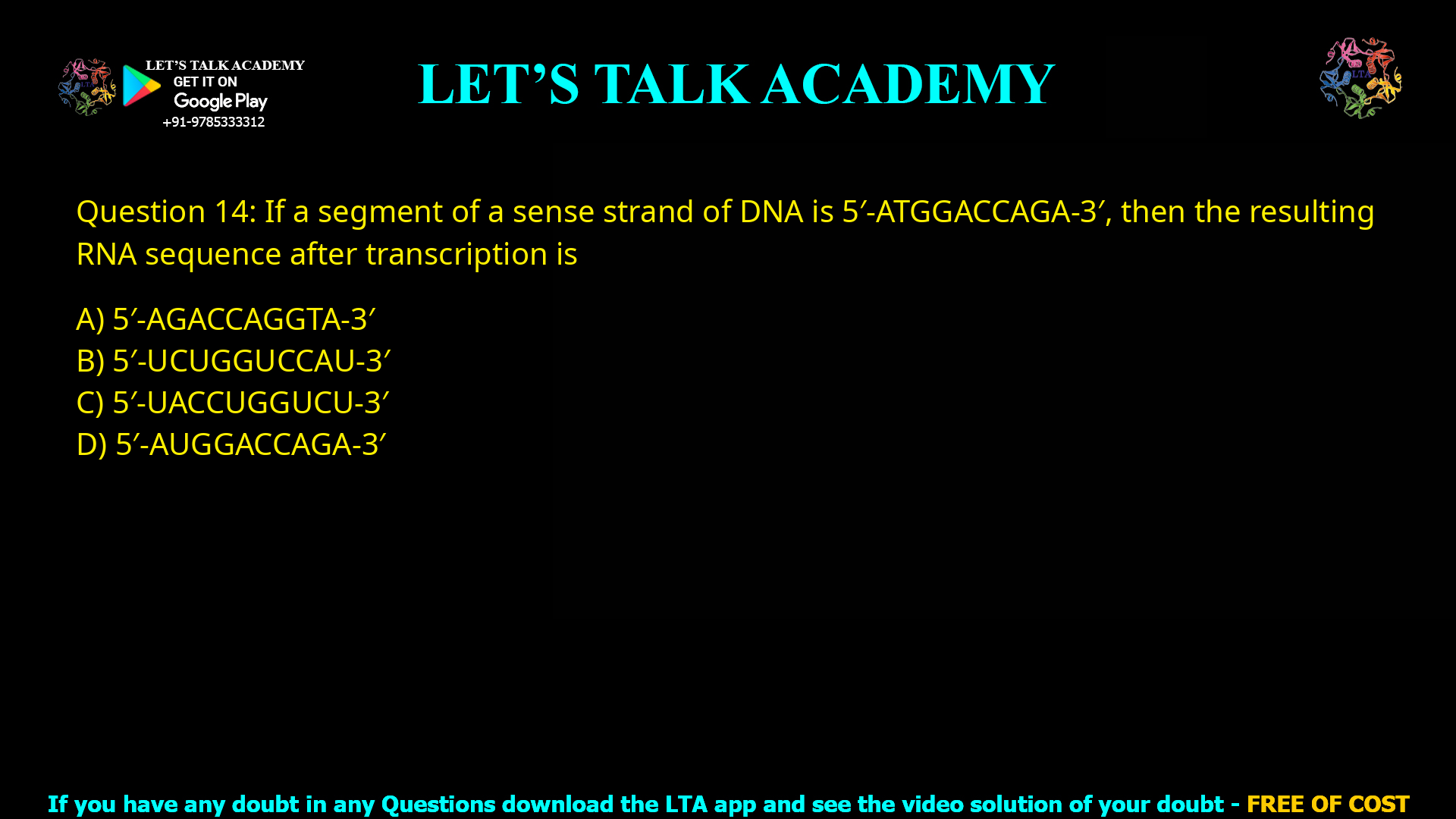
Q.14 If a segment of a sense strand of DNA is 5′-ATGGACCAGA-3′, then the resulting RNA
sequence after transcription is
(A) 5′-AGACCAGGTA-3′
(C) 5′-UACCUGGUCU-3′
(B) 5′-UCUGGUCCAU-3′
(D) 5′-AUGGACCAGA-3′
The correct answer is (D) 5′-AUGGACCAGA-3′. In transcription, the sense (coding) strand of DNA directly matches the mRNA sequence, with thymine (T) replaced by uracil (U).
Transcription Basics
The sense strand (5′-ATGGACCAGA-3′) has the same sequence as mRNA, except DNA uses T where RNA uses U. RNA polymerase reads the complementary antisense (template) strand (3′-TACCTGGTC T-5′) to synthesize mRNA in the 5′ to 3′ direction, resulting in 5′-AUGGACCAGA-3′. This ensures mRNA codons match the gene’s coding sequence for translation.
Option Analysis
-
(A) 5′-AGACCAGGTA-3′: Incorrect; this is a reverse rearrangement with T instead of U, not following sense strand matching or base substitution rules.
-
(B) 5′-UCUGGUCCAU-3′: Incorrect; this is the template strand sequence read 3′ to 5′ with U for T, but transcription produces the sense-like mRNA.
-
(C) 5′-UACCUGGUCU-3′: Incorrect; this matches the template strand directly (with U for T), but mRNA is complementary to the template.
-
(D) 5′-AUGGACCAGA-3′: Correct; identical to sense strand, substituting U for T.
Introduction to Sense Strand DNA to RNA Transcription
Sense strand DNA to RNA transcription converts genetic code from DNA’s coding strand (5′-ATGGACCAGA-3′) into matching mRNA for protein synthesis. This MCQ tests understanding of how RNA polymerase uses the template strand to produce mRNA identical to the sense strand, replacing T with U. Perfect for biotech students mastering molecular biology basics.
Step-by-Step Transcription Process
RNA polymerase binds the promoter, unwinds DNA, and reads the template strand (antisense: 3′-TACCTGGTC T-5′) from 3′ to 5′. It adds complementary ribonucleotides: A opposite T, U opposite A, G opposite C, C opposite G—yielding mRNA 5′-AUGGACCAGA-3′. This preserves the sense strand sequence for accurate translation into amino acids like Met-Asp-Gln.
Why Each Option Fails Except D
Common pitfalls in sense strand DNA transcription questions include confusing template vs sense strands:
-
Option A: Scrambled sequence with DNA bases (T), ignores U substitution.
-
Option B: Reverses template strand direction, common error in polarity.
-
Option C: Direct template copy (U for T), forgets complementarity.
-
Option D: Matches sense strand perfectly with U for T—key to correct RNA sequence.
Exam Tips for DNA to RNA Conversion
Practice by always identifying if given as sense or template: sense → mRNA same (T→U); template → complementary (T→A, A→U, etc.). Use for NEET, CSIR NET biotech prep on transcription, avoiding reverse transcription mix-ups.


