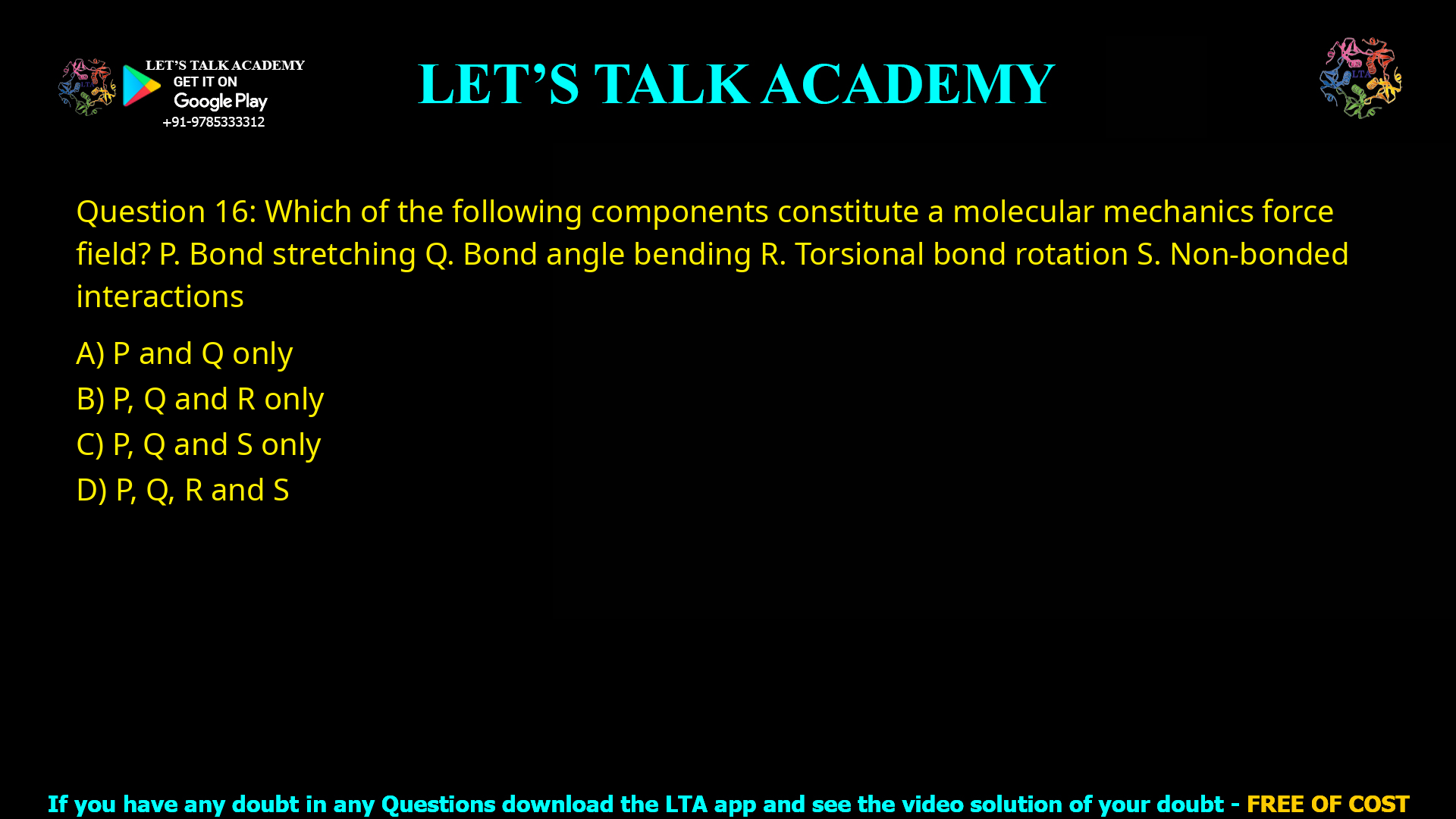
Q.16 Which of the following components constitute a molecular mechanics force field?
P. Bond stretching
Q. Bond angle bending
R. Torsional bond rotation
S. Non-bonded interactions
(A) P and Q only
(B) P, Q and R only
(C) P, Q and S only
(D) P, Q, R and S
Molecular mechanics force fields model molecular potential energy through classical terms. All four listed components—P, Q, R, and S—are standard constituents. The correct answer is (D) P, Q, R and S.
Option Analysis
P. Bond stretching: Captures energy from deviations in bond lengths using harmonic potentials, like Ubond = kb(r−r0)2.
Q. Bond angle bending: Accounts for angle distortions around atoms, typically Uangle = kθ(θ−θ0)2.
R. Torsional bond rotation: Describes rotational barriers via dihedral terms, such as Utorsion = Σkϕ(1+cos(nϕ−γ)).
S. Non-bonded interactions: Includes van der Waals (Lennard-Jones) and electrostatic forces between non-adjacent atoms.
Options (A), (B), and (C) exclude key terms, making them incomplete.
Introduction with Keyphrase
In molecular mechanics force field calculations, essential components like bond stretching, bond angle bending, torsional bond rotation, and non-bonded interactions define the potential energy surface for accurate biomolecular simulations in biotechnology and drug design. These terms enable efficient modeling of protein folding, enzyme kinetics, and genetic engineering structures without quantum costs. Researchers rely on them for graduate-level analysis in molecular biology.
Core Components
Force fields sum bonded and non-bonded energies:
- Bonded terms (P, Q, R) treat vibrations classically.
- Non-bonded (S) handles long-range effects, excluding 1-2/1-3 pairs.
- Common fields like AMBER or CHARMM include all four.
Applications in Biotech
- Predicts conformational flexibility in proteins.
- Optimizes recombinant DNA structures.
- Supports enzyme kinetics modeling via torsional terms.
Component Comparison
| Component | Type | Energy Form | Role in Simulations |
|---|---|---|---|
| P | Bonded | Harmonic stretch | Maintains bond lengths |
| Q | Bonded | Harmonic bend | Controls local geometry |
| R | Bonded | Fourier dihedral | Governs rotations |
| S | Non-bonded | LJ + Coulomb | Drives folding/packing |


