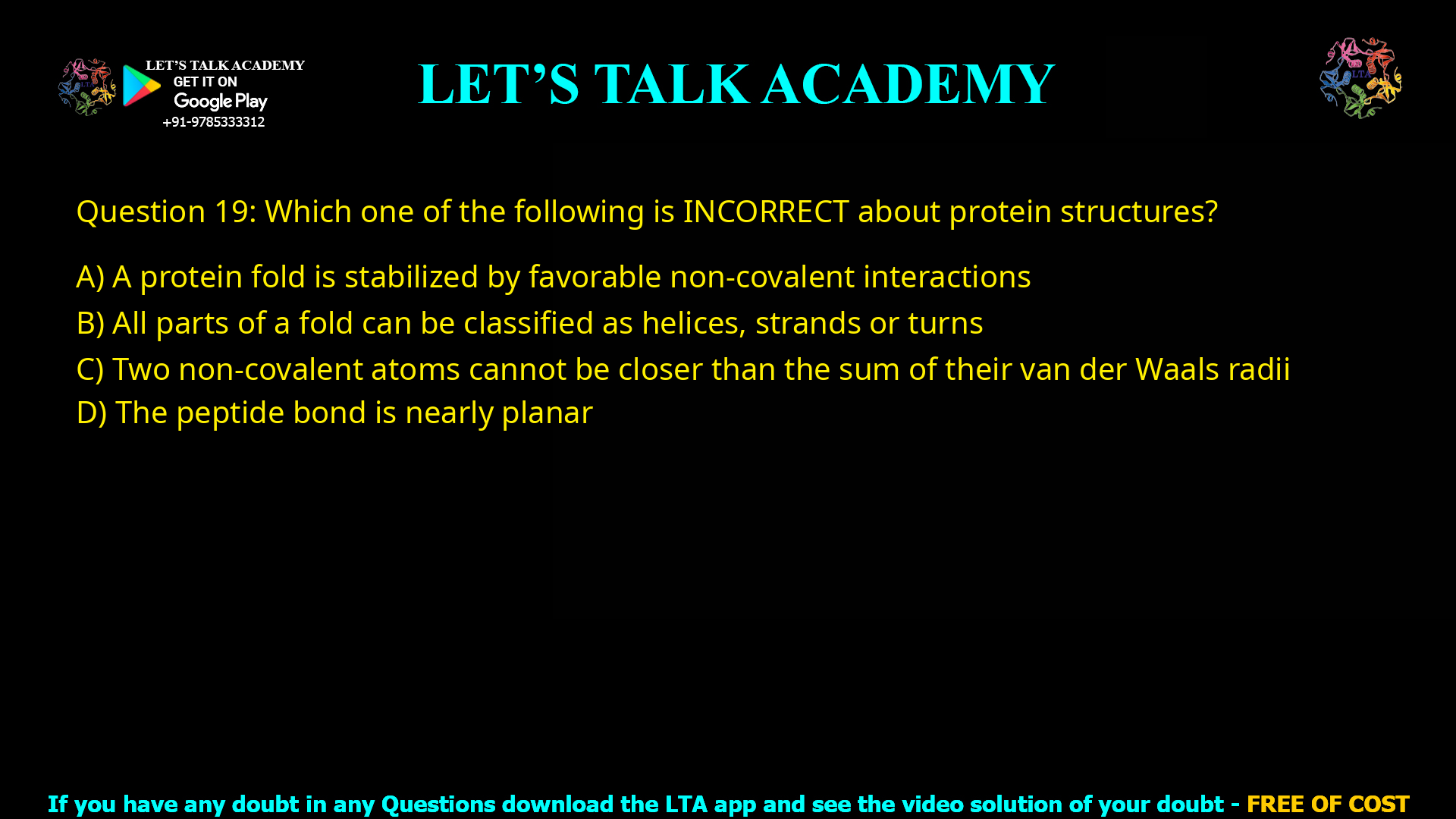
Q.19 Which one of the following is INCORRECT about protein structures?
(A) A protein fold is stabilized by favorable non-covalent interactions
(B) All parts of a fold can be classified as helices, strands or turns
(C) Two non-covalent atoms cannot be closer than the sum of their van der Waals radii
(D) The peptide bond is nearly planar
Protein structures are fundamental to their function, organized into hierarchical levels maintained by specific interactions. The incorrect statement among the options is option B, as not all parts of a protein fold fit neatly into helices, strands, or turns.
Option Analysis
A: Correct
A protein fold relies on non-covalent interactions like hydrogen bonds, hydrophobic effects, van der Waals forces, and ionic bonds for stability. These favorable interactions drive folding and resist unfolding.
B: Incorrect
Protein folds include secondary structure elements (α-helices, β-strands, turns), but also loops, coils, irregular regions, and linker segments that connect these elements. No classification scheme assigns all parts strictly to helices, strands, or turns, making this overly simplistic.
C: Correct
Non-bonded (van der Waals) atoms maintain a minimum distance equal to the sum of their van der Waals radii to avoid steric clashes and Pauli repulsion. Closer approach leads to unfavorable energy.
D: Correct
The peptide bond exhibits partial double-bond character due to resonance between C=O and N-H, restricting rotation and enforcing near planarity (ω ≈ 180°).
incorrect-protein-structures-fold-stabilized-non-covalent-interactions
Proteins achieve their functional 3D shapes through protein structures defined by primary sequence, secondary elements like helices and strands, tertiary folds stabilized by non-covalent interactions, and quaternary assemblies. Understanding misconceptions helps in exams like GATE Biotechnology. This article analyzes a key MCQ on protein fold components, van der Waals limits, and peptide geometry.
Why Option B Fails Protein Fold Classification
While α-helices, β-strands, and turns dominate secondary structure (about 60-70% in globular proteins), the rest comprises unstructured loops, random coils, and flexible linkers essential for flexibility and binding. Tools like DSSP assign eight states, including “bend” and “coil,” proving not all parts classify as just helices, strands, or turns.
Validating Other Protein Structure Facts
-
Non-covalent stabilization: Hydrophobic collapse and H-bonds lock the fold.
-
Van der Waals rule: Prevents atomic overlap, e.g., C-C minimum ~3.4 Å.
-
Planar peptide bonds: Resonance enforces trans configuration (~99% cases).
| Option | Statement | Correct? | Key Reason |
|---|---|---|---|
| A | Protein fold stabilized by non-covalent interactions | Yes | H-bonds, hydrophobic effects drive folding |
| B | All fold parts: helices, strands, or turns | No | Loops/coils unclassified as such |
| C | Non-covalent atoms ≥ sum of van der Waals radii | Yes | Steric repulsion barrier |
| D | Peptide bond nearly planar | Yes | Resonance stabilization |


