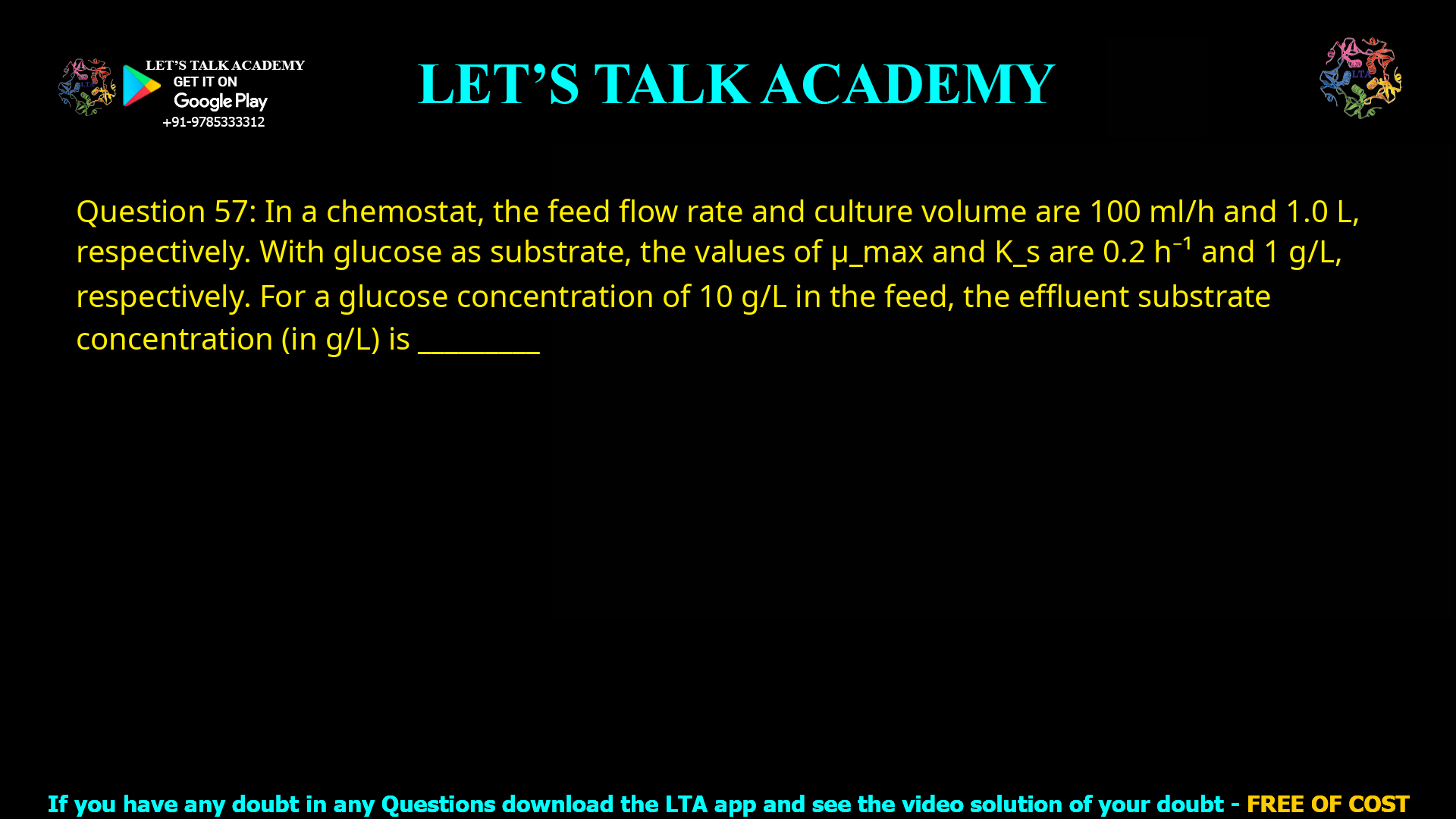
Q.57 In a chemostat, the feed flow rate and culture volume are 100 mL/h and 1.0 L, respectively.
With glucose as substrate, the values of μmax and Ks are 0.2 h-1 and 1 g/L, respectively.
For a glucose concentration of 10 g/L in the feed, the effluent substrate concentration (in g/L) is ________
Chemostat Effluent Substrate Concentration: Solved with Monod Kinetics (0.10 g/L)
In a chemostat with a feed flow rate of 100 mL/h and a culture volume of 1.0 L using glucose as substrate (μmax = 0.2 h-1, Ks = 1 g/L, feed concentration 10 g/L), the steady-state effluent substrate concentration equals 0.10 g/L.
Key Calculation Steps
At steady state, dilution rate equals microbial growth rate:
D = μ
First compute dilution rate:
D = F / V = 0.1 L/h ÷ 1.0 L = 0.1 h-1
Apply the Monod equation:
μ = μmax × S / (Ks + S)
Since μ = D:
D = μmax × S / (Ks + S)
Solve for substrate concentration:
S = D × Ks / (μmax − D)
Substituting values:
S = 0.1 × 1 / (0.2 − 0.1) = 0.10 g/L
Options Analysis
- A) 0.05 g/L: Underestimates S; comes from incorrect D or half-μmax assumption.
- B) 0.10 g/L (Correct): Exact Monod steady-state result.
- C) 0.20 g/L: Occurs if μ ≈ μmax is wrongly applied.
- D) 0.50 g/L: Possible inversion or use of Ks in wrong place.
Chemostat Principles Explained
- Steady state requires D < μmax to avoid washout.
- With excess feed glucose (10 g/L), substrate becomes limiting inside reactor.
- Low effluent substrate means high biomass productivity.
- Mass balance ignores biomass in feed (sterile medium assumption).
Exam Tips for Monod–Chemostat Questions
- Compute dilution rate first using F/V.
- Set D = μ at steady state.
- Ignore yield when asked only for substrate concentration.
- Always check D < μmax to confirm culture stability.


