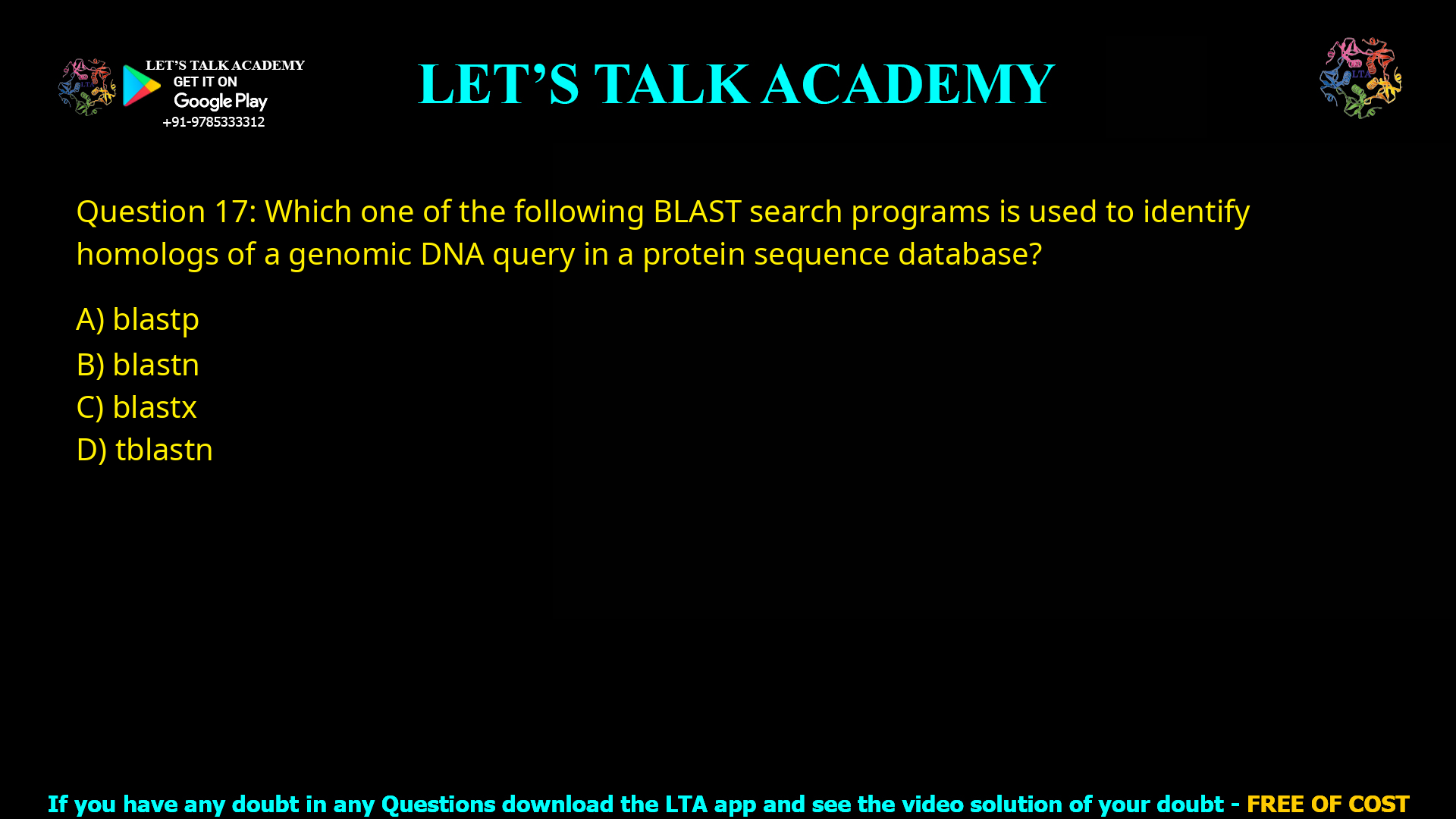
Q.17 Which one of the following BLAST search programs is used to identify homologs of a
genomic DNA query in a protein sequence database?
(A) blastp (B) blastn (C) blastx (D) tblastn
BLAST Search Programs: Identifying Genomic DNA Homologs in Protein Databases
The correct answer is (C) blastx. This program translates a genomic DNA query into all possible protein sequences across reading frames and searches a protein database for homologs, making it ideal for finding protein similarities from nucleotide data.
BLAST Overview
BLAST (Basic Local Alignment Search Tool) compares query sequences against databases to detect similarities indicating homology or function. Different variants handle nucleotide-to-nucleotide, protein-to-protein, or cross-type searches, crucial for genomic analysis in molecular biology.
Option Breakdown
-
(A) blastp: Compares a protein query sequence against a protein database. Used for protein-protein homology but not suitable for genomic DNA inputs.
-
(B) blastn: Aligns nucleotide query sequences (DNA/RNA) against nucleotide databases. Detects DNA similarities but ignores protein translation.
-
(C) blastx (correct): Translates genomic DNA query in all six reading frames to proteins, then searches protein databases. Perfect for finding distant homologs when exon structure or frames are unknown.
-
(D) tblastn: Uses a protein query to search translated nucleotide databases (e.g., genomic DNA). Reverses the input types needed here.
| Program | Query Type | Database Type | Use Case |
|---|---|---|---|
| blastp | Protein | Protein | Protein homology |
| blastn | Nucleotide | Nucleotide | DNA/RNA similarity |
| blastx | Nucleotide (translated) | Protein | DNA vs. protein homologs |
| tblastn | Protein | Nucleotide (translated) | Protein vs. genomic DNA |


