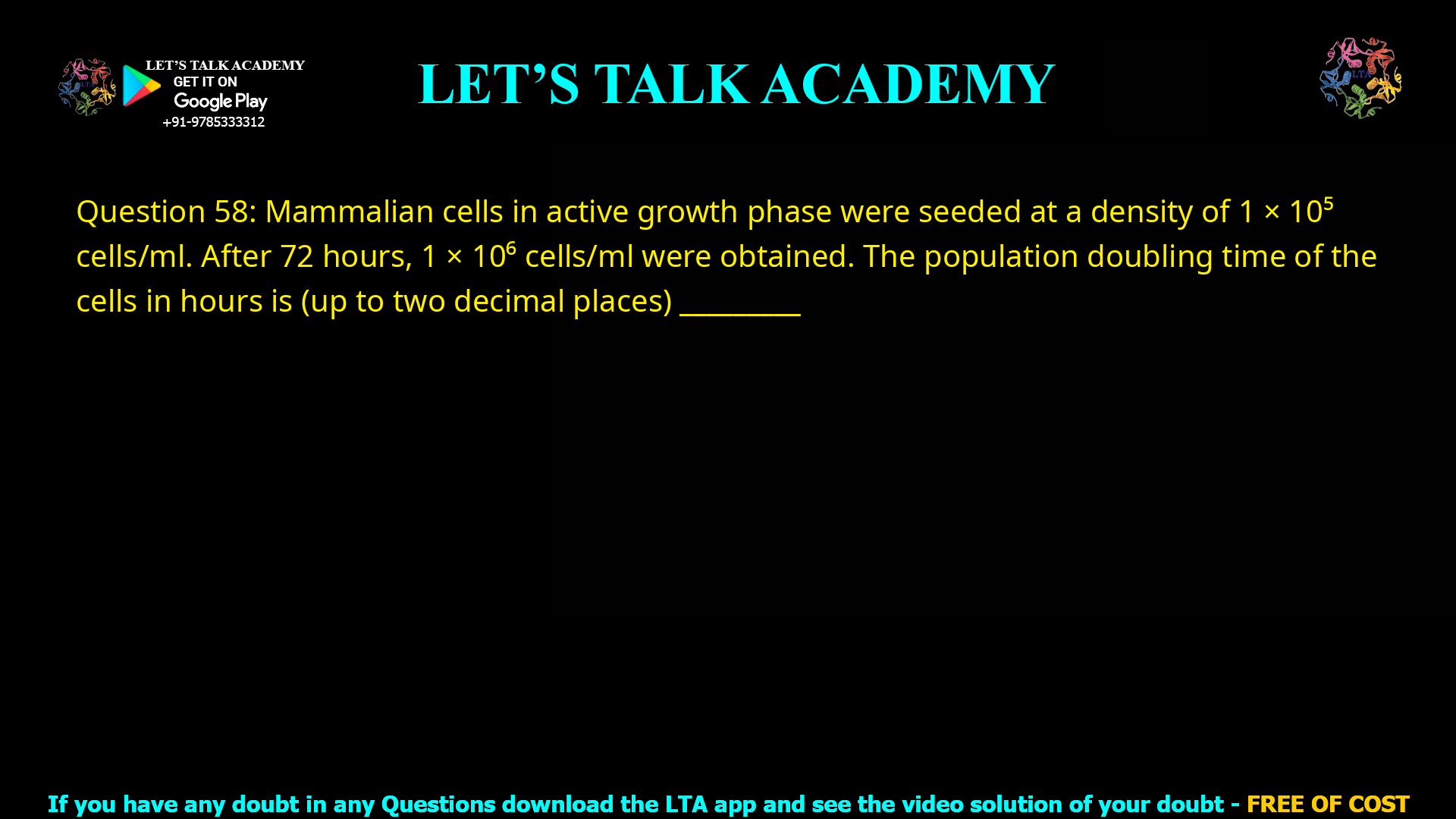
Q.58 Mammalian cells in active growth phase were seeded at a density of 1×10⁵ cells/ml.
After 72 hours, 1×10⁶ cells/ml were obtained.
The population doubling time of the cells in hours is (up to two decimal places) ________
Mammalian Cell Population Doubling Time: Solved (23.10 hours)
Mammalian cells seeded at 1×10⁵ cells/mL reached 1×10⁶ cells/mL after 72 hours, giving a population doubling time of 23.10 hours. This applies exponential growth during the log phase.
Calculation Method
The doubling time equation is:
td = t · ln(2) / ln(Nf / Ni)
- t = 72 hours
- Ni = 1 × 10⁵
- Nf = 1 × 10⁶
Compute natural log term:
ln(106 / 105) = ln(10) = 2.3026
Now substitute into the formula:
td = 72 × 0.6931 / 2.3026 = 23.10 hours
Options Analysis
- A) 18.00 hours: Linear assumption; ignores ln
- B) 23.10 hours (Correct): Exact exponential result
- C) 28.50 hours: Uses log10 instead of ln
- D) 36.00 hours: Incorrect simple halving (72/2)
Cell Growth Principles
Exponential mammalian cell growth is captured by:
Nt = N0 × 2t/td
- Typical doubling time: 20–30 hours (CHO, HEK)
- Lag and stationary phases should be excluded
- Log phase data gives reliable td
Exam Strategies
- 10-fold increase = ~3.32 doublings (log210)
- Use ln(2) ≈ 0.693 for quick checks
- This problem frequently appears in GATE Biotechnology


